
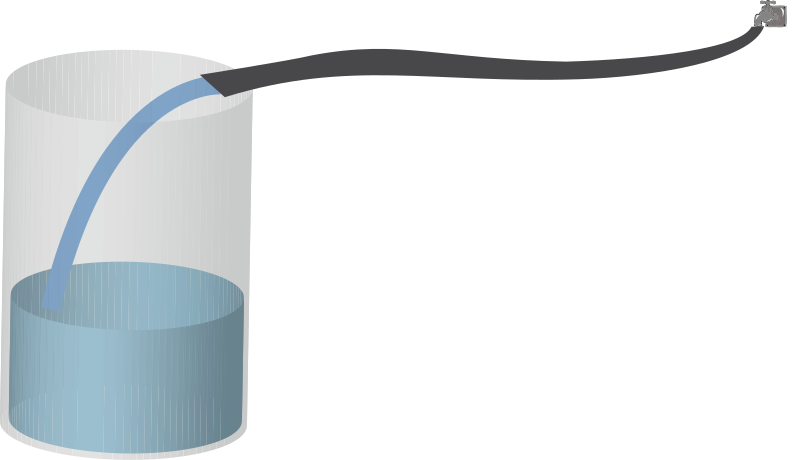
A hose has a radius of 2 cm on one end and a radius of 10 cm on the other. It is connected to a faucet (on the small side) where water comes into the hose at a speed of 0.6 m/s. At the other end (the big side), the hose fills a cylindrical tank with a radius of 3 m and a height of 10 m. How long does it take to fill up the tank?
Use the continuity equation for the fluid flux, and solve for the time \(t\).
The flux of the fluid can be written as:
\begin{equation*}
\frac{dV}{dt} = v A,
\end{equation*}
where the area is a circular area for the tank and the hose with radius \(R\) and \(r\) respectively. We can write the previous equation as:
\begin{equation*}
v_{\text{hose}} A_{\text{hose}}=\frac{V_{\text{tank}} }{t_{ \text{fill} } }.
\end{equation*}
Solving for \(t_{ \text{fill} }\) and in terms of the dimensions we get:
\begin{equation*}
t_{\text{fill}}=\frac{ R^2 h}{v_{\text{hose}} r^2}.
\end{equation*}
With numerical values:
\begin{equation*}
t_{\text{fill}}=7500\,\text{s}.
\end{equation*}
For a more detailed explanation of any of these steps, click on “Detailed Solution”.
In order to know how long it takes to fill up the tank, we must first know how much volume of water per unit time is produced by the hose. We must use one of the main equations of steady flow: the conservation of mass equation. The conservation of mass equations states that at any point in a flow, the amount of mass \(m\) per unit time \(t\) is always the same. That is
\begin{equation}
\label{dmdt}
\frac{dm}{dt}=\text{constant}.
\end{equation}
Writing the mass \(m\) in terms of the fluid’s density \(\rho\) and its volume \(V\) as
\begin{equation}
m=\rho V,
\end{equation}
we can rewrite equation \eqref{dmdt} as
\begin{equation}
\label{flux}
\rho\frac{dV}{dt}=\text{constant}.
\end{equation}
If the density of the fluid is constant along all the flow, then the quantity that must be a constant is the flux
\begin{equation}
\label{flux2}
\frac{dV}{dt}=\text{constant}.
\end{equation}
Thus, the flux at the inlet of the pipe must be the same at entrance of the tank, that is
\begin{equation}
\label{flux3}
\frac{dV}{dt}\Big|_{\text{hose}}=\frac{dV}{dt}\Big|_{\text{tank}}.
\end{equation}
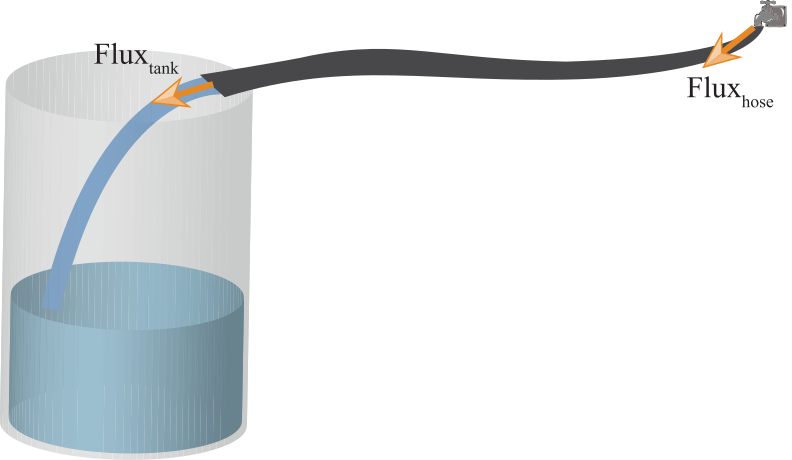
Figure 1: Hose (black) connected to the faucet at one end and pouring water into the tank on the left. The flux at the inlet of the hose must be the same as the flux on the outlet.
For a steady flow, the flux can be calculated at any point as the product of the velocity of the fluid \(v\) by the transverse area \(A\), namely
\begin{equation}
\label{va}
\frac{dV}{dt}=vA.
\end{equation}
Thus, we can use equation \eqref{va} in the left hand side of equation \eqref{flux3} to obtain
\begin{equation}
\label{ratevol}
v_{\text{hose}}A_{\text{hose}}=\frac{dV}{dt}\Big|_{\text{tank}},
\end{equation}
where \(v_{\text{hose}}\) is the velocity of the fluid entering the hose and \(A_{\text{hose}}\) is the transverse area of the hose at this point. The velocity \(v_{\text{hose}}\) is equal to the velocity at which water pours out from the faucet, and the area can be calculated using the equation for the area of a circle of radius \(r\)
\begin{equation}
\label{areacirc}
A_{\text{hose}}=\pi r^2,
\end{equation}
with \(r=2\,\text{cm}\) for our case. Thus, we can use the expression for the hose transverse area given in equation \eqref{areacirc} into equation \eqref{ratevol} to get
\begin{equation}
\label{rate2}
v_{\text{hose}}\pi r^2=\frac{dV}{dt}\Big|_{\text{tank}}.
\end{equation}
Because the rate at which the tank fills is constant from the analysis of equation \eqref{flux2}, then it can be calculated as the ratio of the total volume of the tank \( V_{\text{tank}}\) by the time it takes to fill this volume \(t_{\text{fill}}\). Thus, equation \eqref{rate2} becomes
\begin{equation}
\label{rate3}
v_{\text{hose}}\pi r^2=\frac{V_{\text{tank}}}{t_{\text{fill}}}.
\end{equation}
Solving for \(t_{\text{fill}}\) in equation \eqref{rate3}, we get the expression
\begin{equation}
\label{tfill}
t_{\text{fill}}=\frac{V_{\text{tank}}}{v_{\text{hose}}\pi r^2}.
\end{equation}
The volume of the tank will be the transverse area of the tank \(A_{\text{tank}}\), which is circular, multiplied by its height \(h\). Thus, the equation for the time \(t_{\text{fill}}\) is
\begin{equation}
\label{tfill2}
t_{\text{fill}}=\frac{A_{\text{tank}}h}{v_{\text{hose}}\pi r^2},
\end{equation}
where we can use equation \eqref{areacirc} to calculate the transverse area of the tank in terms of its radius \(R\) to obtain
\begin{equation}
A_{\text{tank}}=\pi R^2.
\end{equation}
Hence, equation \eqref{tfill2} becomes
\begin{equation}
\label{tfill3}
t_{\text{fill}}=\frac{\pi R^2 h}{v_{\text{hose}}\pi r^2},
\end{equation}
which after cancelling out the \(\pi\) is
\begin{equation}
\label{tfill4}
t_{\text{fill}}=\frac{ R^2 h}{v_{\text{hose}} r^2}.
\end{equation}
Using the numerical values in SI units (\(r=0.02\,\text{m}\)), we obtain
\begin{equation}
t_{\text{fill}}=\frac{(3\,\text{m})^2(10\,\text{m})}{(0.6\,\text{m/s})(0.02\,\text{m})},
\end{equation}
\begin{equation}
t_{\text{fill}}=7500\,\text{s}\approx 2.08\,\text{hours}.
\end{equation}


Leave A Comment