

Consider two spheres that both have a radius 65 cm. One is made of copper and has a density of 8940 kg/m\(^3\), and the other one is a wooden sphere with a density of 700 kg/m\(^3\).
a) Determine if the spheres float when immersed in water.
b) If they float, determine the force needed to submerge the spheres completely.
c) Calculate the force needed to submerge only half of the volume of each sphere.
a) Use Newton’s Second Law, and consider the densities of both the fluid and the objects to see if there will be any conditions to float or sink.
b) If any object floats, use again Newton’s Second Law to add a force applied to get the object submerged.
c) Again, use Newton’s Second Law and consider that the buoyant force has only half of the volume of the object.
a) Newton’s second law for a floating object states:
\begin{equation*}
\sum F > 0,
\end{equation*}
which in this case:
\begin{equation*}
F_B – m_s g > 0.
\end{equation*}
Then
\begin{equation*}
\rho_f > \rho_s,
\end{equation*}
which is the case for the wooden sphere with density \(\rho_s = 700 \, \text{kg/m}^3 \). So, the wooden sphere floats.
The opposite happens for the cooper sphere (\(\rho_s = 8940 \, \text{kg/m}^3 \)), then it sinks.
b) For the wooden sphere:
\begin{equation*}
F_B – m_s g – F_D = 0.
\end{equation*}
Solving for \(F_D\) we get:
\begin{equation*}
F_D=\frac{4\pi r^3g}{3}(\rho_f-\rho_s),
\end{equation*}
or with numerical values:
\begin{equation*}
F_D \approx 3385 \, \text{N}.
\end{equation*}
c) For both spheres:
\begin{equation*}
F_B +F_U – m_s g = 0.
\end{equation*}
Solving for \(F_U\) we get:
\begin{equation*}
F_U=\frac{4\pi r^3g}{3}\left(\rho_s-\frac{\rho_f}{2}\right).
\end{equation*}
For the copper sphere:
\begin{equation*}
F_U^{\text{copper}}\approx 9.52\times 10^{4}\,\text{N}.
\end{equation*}
For the wooden sphere:
\begin{equation*}
F_U^{\text{wooden}}\approx 2257\,\text{N}.
\end{equation*}
For a more detailed explanation of any of these steps, click on “Detailed Solution”.
a) They’ve asked us to determine if the spheres float when they are immersed in water. To approach the solution, we must examine the two main forces exerted on the spheres when submerged in a fluid: the weight and the buoyant force. Let’s draw a free body diagram for the sphere when partially or totally submerged in a fluid, as shown in figure 1.

Figure 1: Free body diagram for a sphere that is partially submerged. The two relevant forces exerted on it are the weight \(\vec{W}\) and the buoyant force \(\vec{F}_B\). The coordinate system is placed such that the positive Y-axis points upwards.
From the established coordinate system in figure 1, we can see that the weight is directed in the negative Y direction, its magnitude is \(mg\), where \(m\) is the mass of the sphere and \(g\) is the gravitational acceleration. Hence,
\begin{equation}
\label{w}
\vec{W}=-mg\,\hat{\textbf{j}}.
\end{equation}
We can write the mass of the sphere in terms of its density \(\rho_s\) and its volume \(V\) as
\begin{equation}
\label{mass}
m=\rho_s V.
\end{equation}
Then the expression for \eqref{w} becomes (using the result for \(m\) given in equation \eqref{mass}):
\begin{equation}
\label{w2}
\vec{W}=-\rho_s V g\,\hat{\textbf{j}}.
\end{equation}
The buoyant force \(\vec{F}_{B}\) is directed upwards, towards the positive Y axis and with magnitude, according to Archimedes principle, \(\rho_f V_{\text{sub}}g\). Thus,
\begin{equation}
\label{fb}
\vec{F}_B=\rho_f V_{\text{sub}}g\,\hat{\textbf{j}},
\end{equation}
where \(\rho\) is the density of the fluid in which the sphere is submerged and \(V_{\text{sub}}\) is the amount of volume of the sphere submerged. Notice that the maximum value of the buoyant force is when the whole volume is submerged (\(V_{\text{sub}}=V\)), then
\begin{equation}
\label{fbmax}
\vec{F}_{B \text{max}}=\rho_f Vg\,\hat{\textbf{j}}.
\end{equation}
Now let’s make the following analysis: if the magnitude of the weight is greater than the magnitude of the maximum buoyant force, the sphere will sink. Using the magnitudes in equations \eqref{w2} and \eqref{fbmax}, we can put into equations the analysis above as follows:
\begin{equation}
\label{exp1}
\text{if}\quad \rho_sVg>\rho_fVg \quad \text{the sphere sinks}.
\end{equation}
The inequality given in equation \eqref{exp1} can be simplified to
\begin{equation}
\label{exp2}
\text{if}\quad \rho_s>\rho_f \quad \text{the sphere sinks}.
\end{equation}
Analogously
\begin{equation}
\label{exp3}
\text{if} \quad \rho_s<\rho_f \quad \text{the sphere floats}.
\end{equation}
Because the fluid is water with density \(\rho_f=1000\,\text{kg/m}^3\), we can deduce from equation \eqref{exp2} that the copper sphere with density \(\rho_s=8940\,\text{kg/m}^3\) sinks, thus it can be submerged completely with no additional force.
From equation \eqref{exp3}, we can deduce that the wooden sphere with density \(\rho_s=700\,\text{kg/m}^3\) floats, thus it can be submerged if an additional force is applied to it downwards.
b) For the second part of the problem, we need to determine the force needed to submerge the spheres completely. Note that this question will only apply to the sphere that does not sink, namely the wooden one. As we said before, a force \(\vec{F}_D\) must be applied downwards in order to fully submerge the sphere, as seen in figure 2.
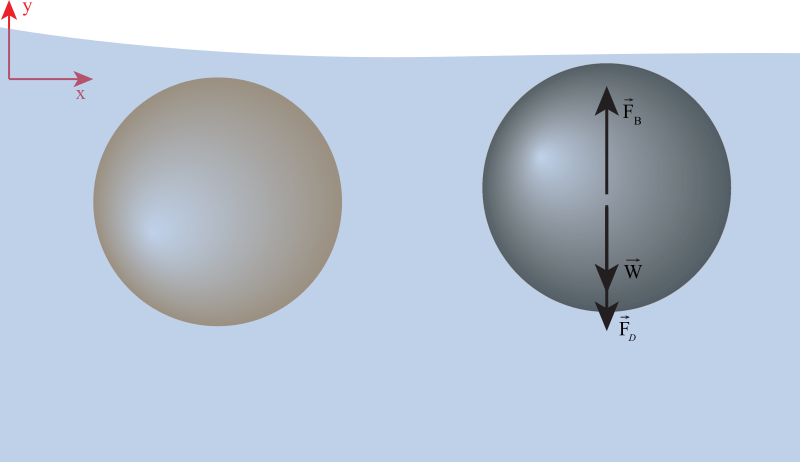
Figure 2: Free-body diagram for the fully submerged wooden sphere, showing three forces exerted on it: the buoyant force \(\vec{F}_B\), the weight \(\vec{W}\), and an applied force downwards \(\vec{F}_D\).
We use Newton’s second law in the static case, that is, null acceleration \(\vec{a}=\vec{0}\), explicitly
\begin{equation}
\sum \vec{F}=m\vec{a},
\end{equation}
\begin{equation}
\label{newton}
\sum \vec{F}=\vec{0},
\end{equation}
where \(\sum \vec{F}\) is the sum of all forces exerted on the sphere. From the free body diagram of figure 2, we can write equation \eqref{newton} as
\begin{equation}
\label{newton2}
\vec{W}+\vec{F}_B+\vec{F}_D=\vec{0}.
\end{equation}
Because the force \(\vec{F}_D\) is a downwards force with magnitude \(F_D\), we can write
\begin{equation}
\label{fd}
\vec{F}_D=-F_D\,\hat{\textbf{j}}.
\end{equation}
Using the explicit expressions for \(\vec{W}\), \(\vec{F}_B\) and \(\vec{F}_D\) given by equations \eqref{w2}, \eqref{fb} and \eqref{fd} respectively into equation \eqref{newton2}, we obtain
\begin{equation}
-\rho_sVg\,\hat{\textbf{j}}+\rho_fV_{\text{sub}}g\,\hat{\textbf{j}}-F_D\,\hat{\textbf{j}}=\vec{0}.
\end{equation}
Because all the forces are along the same direction, we can forget about the vector notation to write the above equation as
\begin{equation}
\label{newton3}
-\rho_s V+\rho_f V_{\text{sub}}g-F_D=0.
\end{equation}
Because we want the sphere to be completely submerged, the submerged volume is the total volume \(V_{\text{sub}}=V\), which for a sphere is
\begin{equation}
\label{volume}
V=\frac{4}{3}\pi r^3,
\end{equation}
where \(r\) is the radius of the sphere. Using the expression for the volume of the sphere given in equation \eqref{volume} into equation \eqref{newton3}, we get
\begin{equation}
\label{newton4}
-\rho_s\frac{4}{3}\pi r^3 g+\rho_f\frac{4}{3}\pi r^3-F_D=0,
\end{equation}
which can be solved for \(F_D\) as
\begin{equation}
\label{newton5}
F_D= -\rho_s\frac{4}{3}\pi r^3 g+\rho_f\frac{4}{3}\pi r^3g.
\end{equation}
After factorizing the term \(\frac{4}{3}\pi r^3g\) in equation \eqref{newton5}, we obtain
\begin{equation}
F_D=\frac{4\pi r^3g}{3}(\rho_f-\rho_s).
\end{equation}
Using the numerical values in SI units (\(r=0.65\,\text{m}\)), we get
\begin{equation}
F_D=\frac{4\pi (0.65\,\text{m})^3(9.81\,\text{m/s}^2)}{3}(1000\,\text{kg/m}^3-700\,\text{kg/m}^3),
\end{equation}
\begin{equation}
F_D\approx 3385\,\text{N}.
\end{equation}
c) To finish the problem, we need to calculate the force needed to submerge only half of the volume of each sphere. In both cases, we will assume that the force necessary for only half of the sphere to be submerged is directed upwards. We will call this force \(\vec{F}_U\), as seen in figure 3.
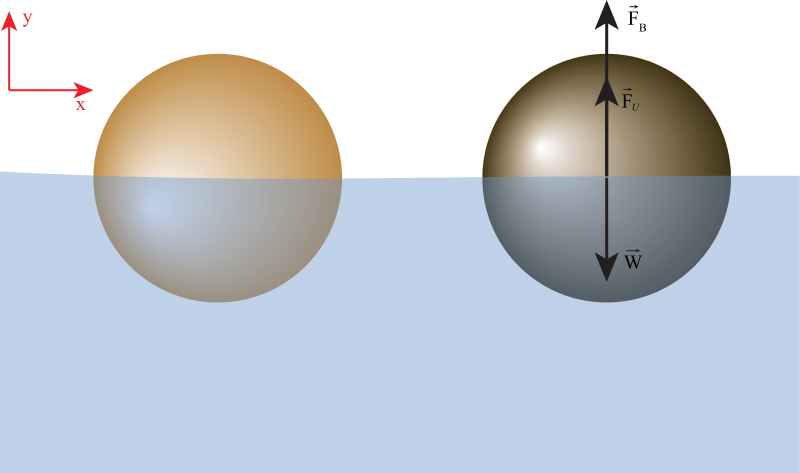
Figure 3: Free-body diagram for the half-submerged spheres, showing three forces exerted on it: the buoyant force \(\vec{F}_B\), the weight \(\vec{W}\), and an applied force upwards \(\vec{F}_U\).
We use Newton’s second law in the static case, that is, null acceleration \(\vec{a}=\vec{0}\), as in equation \eqref{newton}.
From the free body diagram of figure 3, we can write equation \eqref{newton} as
\begin{equation}
\label{newton12}
\vec{W}+\vec{F}_B+\vec{F}_U=\vec{0}.
\end{equation}
Because the force \(\vec{F}_U\) is an upwards force with magnitude \(F_U\), we can write
\begin{equation}
\label{fu}
\vec{F}_U=F_U\,\hat{\textbf{j}}.
\end{equation}
Using the explicit expressions for \(\vec{W}\), \(\vec{F}_B\) and \(\vec{F}_U\) given by equations \eqref{w2}, \eqref{fb} and \eqref{fu} respectively into equation \eqref{newton12}, we obtain
\begin{equation}
-\rho_sVg\,\hat{\textbf{j}}+\rho_fV_{\text{sub}}g\,\hat{\textbf{j}}+F_U\,\hat{\textbf{j}}=\vec{0}.
\end{equation}
Because all the forces are along the same direction, we can forget about the vector notation to write the above equation as
\begin{equation}
\label{newton13}
-\rho_s V+\rho_f V_{\text{sub}}g+F_U=0.
\end{equation}
Because we want the sphere to be half submerged, the submerged volume is the total volume divided by 2, \(V_{\text{sub}}=V/2\). Using the expression for the volume of the sphere given in equation \eqref{volume}, we have
\begin{equation}
V_{\text{sub}}=\frac{\frac{4}{3}\pi r^3}{2}=\frac{4}{6}\pi r^3.
\end{equation}
Using the expression above into equation \eqref{newton13}, we get
\begin{equation}
\label{newton14}
-\rho_s\frac{4}{3}\pi r^3 g+\rho_f\frac{4}{6}\pi r^3+F_U=0,
\end{equation}
which can be solved for \(F_U\) as
\begin{equation}
\label{newton15}
F_U= \rho_s\frac{4}{3}\pi r^3 g-\rho_f\frac{4}{6}\pi r^3g.
\end{equation}
After factorizing the term \(\frac{4}{3}\pi r^3g\) in equation \eqref{newton15}, we obtain
\begin{equation}
\label{fu2}
F_U=\frac{4\pi r^3g}{3}\left(\rho_s-\frac{\rho_f}{2}\right).
\end{equation}
Using the numerical values in SI units (\(r=0.65\,\text{m}\)), we get for the copper sphere
\begin{equation*}
F_U^{\text{copper}}=\frac{4\pi (0.65\,\text{m})^3(9.81\,\text{m/s}^2)}{3}\left((8940\,\text{kg/m}^3-\frac{1000\,\text{kg/m}^3}{2}\right),\end{equation*}
\begin{equation}
F_U^{\text{copper}}\approx 9.52\times 10^{4}\,\text{N}.
\end{equation}
For the wooden sphere, we obtain using equation \eqref{fu2}
\begin{equation*}
F_U^{\text{wooden}}=\frac{4\pi (0.65\,\text{m})^3(9.81\,\text{m/s}^2)}{3}\left(700\,\text{kg/m}^3-\frac{1000\,\text{kg/m}^3}{2}\right),\end{equation*}
\begin{equation}
F_U^{\text{wooden}}\approx 2257\,\text{N}.
\end{equation}


Leave A Comment