

Water and another type of liquid are inserted into a U-shaped tube that is open on both sides and has the dimensions shown in the figure.
a) What is the density of the unknown liquid?
b) If the side holding the unknown liquid was closed to vacuum, what would its density be?
c) If the water side was almost at vacuum, what would the density of the other liquid be? Does it make physical sense?
a) Apply the formula of pressure at a height where the pressure is equal on both sides. Remember the atmospheric pressure.
b) Same hint as part (a).
c) Same hint as part (a). Does the result make sense?
a) At the interface the absolute pressure must be the same:
\begin{equation*}
P_w=P_u.
\end{equation*}
In this case:
\begin{equation*}
P_0+\rho_w g x= P_0+ \rho_u g h,
\end{equation*}
where solving for \(\rho_u\) we get:
\begin{equation*}
\rho_u=\frac{\rho_w x}{h}.
\end{equation*}
Using the numerical values, we obtain
\begin{equation*}
\rho_u\approx 726.2\,\text{kg/m}^3.
\end{equation*}
b) Since one end is closed, we get:
\begin{equation*}
P_0+\rho_w g x=\rho_u g h.
\end{equation*}
Solving for \(\rho_u\) in the equation above, we have
\begin{equation*}
\rho_u=\frac{P_0+\rho_w g x}{g h}.
\end{equation*}
With numerical values:
\begin{equation*}
\rho_u = 3185.41\,\text{kg/m}^3.
\end{equation*}
c) Closed at the other end:
\begin{equation*}
\rho_w g x=P_0+\rho_u g h.
\end{equation*}
Solving for \(\rho_u\), we have
\begin{equation*}
\rho_u=\frac{-P_0+\rho_w g x}{g h}.
\end{equation*}
With numerical values:
\begin{equation*}
\rho_u=-1733.04\,\text{kg/m}^3,
\end{equation*}
which makes no sense since is a negative value.
For a more detailed explanation of any of these steps, click on “Detailed Solution”.
a) We need to find the density of the unknown liquid. Let’s draw the U tube manometer again first, as seen in figure 1, where we have indicated the relevant variables to solve the problem.
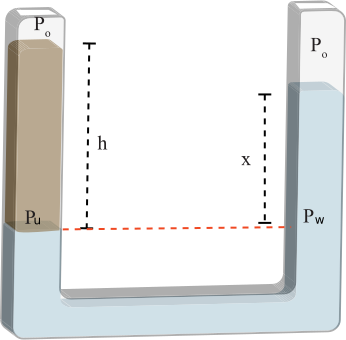
Figure 1: U-shaped tube open on both ends. The pressure at the free surface of both fluids is the atmospheric \(P_0\). The height of the column of both liquids is also shown.
On both ends, we will have the atmospheric pressure \(P_0\). For the liquids to be in equilibrium, the absolute pressure at the interface must be the same coming from the water and coming from the unknown fluid; we will call these pressures \(P_w\) and \(P_u\) respectively. Then, we must have
\begin{equation}
\label{principal}
P_w=P_u.
\end{equation}
To calculate the absolute pressure, we must take into account that it is the sum of several terms. The first of these terms is the atmospheric pressure, when present, and the second term is the hydrostatic pressure \(P_h\) given by the expression:
\begin{equation}
\label{hydrostatic}
P_h=\rho g y,
\end{equation}
where \(\rho\) is the density of the fluid, \(g\) is the gravitational acceleration, and \(y\) is the depth at which the pressure is being calculated.
Therefore, we can write, using the expression given in equation \eqref{hydrostatic}
\begin{equation}
\label{pw}
P_w=P_0+\rho_w gx,
\end{equation}
where \(x\) is defined in the second figure and whose numerical value can be obtained from the first figure to be \(x=4.2\,\text{m}-1.15\text{m}=3.05\,\text{m}\). The density of water is denoted as \(\rho_w\)
The same argument can be made to write
\begin{equation}
\label{pu}
P_u=\rho_u g h,
\end{equation}
where \(\rho_u\) is the density of the unknown fluid and \(h\) is the depth in the unknown fluid up to the interface with water, as seen in figure 1.
Using the explicit expressions for \(P_w\) and \(P_u\) given by equations \eqref{pw} and \eqref{pu} into equation \eqref{principal}, we obtain
\begin{equation}
P_0+\rho_w g x= P_0+ \rho_u g h,
\end{equation}
where we can cancel the term \(P_0\) to get
\begin{equation}
\label{p1}
\rho_w g x= \rho_u g h.
\end{equation}
We can solve \(\rho_u\) from equation \eqref{p1} to obtain
\begin{equation}
\rho_u=\frac{\rho_w g x}{ g h},
\end{equation}
which upon cancellation of the term \(g\) becomes
\begin{equation}
\rho_u=\frac{\rho_w x}{h}.
\end{equation}
Using the numerical values, we obtain
\begin{equation}
\rho_u=\frac{(1000\,\text{kg/m}^3)(3.05\,\text{m})}{(4.2\,\text{m})},
\end{equation}
\begin{equation}
\rho_u\approx 726.2\,\text{kg/m}^3.
\end{equation}
A value that is close to the density of gasoline, for example.
b) Now, the left side is closed such that there is no air between the lid and the unknown fluid but the distances given in the first figure remain the same. We can still make the same analysis and use equation \eqref{principal}. The expression for \(P_w\) is the same but in the expression for \(P_u\) we do not have to include the term for atmospheric pressure, then
\begin{equation}
\label{pu2}
P_h=\rho_u g h.
\end{equation}
Using the new result of \(P_u\) and the explicit expression for \(P_w\) given in equation \eqref{pw} into equation \eqref{principal}, we have
\begin{equation}
P_0+\rho_w g x=\rho_u g h.
\end{equation}
Solving for \(\rho_u\) in the equation above, we have
\begin{equation}
\rho_u=\frac{P_0+\rho_w g x}{g h}.
\end{equation}
Using the numerical values in SI units (\(P_0=101325\,\text{Pa}\), \(x=3.05\,\text{m}\), \(h=4.2\,\text{m}\) and \(g=9.81\,\text{m/s}^2\)), we get
\begin{equation}
\rho_u=\frac{101325\,\text{Pa}+(1000\,\text{kg/m}^3)(9.81\,\text{m/s}^2)(3.05\,\text{m}) }{(9.81\,\text{m/s}^2)(4.2\,\text{m})},
\end{equation}
\begin{equation}
\rho_u=3185.41\,\text{kg/m}^3,
\end{equation}
which is almost twice the density of the densest liquid, Mercury.
c) Now, the right side is closed such that there is no air between the lid and the water, but the distances given in figure 1 remain the same. We can still make the same analysis and use equation \eqref{principal}. The expression for \(P_u\) is the same as equation \eqref{pu}, but in the expression for \(P_w\) we do not have to include the term for atmospheric pressure, then
\begin{equation}
\label{pw2}
P_w=\rho_w g x.
\end{equation}
Using the new result of \(P_w\) and the explicit expression for \(P_u\) given in equation \eqref{pu} into equation \eqref{principal}, we have
\begin{equation}
\rho_w g x=P_0+\rho_u g h.
\end{equation}
Solving for \(\rho_u\) in the equation above, we have
\begin{equation}
\rho_u=\frac{-P_0+\rho_w g x}{g h}.
\end{equation}
Using the numerical values in SI units (\(P_0=101325\,\text{Pa}\), \(x=3.05\,\text{m}\), \(h=4.2\,\text{m}\) and \(g=9.81\,\text{m/s}^2\)), we get
\begin{equation}
\rho_u=\frac{-101325\,\text{Pa}+(1000\,\text{kg/m}^3)(9.81\,\text{m/s}^2)(3.05\,\text{m}) }{(9.81\,\text{m/s}^2)(4.2\,\text{m})},
\end{equation}
\begin{equation}
\rho_u=-1733.04\,\text{kg/m}^3,
\end{equation}
which is negative. Because all densities must be positive values, we conclude that the situation proposed in (c) is impossible in nature. Distances \(x\) and \(h\) readjust when the lid is closed and the vacuum is imposed.


Leave A Comment