

A 0.5 m-sided cube is made of an unknown material. It is placed in water and remains floating with \(80\%\) of the cube below the surface.
a) What is the density of the material?
b) Now suppose the cube is tied to the bottom so that it remains completely submerged. What is the magnitude of the tension in the rope?
a) Use Newton’s Second Law to solve for the density of the object by expressing the mass in terms of the density.
b) Use Newton’s Second Law with the force due to tension force, and solve for that force.
a) The buoyant force is:
\begin{equation*}
F_b= \rho_w V_{w,d} g,
\end{equation*}
[mepr-show rules=”4409″ unauth=”both”]
where \(V_{w,d} = a^2 h\) being \(h\) the submerged height.
By Newton’s second law we get:
\begin{equation*}
F_b – mg = 0,
\end{equation*}
where the mass of the object can be written as \(m = \rho V\). Solving for \(\rho\) we have:
\begin{equation*}
\rho = \frac{ \rho_w h}{a},
\end{equation*}
or with numerical values:
\begin{equation*}
\rho = 800 \, \text{kg/m}^3.
\end{equation*}
b) By Newton’s second law we get:
\begin{equation*}
F_b – T – mg = 0,
\end{equation*}
where \(m\) and \(F_b\) can be written in terms of the density. Solving for \(T\) we have:
\begin{equation*}
T = (\rho_w – \rho) V g.
\end{equation*}
With numerical values:
\begin{equation*}
T = 245 \, \text{N}.
\end{equation*}
For a more detailed explanation of any of these steps, click on “Detailed Solution”.
[/mepr-show]
a) In order to find the density of the material, we should first use Newton’s second law to write the weight of the object in terms of the variables we were given. We can then solve for the density by writing the weight in terms of the density and the volume of the cube.
[mepr-show rules=”4409″ unauth=”both”]
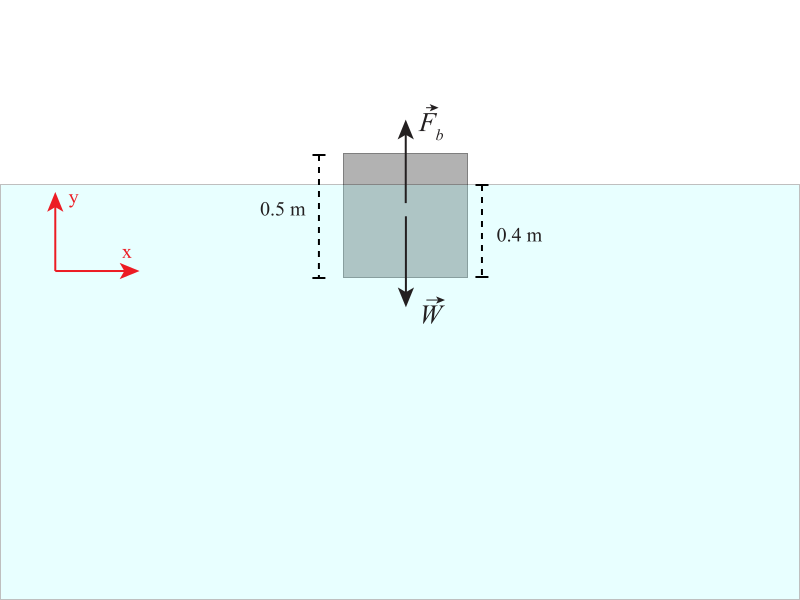
Figure 1: Free-body diagram for the cube showing the two forces exerted on it: the buoyant force \(\vec{F}_b\) and the weight \(\vec{W}=-mg\,\hat{\textbf{j}}\). The submerged portion of the cube is also shown.
Figure 1 shows the relevant variables and the forces acting on the cube. According to this figure, we can write Newton’s second law for the block as
\begin{equation}
\label{EQ:n2l_1}
F_b \hat{\textbf{j}} – mg \hat{\textbf{j}} = ma \hat{\textbf{j}},
\end{equation}
where \(F_b\) is the magnitude of the buoyant force exerted on the block by the water, \(m\) is the mass of the block, and \(a\) is the magnitude of its acceleration. In this case, the block is at equilibrium, and thus \(a = 0\). Hence, eq. \eqref{EQ:n2l_1} becomes
\begin{equation}
F_b \hat{\textbf{j}} – mg \hat{\textbf{j}} = 0.
\end{equation}
Additionally, if we focus only on the dimensions, we get
\begin{equation}
\label{EQ:n2l}
F_b – mg = 0.
\end{equation}
Now, we should find expressions for the mass \(m\) in terms of the density of the block, and for the buoyant force in terms of the variables that were given to us.
The density \(\rho\) of an object is defined as
\begin{equation}
\rho = \frac{m}{V},
\end{equation}
where \(m\) is its mass and \(V\) is its volume. Multiplying this expression by \(V\), we get
\begin{equation}
\label{EQ:rho}
m = \rho V,
\end{equation}
we can substitute this in eq. \eqref{EQ:n2l} for the mass of the object. This gives
\begin{equation}
F_b – \rho V g = 0,
\end{equation}
where \(\rho\) is the density of the block (which is the variable we want to solve for), and \(V\) is its total volume. We can rewrite this equation as
\begin{equation}
\rho V g = F_b.
\end{equation}
The total volume of a cube of side \(a\) is \(V = a^3\). Hence, we can rewrite this equation as
\begin{equation}
\label{EQ:n2l_2}
\rho a^3 g = F_b.
\end{equation}
Now we should find an expression for \(F_b\). According to Archimedes’ principle, the buoyant force is given by the weight of the liquid being displaced by the submerged portion of the block, which we can write as
\begin{equation}
\label{EQ:Fb}
F_b = m_{w,d} g,
\end{equation}
where \(m_{w,d}\) is the mass of water displaced by the submerged fraction of the block. Using the definition of density as shown in eq. \eqref{EQ:rho}, we can write it as
\begin{equation}
m_w = \rho_w V_{w,d},
\end{equation}
where \(\rho_w\) is the density of water, and \(V_{w,d}\) is the volume of water displaced by the block. Substituting this in eq. \eqref{EQ:Fb}, we obtain
\begin{equation}
\label{EQ:Fb2}
F_b = \rho_w V_{w,d} g
\end{equation}
The volume \(V_{w,d}\) of water displaced by the block is exactly equal to the volume of the block that is submerged in the water. According to the first figure, the area of the face of the cube is given by \(a^2\), and the height of the submerged fraction is \(h\). Hence, the submerged volume, or equivalently, the volume of water displaced by the block, is
\begin{equation}
V_{w,d} = a^2 h.
\end{equation}
Substituting this in eq. \eqref{EQ:Fb2} yields
\begin{equation}
F_b = \rho_w a^2 h g.
\end{equation}
Finally, inserting this expression in Newton’s second law (eq. \eqref{EQ:n2l_2}) gives
\begin{equation}
\rho a^3 g = \rho_w a^2 h g.
\end{equation}
If we divide by \(a^3g\), we obtain
\begin{equation}
\label{EQ:final}
\rho = \frac{\rho_w a^2 h g}{a^3 g}
= \frac{\rho_w h}{a},
\end{equation}
and substituting numerical values, we get
\begin{equation}
\rho = \frac{\left(1000 \ \frac{\text{Kg}}{\text{m}^3}\right)( 0.4 \ \text{m})} { 0.5 \ \text{Kg}} = 800 \ \frac{\text{Kg}}{\text{m}^3}
\end{equation}
Notice that the smaller the density of the object, the smaller the submerged height \(h\) is. If the whole block is submerged, we have \(h = a\), and the density of the block will be equal to the density of the water.
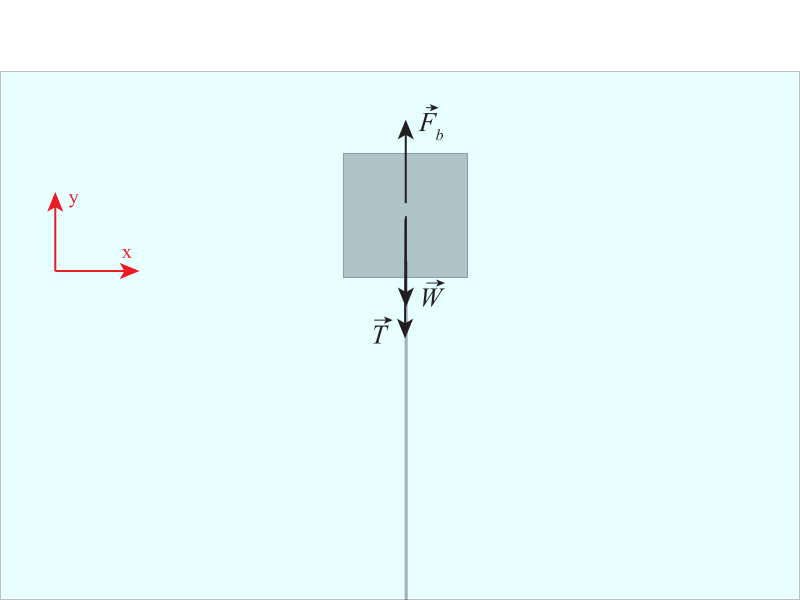
Figure 2: Free-body diagram for the fully submerged cube showing the three forces exerted on it: the buoyant force \(\vec{F}_b\), the weight \(\vec{W}=-mg\,\hat{\textbf{j}}\), and the tension exerted by the rope \(\vec{T}\).
b) In order to find the tension of the rope, we need to apply Newton’s second law. In this case, we must include the tension of the rope apart from the weight of the block and the buoyant force the water exerts on it.
\begin{equation}
F_b \hat{\textbf{j}} – T \hat{\textbf{j}} – mg \hat{\textbf{j}} = ma \hat{\textbf{j}},
\end{equation}
where \(F_b \hat{\textbf{j}}\) is the buoyant force, \(T \hat{\textbf{j}}\) is the tension of the rope, \(m\) is the mass of the block, and \(a\) is the magnitude of its acceleration
If we only focus on the magnitudes, we obtain
\begin{equation}
F_b – T – mg = ma.
\end{equation}
The block is stationary, hence \(a = 0\), and we can write Newton’s second law as
\begin{equation}
F_b – T – mg = 0.
\end{equation}
Solving for the tension \(T\), we get
\begin{equation}
\label{EQ:T}
T = F_b – mg.
\end{equation}
Now, as explained in part a, we can write the mass of the block according to eq. \eqref{EQ:rho} as
\begin{equation}
m = \rho V,
\end{equation}
where \(\rho\) is the density of the block and \(V\) is its volume. Substituting this in eq. \eqref{EQ:T} yields
\begin{equation}
\label{EQ:T2}
T = F_b – \rho V g.
\end{equation}
Also, as in part a), the buoyant force \(F_b\) equals the weight of the water displaced by the block, and we can write this according to eq. \eqref{EQ:Fb2} as
\begin{equation}
F_b = \rho_w V_{w,d} g,
\end{equation}
where \(\rho_w\) is the density of the water and \(V_{w,d}\) is the volume of water displaced by the block. Since, in this case, the block is completely submerged (see figure 2), the volume of water displaced by the block equals the total volume \(V\) of the block. Hence
\begin{equation}
F_b = \rho_w V g.
\end{equation}
After substituting this in eq. \eqref{EQ:T2}, we obtain that the magnitude of the tension is given by
\begin{equation}
T = \rho_w V g\, – \rho V g
= (\rho_w – \rho) V g.
\end{equation}
Finally, after inserting numerical values, we get
\begin{equation}
T = \left(1000 \ \frac{\text{Kg}}{\text{m}^3} – 800 \ \frac{\text{Kg}}{\text{m}^3}\right) (0.5 \ \text{m})^3 \left(9.8 \ \frac{\text{m}}{\text{s}^2}\right)
= 245 \ \text{N}.
\end{equation}
[/mepr-show]


Leave A Comment