
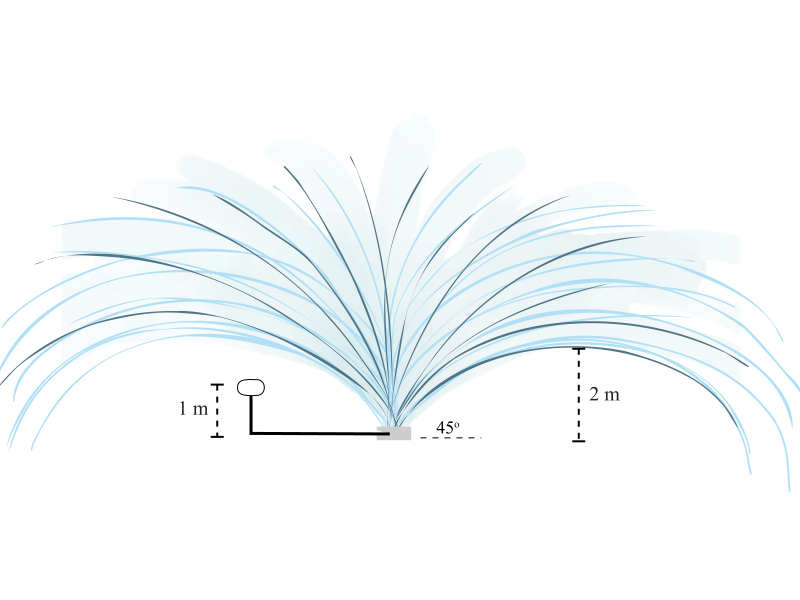
You have been hired to build a fountain in a park. The water should come out at a 45 degree angle from the ground and reach a height of two meters. To achieve this, the fountain must have a pressure chamber at a height of 1 m above the ground level (see the diagram). What should the pressure in the chamber be in order to achieve the desired height?
With kinematic equations, find the initial velocity knowing the maximum height the water can reach. Then, by Bernoulli’s equation find the pressure at point A.
By the kinematic equation for the position:
\begin{equation*}
y = y_0 + v_0y t – \frac{1}{2} g t^2,
\end{equation*}
and
\begin{equation*}
v_y = v_0y \, – g t,
\end{equation*}
where using the conditions for the maximum height reached, we can find the time for the second equation and replace it in the first one. Then, after some algebra, solving for \( v_0^2\) we get:
\begin{equation*}
v_0^2 = \frac{2 g H }{ \cos^2 \theta}.
\end{equation*}
Then, Bernoulli’s equation states:
\begin{equation*}
P_A + \frac{1}{2} \rho v_A^2 + \rho g y_A = P_B + \frac{1}{2} \rho v_B^2 + \rho g y_B.
\end{equation*}
Using the given conditions and the velocity found previously, solving for \(P_A\) after some algebra, we get:
\begin{equation*}
P_A = P_0 + \rho g \frac{H}{ \cos^2 \theta \, – h},
\end{equation*}
or with numerical values:
\begin{equation*}
P_A = 1.3 \times 10^5 \ \text{Pa}.
\end{equation*}
For a more detailed explanation of any of these steps, click on “Detailed Solution”.
They are asking us to figure out what the pressure in the 1 m high chamber needs to be in order to have the water reach 2 m above the ground. We can divide the solution into two parts. First, we have the hydrodynamics part of the problem, which will describe the motion of the water from the pressure pump to the fountain’s outlet. From this, we can obtain an expression that relates the pump pressure to the water velocity at the outlet. The second step involves kinematics, and we’ll model the water as a particle undergoing a parabolic motion. From this, we can calculate the initial velocity of the motion, which is precisely the water’s velocity at the pipe’s outlet.

Figure 1: Fountain pouring out water where we have placed the coordinate system on the ground. On the left part of the drawing, we see the chamber at a height \(h\). Water flows through the black pipe until it comes out with a velocity \(\vec{v}_i\) at an angle \(\theta\) and reaches a maximum height \(H\) in its parabolic motion.
For the hydrodynamics part of the solution, we can use Bernoulli’s equation to relate points A (pump) and B (outlet) inside the pipe, given that the water’s motion is assumed to be ideal and any loss of mechanical energy can be neglected.
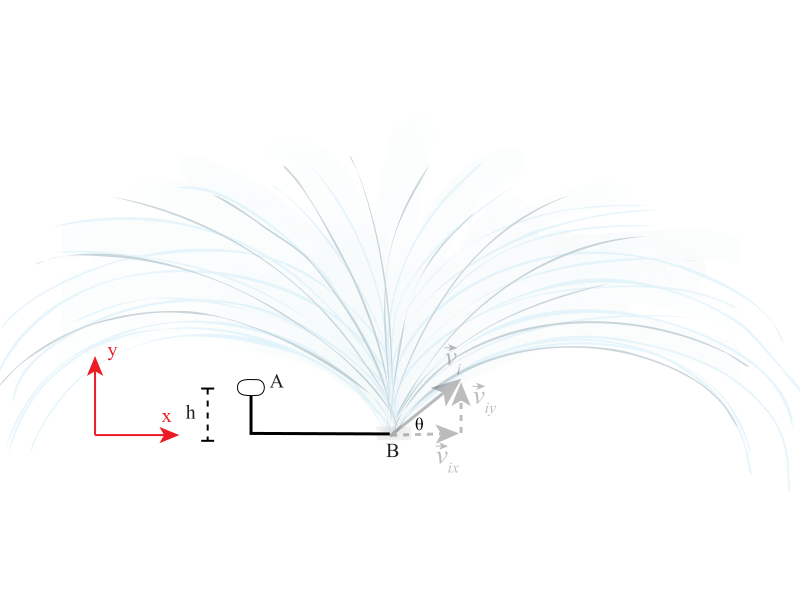
Figure 2: Point A is where the chamber at a height \(h\) is at pressure \(P_A\) while at point B water comes out with a velocity \(\vec{v}_i\) at atmospheric pressure \(P_0\).
Bernoulli’s equation can be written as
\begin{equation}
\label{Bernoulli1}
P_A + \frac{1}{2} \rho v_A^2 + \rho g y_A = P_B + \frac{1}{2} \rho v_B^2 + \rho g y_B.
\end{equation}
As it is shown in the diagram above, water starts at rest inside the pump, thus \(v_A = 0\), at a height \(y_A = h = 1 m\). At point B (on the ground \(y_B = 0\)) it reaches a velocity \(v_B = v_0\), still unknown. Pressure at point A is precisely the quantity we need to find, whereas pressure at B is the atmospheric pressure \(P_0\), given that this point is open to the atmosphere. This reasoning yields
\begin{equation}
\label{Bernoulli2}
P_A + 0 + \rho g h = P_0 + \frac{1}{2} \rho v_0^2 + 0.
\end{equation}
Taking the gravitational term on the left to the right-hand side
\begin{equation}
\label{Bernoulli3}
P_A = P_0+ \frac{1}{2} \rho v_0^2 – \rho g h,
\end{equation}
and factoring \(\rho\), we get
\begin{equation}
\label{Bernoulli3a}
P_A = P_0+ \rho\left( \frac{1}{2} \rho v_0^2 – g h\right).
\end{equation}
The expression for \(P_A\) cannot be calculated yet, as we still don’t know \(v_0\). So, let’s move on to the second part of the solution, which involves kinematics and will allow us to find an expression for \(v_0\) in terms of known parameters.
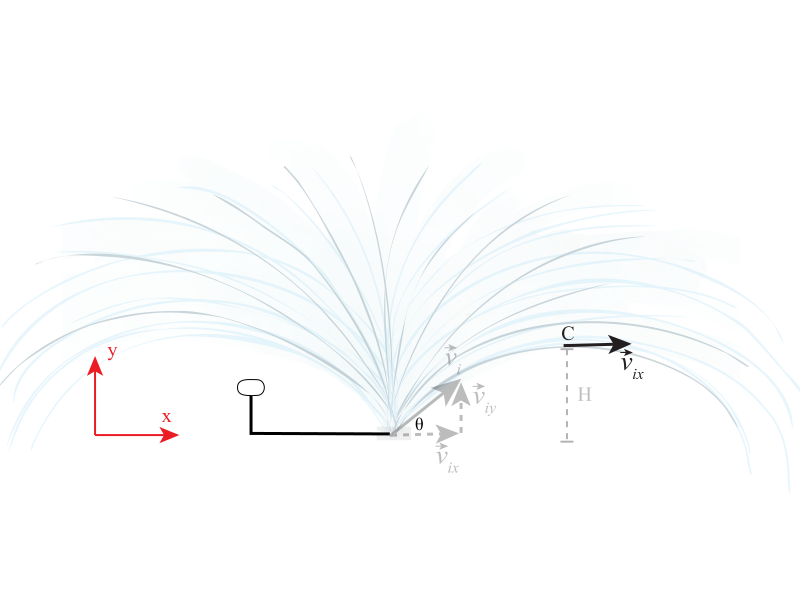
Figure 3: At point C, where the stream of water attains its maximum height \(H\) the velocity is horizontal \(\vec{v}_{ix}\).
In figure 3, we show the initial point of the parabola, point B, and point C of maximum height. Water starts with velocity \(v_0\) directed \(45^o\) above the horizontal, yielding the velocity components in each direction as shown. At its maximum height, water will only have velocity in the x-direction, thus \(v_cy = 0\).
We recall the kinematics equation for the y component of the parabolic motion
\begin{equation}
\label{ykinematics}
y = y_0 + v_0y t – \frac{1}{2} g t^2,
\end{equation}
and its derivative, the y component of the velocity
\begin{equation}
\label{vykinematics}
v_y = v_0y \, – g t.
\end{equation}
Then, in both equations, we replace the height in C, \(y = H\), the initial height, \(y_0 = 0\), and the initial component of the velocity, \(v_{0y} = v_0 \cos \theta \), getting
\begin{equation}
\label{ykinematics2}
H = 0 + v_0 \cos \theta t – \frac{1}{2} g t^2,
\end{equation}
and
\begin{equation}
\label{vykinematics2}
0 = v_0 \cos \theta \, – g t,
\end{equation}
where we used the fact that the velocity component in C is zero. Since we do not know the time \(t\), we will eliminate it from both equations. We take the subtracting term at the right of equation \eqref{vykinematics2} to its left-hand side
\begin{equation}
\label{time1}
gt = v_0 \cos \theta,
\end{equation}
and we divide by the gravity
\begin{equation}
\label{time2}
t = v_0\frac{\cos \theta}{g}.
\end{equation}
Replacing this in \eqref{ykinematics2}, we have
\begin{equation}
\label{maximumheight1}
H = v_0 \cos \theta \left(v_0\frac{\cos \theta}{g}\right) – \frac{1}{2} g \left(v_0\frac{\cos \theta}{g}\right)^2
\end{equation}
operating
\begin{equation}
\label{maximumheight2}
H = v_0^2 \frac{\cos^2 \theta}{g} – \frac{1}{2} g \left(v_0^2 \frac{\cos^2 \theta}{g}^2\right),
\end{equation}
cancelling out one gravity in the last term, we have
\begin{equation}
\label{maximumheight3}
H = v_0^2 \frac{\cos^2 \theta}{g} – \frac{1}{2} \left(v_0^2 \frac{\cos^2 \theta}{g}\right),
\end{equation}
which yields
\begin{equation}
\label{maximumheight4}
H = v_0^2 \frac{\cos^2 \theta}{ 2g}.
\end{equation}
Notice that we know everything in this expression, except the velocity \(v_0\), which is precisely what we need to calculate the pump’s pressure. Then, we pass the dividing \(2g\) to multiply at the left-hand side
\begin{equation}
\label{v0}
2 g H = v_0^2 \cos^2 \theta,
\end{equation}
and we divide by \(\cos^2 \theta\)
\begin{equation}
\label{v0-2}
\frac{2 g H }{ \cos^2 \theta }= v_0^2.
\end{equation}
We can then replace equation \eqref{v0-2} in \eqref{Bernoulli3}
\begin{equation}
\label{Pressure1}
P_A = P_0 + \rho (\frac{1}{2}(2 g H / \cos^2 \theta) – g h).
\end{equation}
Now we cancel out the 2’s, getting
\begin{equation}
\label{Pressure2}
P_A = P_0 + \rho \frac{g H} { \cos^2 \theta \, – g h},
\end{equation}
then we factor out gravity, finally yielding
\begin{equation}
\label{Pressure3}
P_A = P_0 + \rho g \frac{H}{ \cos^2 \theta \, – h},
\end{equation}
where we know every parameter. Thus, we replace all the known quantities
\begin{equation}
\label{Pressure4}
P_A = 1.01 \times 10^5 \ \text{Pa} + \left(1000 \ \frac{\text{kg}}{\text{m}^3}\right) \left(10 \ \frac{\text{m}}{\text{s}^2}\right) \left(\frac{2\ \text{m}}{\frac{1}{2}} – 1 \ \text{m}\right),
\end{equation}
obtaining
\begin{equation}
\label{PressureNum}
P_A = 1.3 \times 10^5 \ \text{Pa} \approx 1.3 \ \text{atm}.
\end{equation}
Hence, in order for the fountain to work as proposed the pump’s pressure has to be approximately 30 \(\%\) more than that of the atmosphere at sea level.


Leave A Comment