

Theresa and her friends find an abandoned boat in a river. She decides to find out if the boat will sink before they all get on board. In order to do this, she makes some measurements and concludes that the boat is 2 m long, 1 m wide, and 50 cm high. She also notices that 20 cm of the boat is already below water.
a) How much does the boat weigh? Remember that the density of water is \(1000 \, \text{kg/}\text{m}^3\).
b) What is the average density of the boat?
c) If Theresa and her friends each have a mass of \(50 \,\text{kg}\), how many people can get on the boat before it sinks?
a) Use Newton’s Second Law and the definition of the buoyant force to solve for the mass.
b) Use the formula for density, and plug in the other variables.
c) Define the weight of N persons as \(N Mg\). Use Newton’s Second Law to solve for \(N\).
a) In equilibrium, Newton’s second law states:
\begin{equation*}
\sum F = 0,
\end{equation*}
where in this case:
\begin{equation*}
F_b – m_B g = 0.
\end{equation*}
The buoyant force is defined as \(F_B = \rho_w V_B’ g\), where \(V_B’\) means the submerged part is not the entire volume of the boat. Solving for \(m_B\) we get:
\begin{equation*}
m_B = \rho_w \ell w h’,
\end{equation*}
or with numerical values:
\begin{equation*}
m_B = 400 \, \text{kg}.
\end{equation*}
b) The density is:
\begin{equation*}
\rho_B = \frac{m_B}{V_B},
\end{equation*}
or with numerical values:
\begin{equation*}
\rho_B = 400 \, \frac{ \text{kg} }{ \text{m}^3}.
\end{equation*}
c) By Newton’s second law we get:
\begin{equation*}
F_b – m_B g – N m_p g,
\end{equation*}
where \(N\) is the number of people in the boat. Solving for \(N\) with the definition of the buoyant force we get:
\begin{equation*}
N = \frac{\rho_w}{m_p} \ell w (h-h’),
\end{equation*}
or with numerical values:
\begin{equation*}
N = 12.
\end{equation*}
For a more detailed explanation of any of these steps, click on “Detailed Solution”.
a) The first part of the problem asks us to calculate the weight of the boat. Since she takes all relevant measurements of the boat, Theresa could easily calculate the total volume of the boat and also the volume of the part of the boat that is submerged under the river before she or any of her friends can board it. These two quantities are going to be enough to calculate the boat’s mass and weight, given that it is static and that we can use Newton’s second law with zero acceleration to relate the forces exerted on the boat at that moment.
Let’s draw a force diagram on the boat, using a cartesian coordinate system with the \(x\) axis pointing to the right and the \(y\) axis upwards. The gravitational force \(W_{B}\) exerted by the Earth is acting on it (weight), as well as the buoyant force \(F_{b,i}\), where the subindex \(i\) refers to the moment before anyone tries to board the boat. The buoyant force is produced by the water displaced by the boat, as shown in figure 1.
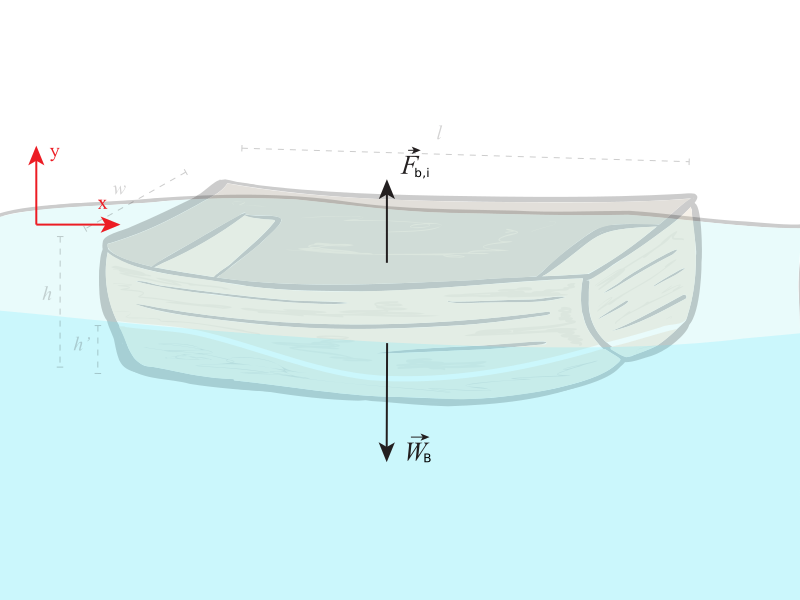
Figure 1: Free-body diagram for the boat. The two forces exerted on the boat are along the Y-axis: the buoyant force before anyone gets in the boat \(\vec{F}_{b,i}\) and the weight of the boat \(\vec{W}_B\).
Now, we can write Newton’s second law on the boat of mass \(m_B\):
\begin{equation}
\label{2Newton}
\sum F\mathbf{\hat{\textbf{j}}}=m_B a\mathbf{\hat{\textbf{j}}}=0,
\end{equation}
where we have used the static condition of the boat, which yields zero acceleration. In this case, we will only have force component in the \(y\) direction, as seen in the diagram, thus
\begin{equation}
\label{2Newton_bef1}
F_{b,i}\hat{\textbf{j}}-W_B\hat{\textbf{j}}=0.
\end{equation}
If we focus only in the magnitudes and use that \(W_B=m_Bg\), we get
\begin{equation}
\label{2Newton_bef2}
F_{b,i}-m_Bg=0.
\end{equation}
We can add the subtracting term in the left to the right, obtaining the equality
\begin{equation}
\label{2Newton_bef3}
F_{b,i}=m_B g.
\end{equation}
Let’s remember that the buoyant force is defined as the weight of the displaced liquid by the submerged object:
\begin{equation}
\label{Buoy_bef1}
F_{b,i} = m_{w,i} g,
\end{equation}
where \(m_{w,i}\) is the mass of water displaced by the boat before it is carrying anyone. We can rewrite that mass using the definition of volume density \(\rho=m/V\) like this: (m=\rho V\). So, the previous equation becomes
\begin{equation}
\label{Buoy_bef2}
F_{b,i}=\rho_w V_B’g,
\end{equation}
where \(\rho_w\) is the density of water and the portion of submerged boat has a volume given by \(V_B’=\ell w h’\) (modeling it as a parallelepiped), yielding
\begin{equation}
\label{Buoy_bef3}
F_{b,i}=\rho_w \ell w h’g.
\end{equation}
We then replace this force \eqref{Buoy_bef3} in \eqref{2Newton_bef3}, to get
\begin{equation}
\label{mass1}
\rho_w\ell w h’g = m_Bg.
\end{equation}
where we can cancel out the gravity \(g\) as it is present in all terms of the equation, which gives us the boat’s mass
\begin{equation}
\label{mass2}
m_B = \rho_w \ell w h’ = \left(1000 \ \frac{\text{Kg}}{\text{m}^3}\right)\left(2 \ \text{m}\right)\left(1 \ \text{m}\right) \left(0.2 \ \text{m}\right)= 400 \ \text{kg}.
\end{equation}
The boat’s mass is then 400 kg. Using \(g = 10\ \frac{\text{m}}{\text{s}^2}\), we find the weight to be 4000 N.
b) Since we already know the boat’s mass and also its volume \(V_B=\ell w h\), we can use the definition of density
\begin{equation}
\label{density1}
\rho_B = \frac{m_B}{V_B} = \frac{m_B}{\ell w h},
\end{equation}
which gives us the average density of the boat. Replacing all the known quantities, we get
\begin{equation}
\label{density2}
\rho_B=\frac{400\ \text{kg}}{(2 \ \text{m})(1 \ \text{m})(0.5 \ \text{m})}=400 \ \frac{\text{Kg}}{\text{m}^3}.
\end{equation}
This density is lower than that of the water, which makes physical sense since we know that the boat is floating on the river.
c) Now we want to calculate the maximum number of people that the boat can accommodate before sinking, knowing that the average mass of each person is \(m_P=50\ \text{kg}\).
We need to analyze the critical moment when the boat is about to sink. This condition is fulfilled when the boat is just totally submerged, with water up to its upper surface and with N people on it, as shown in the new force diagram in figure 2.

Figure 2: Free-body diagram for the boat with Theresa and her friends on it. The two forces exerted on the people-boat system are along the Y-axis: the buoyant force once \(N\) people get on the boat \(\vec{F}_{b,f}\) and the total weight of the boat-people system \(\vec{W}_T=\vec{W}_B+N\vec{W}_P\).
Considering this, let’s write Newton’s second law again for this situation:
\begin{equation}
\label{2Newton_aft1}
F_{b,f}\hat{\textbf{j}}-W_B\hat{\textbf{j}}-N W_P\hat{\textbf{j}}=0,
\end{equation}
where, again, we used the fact that the system’s acceleration is zero (rest condition) and the last term corresponds to the total weight of N people. Taking only the magnitudes, we have
\begin{equation}
\label{2Newton_aft2}
F_{b,f}\, – W_B \,- N W_P = 0.
\end{equation}
The buoyant force for this case will be the weight of displaced water by the boat as a whole, thus
\begin{equation}
\label{Forces1}
F_{b,f} = m_{w,f} g = \rho_w V_B g = \rho_w \ell w h g.
\end{equation}
Replacing this and the weights of both the boat and the people, this yields
\begin{equation}
\label{2Newton_aft3}
\rho_w \ell w h g \, – m_B g \, – N m_p g = 0,
\end{equation}
where we can cancel out the gravity g from all the terms in the equation. We can also replace \(m_B\) here, obtaining
\begin{equation}
\label{N1}
\rho_w \ell w h \,- \rho_w \ell w h’ – N m_p = 0.
\end{equation}
Taking the last term to the right-hand side of the equation, we get
\begin{equation}
\label{N2}
\rho_w \ell w h \, – \rho_w \ell w h’ = N m_p,
\end{equation}
factoring the terms to the left, we have
\begin{equation}
\label{N3}
\rho_w \ell w (h-h’)=N m_p,
\end{equation}
and solving for N, dividing by \(m_p\), we get
\begin{equation}
\label{N4}
N = \frac{\rho_w}{m_p} \ell w (h-h’),
\end{equation}
where we can finally replace the quantities given
\begin{equation}
\label{N5}
N = \frac{(1000 \ \frac{\text{Kg}}{\text{m}^3})(2 \ \text{m})(1 \ \text{m})(0.5 \ \text{m} – 0.2 \ \text{m})}{50\ \text{kg}} = 12,
\end{equation}
obtaining a maximum capacity of 12 people with an average mass of 50 kg each. If Theresa and her friends sum up less than 12 people, they could board the boat without fear of sinking.
It is important to note that for this calculation we wouldn’t need the boat’s mass, if we express the maximum capacity as equation \eqref{N4}, because it will only depend on the density of water, the measurements of the boat made by Theresa, and the average mass of each person.


Leave A Comment