
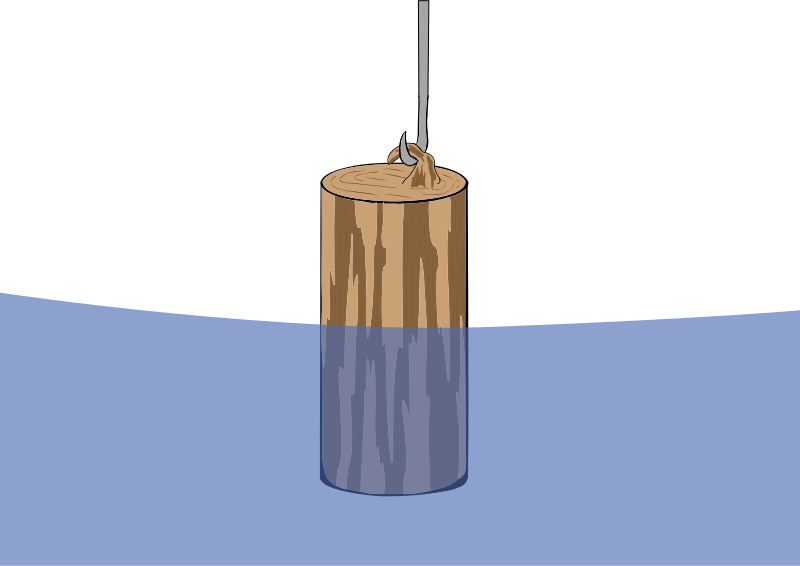
The captain of a ship sees a big cylindrical wooden log with a diameter of 40 cm floating in the sea, and he wants to remove it from the water. He gives the order to his sailors, who estimate that the height of the log section above water is about 1.5 m. They decide to try and pull it up with a small hook. When they manage to catch it, they pull it from the water so that the visible part is now twice as large as before, but some of the cylinder-shaped log is still submerged.
a) What are the full dimensions of the wooden log?
b) How much force does the hook manage to exert on the log?
Consider that the density of the seawater is 1030 kg/m\(^3\) and the density of wood is 670 kg/m\(^3\).
a) Use Newton’s second law to relate the buoyant force and the weight of the object. Express the mass in terms of the density and the volume to get the dimensions.
b) With Newton’s second law as in a) but with one extra force. The area can be expressed in terms of the area, and the force of the hook will be obtained.
a) The buoyant force is:
\begin{equation*}
F_B = \rho_f V_s g.
\end{equation*}
By Newton’s second law we get:
\begin{equation*}
F_B – mg=0.
\end{equation*}
The mass \(m\) can be expressed in terms of the volume \(V_T = AL\). The submerged volume \(V_s = A(L-\ell )\). With the volumes in the last equation we can solve for \(L\) to get:
\begin{equation*}
L=\frac{\rho_f\ell}{\rho_f-\rho_c},
\end{equation*}
or with numerical values:
\begin{equation}
L=4.3 \, \text{m}.
\end{equation}
b) Using Newton’s second law again we have:
\begin{equation}
F_B + F_h – mg =0,
\end{equation}
where the buoyant force is related with a volume \(V_s’ = A(L-2\ell)\). Since the area is \(A = \pi \left( \frac{d}{2} \right)^2 \), then we can solve for \(F_h\) we get:
\begin{equation*}
F_h=(\rho_cL-\rho_f(L-2\ell))\pi\frac{d^2}{4}g,
\end{equation*}
or with numerical values:
\begin{equation*}
F_h \approx 1900 \, \text{N}.
\end{equation*}
For a more detailed explanation of any of these steps, click on “Detailed Solution”.
a) To approach the first part of the problem, we will have to find the total length \(L\) of the cylinder. In order to do that, we’ll first examine which forces act on the cylinder before the sailors pull it up and from the water. Second, we’ll find an expression for the total volume and submerged volume in terms of \(L\) and the density of the material from which the cylinder is made. Let’s start by making a force diagram for the first situation, where we will use a coordinate system with Y pointing upwards and X pointing to the right.

Figure 1: Wooden log partially submerged in equilibrium. We place the coordinate system such that the Y-axis points upwards. The forces exerted on the log are shown: the buoyant force \(\vec{F}_B\) and the weight \(\vec{W}\).
In the force diagram (figure 1), we identify two forces: the weight \( \vec{W}\) pointing in the same direction as gravity and the buoyancy force \( \vec{F}_B\) exerted by the sea water in the upward direction. Because, at first, the cylinder is neither sinking nor going upwards, it has no acceleration. Therefore, we can write Newton’s second law as
\begin{equation}
\label{eq:newton1}
\sum \vec{F}=m\vec{a},
\end{equation}
and take \( \vec{a}=\vec{0}\) to obtain
\begin{equation}
\label{eq:newton2}
\sum \vec{F}=\vec{0}.
\end{equation}
Since we only have two forces, we can make the sum of the left-hand side of equation \eqref{eq:newton2} to obtain
\begin{equation}
\label{eq:newton3}
-W\,\hat{\textbf{j}}+F_B\,\hat{\textbf{j}}=\vec{0},
\end{equation}
where we know that the direction of the weight \(W\) is downwards while the direction of the bouyancy force \(F_B\) is upwards in the \(Y\) axis.
We can now write down explicitly the expression for the weight
\begin{equation}
\label{eq:peso}
W=mg,
\end{equation}
where \(m\) is the total mass of the cylinder and \(g\) is the gravitational constant of Earth. The minus sign comes from the fact that the weight is directed in the negative direction of our \(Y\) axis. Putting the expression of equation \eqref{eq:peso} into equation \eqref{eq:newton3}, we obtain
\begin{equation}
\label{eq:newton4}
-mg\,\hat{\textbf{j}}+F_B\hat{\textbf{j}}=\vec{0}.
\end{equation}
We can also write the explicit expression for the buoyancy force as
\begin{equation}
\label{eq:fb}
F_B=\rho_f V_{s} g,
\end{equation}
where \(\rho_f\) is the density of the fluid, in this case sea water, \(V_s\) is the volume of the cylinder that is submerged and \(g\) is the gravitational constant on Earth. Using equation \eqref{eq:fb} in equation \eqref{eq:newton4}, we can write
\begin{equation}
\label{eq:newton5}
-mg\,\hat{\textbf{j}}+\rho_f V_{s} g\,\hat{\textbf{j}}=\vec{0},
\end{equation}
or focusing just on the magnitudes
\begin{equation}
\label{eq:newton6}
-mg+\rho_fV_sg=0.
\end{equation}
Now we are interested in finding the full dimensions of the cylinder. We already know its diameter but need to find its total length \(L\). Thus, we will have to find a relation between the mass \(m\) of the cylinder and its volume \(V\). The physical quantity that relates such variables is the density \(\rho\), defined as
\begin{equation}
\label{eq:density}
\rho=\frac{m}{V}.
\end{equation}
Solving for \(m\) we have for the cylinder
\begin{equation}
\label{eq:mass}
m=\rho_c V_T,
\end{equation}
where \(\rho_c\) is the density of the material that the cylinder is made of and \(V_T\) is the total volume of the cylinder. Using \eqref{eq:mass} in \eqref{eq:newton6}, we obtain
\begin{equation}
\label{eq:newton7}
-\rho_cV_Tg+\rho_fV_sg=0.
\end{equation}
Furthermore, let’s write the volumes \(V_s\) and \(V_T\) in term of the transverse area and height for a cylinder
\begin{equation}
\label{eq:volcyl}
V=Ah,
\end{equation}
where \(A\) is the transverse area, which is circular, and \(h\) is its height. Applying equation \eqref{eq:volcyl} to calculate the total volume, we obtain
\begin{equation}
\label{eq:vt}
V_T=AL.
\end{equation}
Now applying \eqref{eq:volcyl} to calculate the submerged volume \(V_s\), we get
\begin{equation}
\label{eq:vs}
V_s=A(L-\ell),
\end{equation}
where \((L-\ell)\) with \(\ell=1.5\,\text{m}\) is the height corresponding to the submerged portion of the cylinder. Using the results of equations \eqref{eq:vt} and \eqref{eq:vs} into equation \eqref{eq:newton7}, we can write
\begin{equation}
\label{eq:newton8}
-\rho_c ALg+\rho_fA(L-\ell)g=0.
\end{equation}
Taking the negative term to the right side of the equation, we get
\begin{equation}
\label{eq:newton9}
\rho_f A(L-\ell)g=\rho_cALg,
\end{equation}
where we can cancel out \(A\) and \(g\), thus we arrive to the following expression
\begin{equation}
\label{eq:newton10}
\rho_f(L-\ell)=\rho_cL,
\end{equation}
which is our first expression in terms of the unknown variable of the problem: the total length \(L\). Expanding the parenthesis on the left-hand side of equation \eqref{eq:newton10}, we have
\begin{equation}
\label{eq:newton10.1}
\rho_fL-\rho_f\ell=\rho_cL.
\end{equation}
Now we can put on the left-hand side the terms that contain \(L\) and on the right-hand side the terms that do not. We get from equation \eqref{eq:newton10.1}
\begin{equation}
\rho_fL-\rho_cL=\rho_f\ell,
\end{equation}
where we can factorize on the left-hand side the unknown \(L\)
\begin{equation}
\label{eq:newton10.2}
(\rho_f-\rho_c)L=\rho_f\ell,
\end{equation}
and solve for \(L\) to obtain
\begin{equation}
L=\frac{\rho_f\ell}{\rho_f-\rho_c}.
\end{equation}
Inserting the numerical values given, we have
\begin{equation}
L=\frac{(1030\, \text{kg}/\text{m}^3)(1.5\,\text{m})}{(1030\, \text{kg}/\text{m}^3)-(670\, \text{kg}/\text{m}^3)}=4.3\,\text{m}.
\end{equation}
b) For the last part of the problem, we need to find the force that the hook exerts on the cylinder. We’ll perform the exact same analysis as before, but now the sailors have partially lifted the cylinder from the seawater Let’s start again by examining the force diagram, where we will have to include an additional force due to the hook.

Figure 2: Wooden log partially submerged in equilibrium with an additional force exerted by a hook. We place the coordinate system such that the Y-axis points upwards. The forces exerted on the log are shown: the buoyant force \(\vec{F}_B\), the force exerted upwards by the hook \(\vec{F}_h\), and the weight \(\vec{W}\).
Since, in this second situation, the cylinder is static, its acceleration is zero \(\vec{a}=0\); thus, we can write again
\begin{equation}
\label{eq:newton11}
\sum \vec{F}=\vec{0}.
\end{equation}
Now we that have three forces, we can make the sum of the left-hand side of equation \eqref{eq:newton11} to obtain
\begin{equation}
\label{eq:newton12}
-W\,\hat{\textbf{j}}+F_B\,\hat{\textbf{j}}+F_h\,\hat{\textbf{j}}=\vec{0}.
\end{equation}
where \(\vec{F}_h\) is the force exerted by the hook pulling the cylinder up. The expression for the weight is the same as in \eqref{eq:peso} because this force only depends on the mass of the cylinder, which has not changed.
Putting the expression of equation \eqref{eq:peso} into equation \eqref{eq:newton12}, we obtain
\begin{equation}
\label{eq:newton13}
-mg\,\hat{\textbf{j}}+F_B\,\hat{\textbf{j}}+F_h\,\hat{\textbf{j}}=\vec{0}.
\end{equation}
The expression for the buoyancy force is the same as in equation \eqref{eq:fb}, the only thing that has changed is the submerged volume. The new submerged volume will be denoted by \(V_{s’}\). Using equation \eqref{eq:fb} in equation \eqref{eq:newton13}, we can write
\begin{equation}
\label{eq:newton14}
-mg\,\hat{\textbf{j}}+\rho_f V_{s’} g\,\hat{\textbf{j}}+F_h\,\hat{\textbf{j}}=\vec{0}.
\end{equation}
Now we turn our attention to the force \(\vec{F}_h\). We know that the maximum force is \(100\,N\), and when it is applied the length of the exposed part is doubled. Focusing just on the magnitude of equation \eqref{eq:newton14}, we have
\begin{equation}
\label{eq:newton15}
-mg+\rho_fV_{s’}g+F_h=0.
\end{equation}
Once again, we use \eqref{eq:mass} in \eqref{eq:newton15} to write
\begin{equation}
\label{eq:newton16}
-\rho_cV_Tg+\rho_fV_{s’}g+F_h=0.
\end{equation}
The total volume of the cylinder does not change, thus we can use equation \eqref{eq:vt} again, but the submerged volume does change; so, we must use equation \eqref{eq:volcyl} to calculate the new submerged volume
\begin{equation}
\label{eq:vs2}
V_{s’}=A(L-2\ell),
\end{equation}
where \((L-2\ell)\), with \(2\ell=3\,\text{m}\), is the new height corresponding to the submerged portion of the cylinder. Using the results of equations \eqref{eq:vt} and \eqref{eq:vs2} into equation \eqref{eq:newton16}, we can write
\begin{equation}
\label{eq:newton17}
-\rho_c ALg+\rho_fA(L-2\ell)g+F_h=0,
\end{equation}
where we can solve for \(F_h\) by taking the first two terms in \eqref{eq:newton17} to the right-hand side. Then,
\begin{equation}
F_h=\rho_c ALg-\rho_fA(L-2\ell)g,
\end{equation}
where we can factorize the common variables in both terms, \(A\) and \(g\)
\begin{equation}
\label{eq:newton18}
F_h=(\rho_cL-\rho_f(L-2\ell))Ag.
\end{equation}
The only thing we have not calculated so far is the transverse area \(A\), which for a cylinder is a circle; thus,
\begin{equation}
\label{eq:area}
A=\pi\left(\frac{d}{2}\right)^2=\pi\frac{d^2}{4},
\end{equation}
where \(d\) is the diameter of the cylinder. Using \eqref{eq:area} in \eqref{eq:newton18}, we finally get
\begin{equation}
\label{eq:newton19}
F_h=(\rho_cL-\rho_f(L-2\ell))\pi\frac{d^2}{4}g.
\end{equation}
Replacing the variables by their numerical values, we can calculate \(F_h\) to be
\begin{equation}
F_h=((670\,\text{kg}/\text{m}^3) (4.3\,\text{m})-(1030\,\text{kg}/\text{m}^3)(4.3\,\text{m}-3\,\text{m}))\pi \frac{(0.4\,\text{m})^2}{4}(9.8\,\text{m}/\text{s}^2),
\end{equation}
\begin{equation}
F_h\approx1900\,N.
\end{equation}


Leave A Comment