
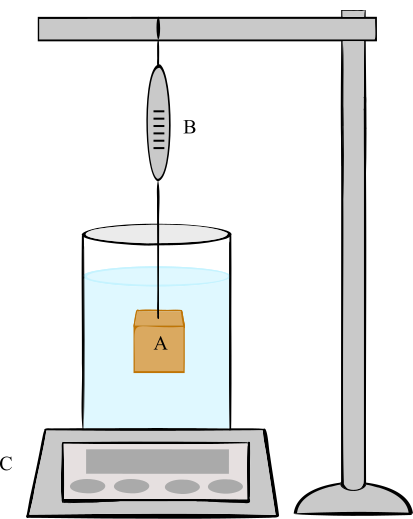
A block (A in the figure) has a volume of \(4000 \, \text{cm}^3\) and hangs by a very thin wire from a scale (B). The block is immersed in a container with a certain liquid. The joint mass of the liquid and the container is 3.8 kg. Scales B and C display 2 kg and 8.9 kg, respectively.
a) Find the density of the fluid.
b) What is the real mass of block A?
a) Use Newton’s Second Law to relate the forces in the problem.
b) Using the obtained relations, solve for the mass \(m_A\).
a) The buoyant force is:
\begin{equation*}
\vec{F}_B = \rho_f V_{\text{sub}} g,
\end{equation*}
Newton’s second law on the block is:
\begin{equation*}
T + F_B – m_A g = 0.
\end{equation*}
For the fluid and recipient we have:
\begin{equation*}
N – F_B – m_F g = 0.
\end{equation*}
Since \(T = m_B g\) and \(N = m_C g \), combining both equations and solving for the density \(\rho_f\) we get:
\begin{equation*}
\rho_f=\frac{m_C-m_f}{V},
\end{equation*}
or with numerical values:
\begin{equation*}
\rho_f= 1275 \, \text{kg/m}^3.
\end{equation*}
b) With Newton’s second law for the block is:
\begin{equation*}
m_Bg+\rho_fVg -m_A g=0.
\end{equation*}
Solving for \(m_A\) we get:
\begin{equation*}
m_A = m_B+\rho_fV,
\end{equation*}
or with numerical values:
\begin{equation*}
m_A = 2.51 \, \text{kg}.
\end{equation*}
For a more detailed explanation of any of these steps, click on “Detailed Solution”.
a) We need to find the density of the liquid. To approach the solution of this problem, we will examine the forces exerted on block A and on the liquid+container. Then, we will use Archimedes’ principle to evaluate the buoyancy force and solve for the unknowns.
First, let’s identify the forces exerted on the block. We have the weight \(\vec{W}\), the tension from scale B \(\vec{T}\), and the buoyancy force \(\vec{F}_B\), as seen in the free-body diagram in figure 1.
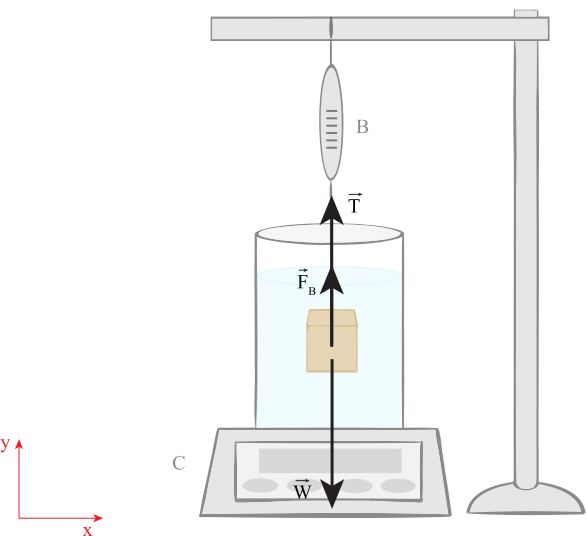
Figure 1: Block totally submerged in equilibrium. We place the coordinate system such that the Y axis points upwards. The forces exerted on the block are shown: the buoyant force \(\vec{F}_B\), the tension \(\vec{T}\), and the weight \(\vec{W}\).
For the fluid+container, we have the weight \(\vec{W}_f\), the contact force with the scale C \(\vec{N}\), and, from Newton’s third law, the buoyancy force exerted by the block on the fluid. It has the same magnitude as \(\vec{F}_B\), but it has the opposite direction, as seen in the figure 2.

Figure 2: Free-body diagram for the fluid and recipient. We place the coordinate system such that the Y axis points upwards. The forces exerted on the fluid are shown: the buoyant force \(\vec{F}_B\), the contact force with the balance C \(\vec{N}\), and the weight \(\vec{W}_f\).
Now we can apply Newton’s second law to both (block and fluid+container). Newton’s second law in the static case (in the case that the acceleration \(\vec{a}\) is zero) is
\begin{equation}
\sum \vec{F}=m\vec{a},
\end{equation}
\begin{equation}
\label{newton}
\sum \vec{F}=\vec{0},
\end{equation}
where \(m\) is the mass of the object, we are analyzing and \(\sum \vec{F}\) is the sum of all forces exerted on that object.
For the block, equation \eqref{newton} reads:
\begin{equation}
\label{newtonblock}
\vec{W}+\vec{T}+\vec{F}_B=\vec{0}.
\end{equation}
For the fluid+container equation \eqref{newton} can be written as
\begin{equation}
\label{newtonfc}
\vec{W}_f+\vec{N}+\vec{F}_B’=\vec{0},
\end{equation}
where \(\vec{F}_B’\) has the same magnitude as the buoyant force \(\vec{F}_B\) but with opposite direction.
The weight in both cases is directed in the negative Y axis and has magnitude \(mg\) where \(m\) is the mass of the object and \(g\) the gravitational acceleration. Explicitly,
\begin{equation}
\label{weightblock}
\vec{W}=-m_Ag\,\hat{\textbf{j}},
\end{equation}
where \(m_A\) is the mass of block A. For the fluid+container
\begin{equation}
\label{weightfc}
\vec{W}_f=-m_f g\,\hat{\textbf{j}},
\end{equation}
where \(m_f\) is the joint mass of fluid+container.
For the buoyant force we use Archimedes’ principle to write
\begin{equation}
\label{buo}
\vec{F}_B=\rho_{f}V_{\text{sub}}g\,\hat{\textbf{j}},
\end{equation}
where \(\rho_f\) is the density of the fluid and \(V_{\text{sub}}\) is the volume submerged in the fluid, in this case the whole volume \(V\), as seen in the first figure. Therefore, because of Newton’s third law, the force \(\vec{F}_B’\) is
\begin{equation}
\label{buop}
\vec{F}_{B}’=-\rho_fV_{\text{sub}}g\,\hat{\textbf{j}}.
\end{equation}
To find the tension \(\vec{T}\) exerted by scale B, we must multiply the apparent mass that can be read on the scale by the gravitational constant, namely
\begin{equation}
\label{tension}
\vec{T}=m_Bg\,\hat{\textbf{j}},
\end{equation}
where \(m_B\) is the mass reported in scale B.
An expression for \(\vec{N}\) can be found in a similar manner, multiplying the value of the mass reported by the scale \(m_C\) by the gravitational acceleration \(g\), explicitly
\begin{equation}
\label{normal}
\vec{N}=m_Cg\,\hat{\textbf{j}}.
\end{equation}
Using the explicit results for the forces of equations \eqref{weightblock}, \eqref{buo}, and \eqref{tension} into equation \eqref{newtonblock}, we obtain
\begin{equation}
-m_Ag\,\hat{\textbf{j}}+m_Bg\,\hat{\textbf{j}}+\rho_f Vg\,\hat{\textbf{j}}=\vec{0},
\end{equation}
where we notice that all forces are along the Y axis, then we can omit the vector notation and write
\begin{equation}
\label{newtonblock2}
-m_Ag+m_Bg+\rho_fVg=0.
\end{equation}
Using the result for the forces exerted on the fluid+container given by equations \eqref{weightfc}, \eqref{buop} and \eqref{normal} into equation \eqref{newtonfc}, we obtain
\begin{equation}
-m_fg\,\hat{\textbf{j}}+m_Cg\,\hat{\textbf{j}}+\rho_fVg\,\hat{\textbf{j}}=\vec{0},
\end{equation}
where we can omit the vector notation since all forces are exerted along the same axis, thus
\begin{equation}
\label{newtonfc2}
-m_fg+m_Cg-\rho_fVg=0.
\end{equation}
The density of the fluid can be solved from equation \eqref{newtonfc2} as
\begin{equation}
\rho_f=\frac{m_Cg-m_fg}{Vg},
\end{equation}
where we can cancel out the term \(g\) in the numerator and denominator to obtain
\begin{equation}
\rho_f=\frac{m_C-m_f}{V}.
\end{equation}
Using the numerical values in SI units (\(V=4\times 10^{-3}\,\text{m}^3.\)), we get
\begin{equation}
\rho_f=\frac{8.9\,\text{kg}-3.8\,\text{kg}}{4\times10^{-3}\,\text{m}^3},
\end{equation}
\begin{equation}
\rho_f=1275\,\text{kg/m}^3.
\end{equation}
b) The real mass of block A \(m_A\) can be calculated from equation \eqref{newtonblock2} as
\begin{equation}
m_A=\frac{m_Bg+\rho_f Vg}{g},
\end{equation}
where we can simplify the term \(g\) to write
\begin{equation}
m_A=m_B+\rho_fV.
\end{equation}
Using the numerical values in SI units, we obtain
\begin{equation}
m_A=2\,\text{kg}+(1275\,\text{kg/m}^3)(4\times 10^{-4}\,\text{m}^3),
\end{equation}
\begin{equation}
m_A=2.51\,\text{kg}.
\end{equation}


Leave A Comment