

Marie took her family on holiday, and is skiing with her daughter named Eve. Marie has a mass of 64 kg, and they are holding a rope that prevents Eve from straying too far, as illustrated in the figure. While skiing downhill, Eve accelerates at \(2\,\text{m}/\text{s}^2\) while the rope is held taught. The coefficient of kinetic friction between Marie’s skis and the snow is 0.7, the coefficient of kinetic friction between Eve’s skis and the snow is 0.4, and the slope is 40º relative to the flat ground at the base of the mountain..
a) What is Eve’s mass?
b) What is the force of tension in the rope?
a) The free body diagrams for Eve and Maria should include tension and frictional forces. Note that the direction of their motion will coincide with the direction of their acceleration which is related to the net force. Write the equations for Newton’s Second Law, and combine the equations to solve for the answer.
b) The equations obtained in part (a) can be solved to obtain the tension.
a) Newton’s Second Law, written in terms of the \({y-}\)direction for both Maria and Eve is:
\begin{equation*}
N-mg\cos\theta =0.
\end{equation*}
Newton’s Second Law, written in terms of the \({x-}\)direction for Eve gives us:
\begin{equation*}
m_e g \sin \theta – f_{r_e}-T = m_e a,
\end{equation*}
and for Maria:
\begin{equation*}
T + m_m g \sin \theta – f_{r_m} = m_m a,
\end{equation*}
Combining these equations, remembering that \(f_r = \mu N\), solving for \(m_e\), and using some algebra, we get:
\begin{equation*}
m_e = \frac{m_m a_{e_x} – m_m g \sin \theta + \mu_m m_m g \cos \theta}{g \sin \theta – \mu_e g \cos \theta – a_{e_x}},
\end{equation*}
which, with numerical values, is:
\begin{equation*}
m_e = 47.2 \, \text{kg}.
\end{equation*}
b) We do not need to solve for \(m_e\) because it was already found in part (a). We can therefore substitute the value in the equation relating the \({x-}\)components for either Eve or Maria to get:
\begin{equation*}
T_e = 61.2 \, \text{N}.
\end{equation*}
For a more detailed explanation of any of these steps, click on “Detailed Solution”.
a) In order to find Eve’s mass, we need to relate her mass to her acceleration, which we already know. From Newton’s Second Law, we know that the total force is proportional to the mass times the acceleration, so the key to finding Eve’s mass comes down to finding the total force acting on her.
Let’s start by making a force diagram for each of them, using a coordinate system where the X-axis is parallel to the direction of motion (parallel to the slope), as it is common with inclined plane problems.
Figure 1: We choose the coordinate system with the X axis parallel to the mountain and in the direction of motion of Maria and Eve. The Yaxis is perpendicular to the mountain surface.
For the diagram, we need to identify the forces. There are two forces along Y over Eve: the normal force produced by the snow (in the positive Y-direction), and the Y-component of the weight (in the negative direction). In X, there are three forces on Eve, the tension, that goes in the negative X-direction (because the rope pulls her towards her mom), the friction that also goes on the negative X-direction, and the X-component of the weight, which is positive. So, the force diagram for Eve is shown in figure 2.
Figure 2: Force diagram for Eve. The forces shown are: the contact force \(N_e\), the weight \(W_e\), the tension \(T_e\), and the friction \(f_{re}\). The weight is decomposed along it X and Y components using the angle of inclination of the mountain \(\theta\).
There are two forces along Y over Marie: the normal force produced by the snow, and the Y-component of the weight, that points in the negative Y-direction. Along X, there are three forces: the X-component of the weight, that points in the positive X direction, the friction produced by the snow, which is negative in X, and the tension produced by the rope, that points in the positive X-direction (the tension pulls Marie towards her daughter). Hence, the force diagram for Marie is shown in figure 3.
Figure 3: Force diagram for Eve. The forces shown are: the contact force \(N_m\), the weight \(W_m\), the tension \(T_m\), and the friction \(f_{rm}\). The weight is decomposed along it X and Y components using the angle of inclination of the mountain \(\theta\).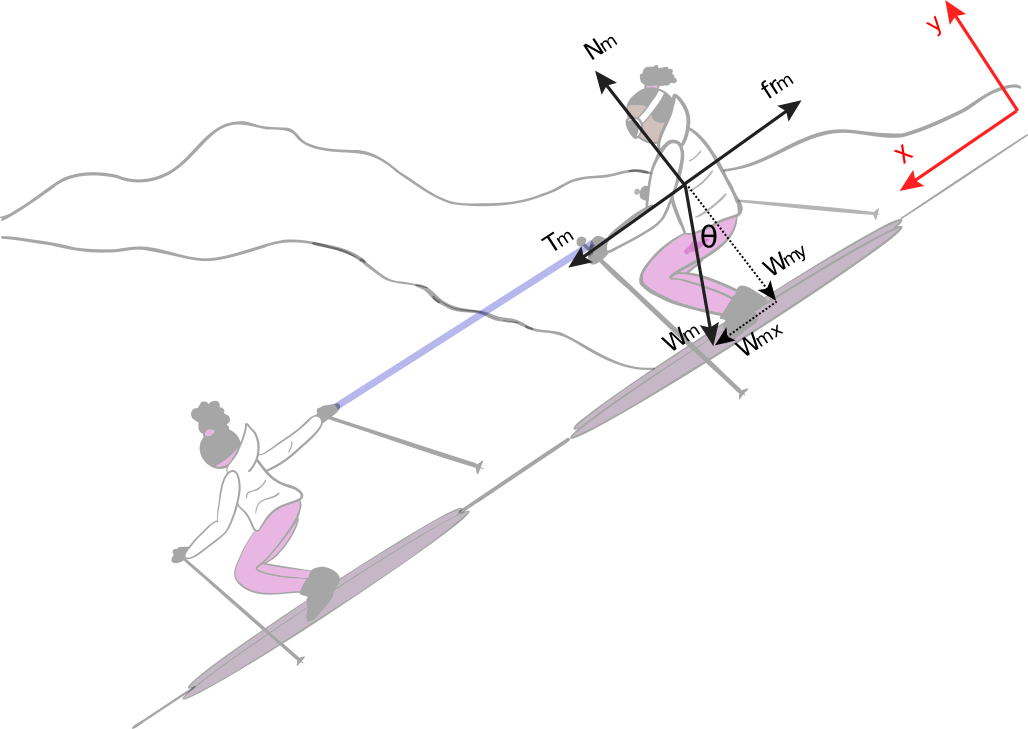
Now that we have the force diagram for Eve and Marie, we can easily write the force equations in X and Y for both of them. Let’s start with the force equations for Eve in X. From the force diagram, it is clear that this equation is
\begin{equation}
W_{e_x} \, \hat{\textbf{i}} – f_{r_e} \, \hat{\textbf{i}} – T_e \, \hat{\textbf{i}}= m_e a_{e_x} \, \hat{\textbf{i}},
\end{equation}
where the subscript ‘e’ in all the terms helps us remember that we are talking of variables over Eve. From the force diagram it is clear that \(W_{e_x}=W_e \sin \theta\), and since \(W_e=m_e g\), we then get
\begin{equation}
\label{EveMarie_fuerzasXEve}
{(m_e g \sin \theta)} \, \hat{\textbf{i}} – f_{r_e} \, \hat{\textbf{i}} – T_e \,\hat{\textbf{i}} = m_e a_{e_x} \, \hat{\textbf{i}}.
\end{equation}
Thus, the mass that we are looking for appears in two terms of this equation. In order to find it, we need to find \(f_{r_e}\) and \(T_e\). The magnitude of the kinetic friction is \(\mu_e N_e\) (\(N_e\) is the normal force over Eve), and so we can write equation \eqref{EveMarie_fuerzasXEve} as
\begin{equation}
\label{EveMarie_fuerzasXEve2}
m_e g \sin \theta \, \hat{\textbf{i}} – {(\mu_e N_e)} \, \hat{\textbf{i}} – T_e \, \hat{\textbf{i}}= m_e a_{e_x} \, \hat{\textbf{i}}.
\end{equation}
Now, to find \(N_e\), we need to use Newton’s Second Law along Y. From the force diagram, we get the following force equation
\begin{equation}
N_e \, \hat{\textbf{j}} – W_{e_y} \, \hat{\textbf{j}} = m_e a_{e_y} \, \hat{\textbf{j}}.
\end{equation}
But there is no acceleration along Y, so we get
\begin{equation}
N_e \, \hat{\textbf{j}} – W_{e_y} \, \hat{\textbf{j}} = 0 \, \hat{\textbf{j}}.
\end{equation}
If we move the weight term to the other side, and focus only on the magnitudes, we get
\begin{equation}
N_e=W_{e_y}.
\end{equation}
Finally, let’s use that \(W_{e_y} = W_e \cos \theta\), and \(W_e=m_eg\):
\begin{equation}
N_e = (m_e g \cos \theta).
\end{equation}
We can then use this result in equation \eqref{EveMarie_fuerzasXEve2} to get
\begin{equation}
\label{EveMarie_fuerzasXEveTodo}
m_e g \sin \theta \, \hat{\textbf{i}} – \mu_e {( m_e g \cos \theta)} \, \hat{\textbf{i}} – T_e \, \hat{\textbf{i}}= m_e a_{e_x} \, \hat{\textbf{i}}.
\end{equation}
So, the only variable we still need to find in order to obtain \(m_e\) from this equation is \(T_e\). Since there are no more force equations for Eve, we will have to find \(T_e\) from the equations on Marie.
From the force diagram, we can see that the forces along X for Marie give us
\begin{equation}
T_m \, \hat{\textbf{i}} + W_{m_x} \, \hat{\textbf{i}} – f_{r_m} \, \hat{\textbf{i}}= m_m a_{m_x} \, \hat{\textbf{i}}.
\label{EveMarie_fuerzasXMarie}
\end{equation}
As for the case of Eve, we know that \(W_{m_x}=m_m g \sin \theta\) and \(f_{r_m}= \mu_m N_m\) (where \(\mu_m\) is the coefficient of kinetic friction for Marie and \(N_m\) is the normal force over her). Thus, equation \eqref{EveMarie_fuerzasXMarie} becomes
\begin{equation}
T_m \, \hat{\textbf{i}} + {(m_m g \sin \theta)} \, \hat{\textbf{i}} – {(\mu_m N_m)} \, \hat{\textbf{i}}= m_m a_{m_x} \, \hat{\textbf{i}}.
\label{EveMarie_fuerzasXMarieReemp}
\end{equation}
As before, let’s find \(N_m\) by using the equations along Y.
\begin{equation}
N_m \, \hat{\textbf{j}} – W_{m_y} \, \hat{\textbf{j}} = m_m a_{m_y} \, \hat{\textbf{j}}
\end{equation}
Again, there is no acceleration in Y, and \(W_m=m_m g \cos \theta\). So, we get
\begin{equation}
N_m \, \hat{\textbf{j}} – {(m_m g \cos \theta)} \, \hat{\textbf{j}} = 0 \, \hat{\textbf{j}}.
\end{equation}
If we focus on the magnitudes and rearrange the equation, we get
\begin{equation}
N_m = m_m g \cos \theta.
\end{equation}
So, we can use this term on equation \eqref{EveMarie_fuerzasXMarieReemp}:
\begin{equation}
T_m \, \hat{\textbf{i}} + m_m g \sin \theta \, \hat{\textbf{i}} – \mu_m {(m_m g \cos \theta)} \, \hat{\textbf{i}}= m_m a_{m_x} \, \hat{\textbf{i}}.
\end{equation}
Now, remember that we need to find \(T_e\). To do so, we now use that the magnitude of the tension that a rope (which we assume to be ideal) produces on its two endpoints is the exact same. This means that the magnitude of the tension the rope makes on Marie’s hands is the same as the magnitude of the tension the rope makes on Eve’s hands (the direction of this tension is not the same because Marie is pulled in the positive X direction and Eve in the negative X direction). Thus, \(T_e=T_m\) and so we get:
\begin{equation}
{(T_e)} \, \hat{\textbf{i}} + m_m g \sin \theta \, \hat{\textbf{i}} – \mu_m m_m g \cos \theta \, \hat{\textbf{i}}= m_m a_{m_x} \, \hat{\textbf{i}}.
\label{EveMarie_fuerzasXMarieTodo}
\end{equation}
Also, since the rope is tensed, the magnitude of the acceleration of its two endpoints is the same. Thus, the magnitude of Marie’s acceleration must be the same as the magnitude of Eve’s acceleration (since both are holding the endpoints of the rope). Then, \(a_{m_x}=a_{e_x}\). So equation \eqref{EveMarie_fuerzasXMarieTodo} becomes:
\begin{equation}
T_e \, \hat{\textbf{i}} + m_m g \sin \theta \, \hat{\textbf{i}} – \mu_m m_m g \cos \theta \, \hat{\textbf{i}}= m_m {(a_{e_x})}\, \hat{\textbf{i}}.
\end{equation}
We can now leave the \(T_e\) term on one side and move everything else to the other side. If we do that and focus on the magnitudes, we get
\begin{equation}
T_e = m_m a_{e_x} – m_m g \sin \theta + \mu_m m_m g \cos \theta.
\label{EveMarie_tension}
\end{equation}
So, we have found an expression for \(T_e\) in terms of known variables. Thus, we can replace this result in equation \eqref{EveMarie_fuerzasXEveTodo}:
\begin{equation}
\label{EveMarie_reemplazarTension}
m_e g \sin \theta \, \hat{\textbf{i}} – \mu_e m_e g \cos \theta \, \hat{\textbf{i}} – {(m_m a_{e_x} – m_m g \sin \theta + \mu_m m_m g \cos \theta)} \, \hat{\textbf{i}}= m_e a_{e_x} \, \hat{\textbf{i}}.
\end{equation}
Notice that we have found an equation where the only unknown variable is \(m_e\). To find \(m_e\), let’s move all the terms with \(m_e\) to the left side and the other ones to the right side, and let’s focus on the magnitudes only.
\begin{equation}
m_e g \sin \theta – \mu_e m_e g \cos \theta – m_e a_{e_x} = m_m a_{e_x} – m_m g \sin \theta + \mu_m m_m g \cos \theta.
\end{equation}
Then, we can factorize \(m_e\):
\begin{equation}
m_e( g \sin \theta – \mu_e g \cos \theta – a_{e_x} ) = m_m a_{e_x} – m_m g \sin \theta + \mu_m m_m g \cos \theta.
\end{equation}
And now we can divide by \(( g \sin \theta – \mu_e g \cos \theta – a_{e_x} )\):
\begin{equation}
m_e = \frac{m_m a_{e_x} – m_m g \sin \theta + \mu_m m_m g \cos \theta}{g \sin \theta – \mu_e g \cos \theta – a_{e_x}}.
\end{equation}
Finally, we insert the numerical values of the different variables:
\begin{equation}
m_e = \frac{{(64 \, \text{kg})} {(2 \, \text{m/s}^2)} – {(64 \, \text{kg})} {(9.8 \, \text{m/s}^2)} \sin {(40^\circ)} + {(0.7)} {(64 \, \text{kg})} {(9.8 \, \text{m/s}^2)} \cos {(40^\circ)}}{{(9.8 \, \text{m/s}^2)} \sin {(40^\circ)} – {(0.4)} {(9.8 \, \text{m/s}^2)} \cos {(40^\circ)} – {(2 \, \text{m/s}^2)}},
\end{equation}
to get
\begin{equation}
m_e = 47.2 \, \text{kg}.
\label{EveMarie_masaEve}
\end{equation}
(b) To find the tension that the rope exerts on Marie’s hands, we can simply use equation \eqref{EveMarie_tension}. Let’s insert the known numerical values there:
\begin{equation}
T_e = {(64 \, \text{kg})} {(2 \, \text{m/s}^2)} – {(64 \, \text{kg})} {(9.8 \, \text{m/s}^2)} \sin {(40^\circ)} + {(0.7)} {(64 \, \text{kg})} {(9.8 \, \text{m/s}^2)} \cos {(40^\circ)}.
\label{EveMarie_tensionResultado}
\end{equation}
The result is
\begin{equation}
T_e = 61.2 \, \text{N}.
\end{equation}

Poorly worded, if E’s acceleration is 2 m/s with tension on the rope, that implies that a(net) is 2 m/s. And a(net)=f(net)/m(net)… but that is not how the question was solved
Hi, thanks for your comment. Equation (2) is precisely what you say: the total acceleration times Eve’s mass equals the total force over Eve. So if you divide by Eve’s mass, you get that the total acceleration equals the total force over Eve’s mass, as you said. But this info is not sufficient to solve the problem, because you do not have the total force over Eve yet (you do not know the tension or the friction yet). This is why you need more equations, as it is explained in the solution. Please let us know if there still is something confusing (notice that the problem is asking for Eve’s mass, so the equation you wrote would not help unless you know F(net) )