
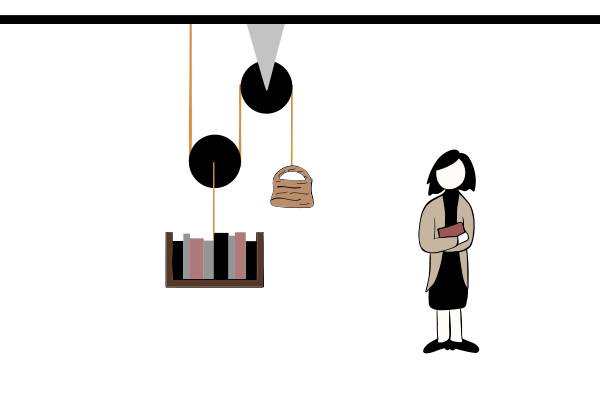
Vivian wants to lift her library from the ground using the pulley system shown in the figure, where she can change the mass inside the basket. One of the pulleys is attached to the roof while the other can move vertically. Both pulleys are considered ideal, that is, massless and frictionless. If the library has a mass of \(80\,\text{kg}\) and the basket a mass of \(2\,\text{kg}\), find:
a) The amount of mass that Vivian has to add to the basket such that the library could be static or move at a constant speed.
b) If Vivian moves the basket downwards a distance of \(1\,\text{m}\), in which direction and how much distance will the library move?
c) The amount of mass that Vivian has to add t the basket such that the library has an upwards acceleration of \(2\,\text{m/s}^2\).
a) Use Newton’s second law for equilibrium and solve for mass \(m_A\).
b) Define some distance variables to relate the length of the rope to them. Then, after equalling the initial and final state, it is possible to get a relation between the differences of the heights.
c) With the time derivative for the relation obtained in b), there will be a relation between the accelerations. By Newton’s second law and the recently found relation with the accelerations, solve for the mass \(m_A\).
a) Newton’s second law for an object moving at a constant speed can be written as:
\begin{equation*}
\sum \vec{F}=0.
\end{equation*}
For the library along the Y-axis we have:
\begin{equation*}
m_L g -2T =0,
\end{equation*}
and for the basket we have:
\begin{equation*}
(m_B+m_A)g -T =0.
\end{equation*}
Solving for \(m_A \) on the \(2 \times 2\) system of equations, we have:
\begin{equation*}
m_A=\frac{m_L}{2}-m_B.
\end{equation*}
Using the numerical values, we get our result:
\begin{equation*}
m_A=38\,\text{kg}.
\end{equation*}
b) Define distances for the pulley as:

The length of the rope for the initial position is:
\begin{equation*}
\ell=d+2y_{Li}+c_2+c_1+y_{Bi},
\end{equation*}
and for the final position is:
\begin{equation*}
\ell=d+2y_{Lf}+c_2+c_1+y_{Bf}.
\end{equation*}
Making those two expressions equal (since the length \(\ell \) is the same) and rearranging all the terms after some algebra we get:
\begin{equation*}
0=2(y_{Lf}-y_{Li})+(y_{Bf}-y_{Bi}),
\end{equation*}
where the differences can be written as deltas. Then, solving for one of the deltas we get:
\begin{equation*}
\Delta y_{L}=-\frac{\Delta y_{B}}{2}.
\end{equation*}
With numerical values, the result is:
\begin{equation*}
\Delta y_{L}=-0.5\,\text{m}.
\end{equation*}
c) Taking the derivative of the previous relation found we get:
\begin{equation*}
a_{By}=-2a_{Ly}.
\end{equation*}
Newton’s second law for the library is:
\begin{equation*}
m_L g – 2T = m_L a_{L_y},
\end{equation*}
and for the basket is:
\begin{equation*}
(m_B+m_A)g – T = (m_B + m_A) a_{B_j}.
\end{equation*}
Combining those expression we obtain:
\begin{equation*}
(m_B+m_A)g-\frac{m_L g}{2}+\frac{m_La_{Ly}}{2}=m_Ba_{By}+m_A a_{By}.
\end{equation*}
Solving for the mass \(m_A\) we get:
\begin{equation*}
m_{A}=\frac{-2m_B a_{Ly}+\frac{m_Lg}{2}-\frac{m_L a_{Ly}}{2}-m_{B}g}{g+2a_{Ly}},
\end{equation*}
or with numerical values:
\begin{equation*}
m_A\approx 79.4\,\text{kg}.
\end{equation*}
For a more detailed explanation of any of these steps, click on “Detailed Solution”.
a) To begin the problem we define our coordinate system as shown in the figure below, with the Y-axis positive along the downwards direction:

We will make the free body diagram of the basket and on the library+pulley system and then use Newton’s second law. Throughout the problem, we will use the fact that the pulleys are ideal, which means that the tension along the rope is constant in magnitude.
Let us begin by making the force diagram of the system library+moving-pulley as shown in figure 1.
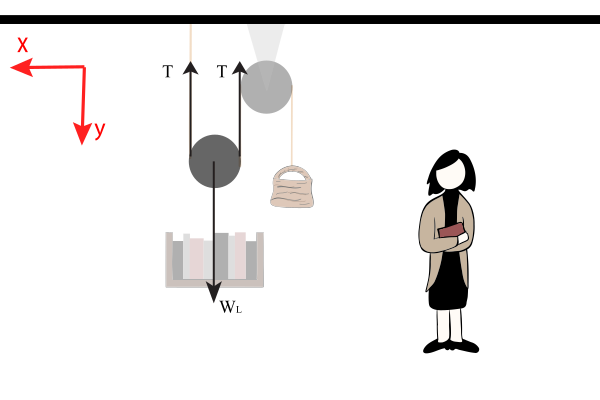
Figure 1: Free-body diagram for the library+pulley.
We can see that the forces present are the weight of the library \(\vec{W}_L\) and the tension \(\vec{T}\), which appears twice in the upwards direction because the rope acts twice on this system. Newton’s second law reads
\begin{equation}\label{n2l}
\sum \vec{F}=m\vec{a},
\end{equation}
where \(\sum \vec{F}\) is the sum of all forces exerted on the object of interest, \(m\) its mass and \(\vec{a}\) its acceleration. Notice that for the library+moving pulley system there are only forces along the Y-axis, thus we can write equation \eqref{n2l} for the Y-axis as
\begin{equation}\label{nl}
W_L\,\hat{\textbf{j}}-2T\,\hat{\textbf{j}}=m_{L}a_{Ly}\,\hat{\textbf{j}},
\end{equation}
where \(W_{L}\) is the magnitude of the weight, \(T\) is the magnitude of the tension, \(a_{Ly}\) is the acceleration of the library+moving pulley system along the Y-axis and \(m_{L}\) is the mass of the library. Notice that the signs coincide with our choice for the positive direction of our coordinate system.
The free-body diagram for the basket is shown in figure 2, where only the tension \(\vec{T}\) and the basket’s weight \(\vec{W}_B\) are the forces exerted on the basket.

Figure 2: Free-body diagram for the basket
Writing Newton’s second law (equation \eqref{n2l}) for the basket along the Y axis we obtain
\begin{equation}\label{nb}
W_{B}\,\hat{\textbf{j}}-T\,\hat{\textbf{j}}=(m_B+m_{A})a_{Bj}\,\hat{\textbf{j}},
\end{equation}
where \(W_{B}\) is the magnitude of the basket’s weight, \(m_B\) is the mass of the basket, \(m_A\) is the mass that must be added on the basket and \(a_{Bj}\) is the basket’s acceleration along the Y axis.
Because for this first part of the problem we want the library to move at constant speed, its acceleration must be zero \(a_{Ly}=0\), therefore we obtain from equation \eqref{nl} the following expression
\begin{equation}
W_{L}\,\hat{\textbf{j}}-2T\,\hat{\textbf{j}}=0\,\hat{\textbf{j}},
\end{equation}
where we can drop the unitary vector notation since all terms are along the same direction to obtain
\begin{equation}\label{T1}
W_{L}-2T=0.
\end{equation}
We know the mass of the library \(m_L\), hence, its weight is
\begin{equation}\label{weightL}
W_L=m_Lg,
\end{equation}
where \(g=9.8\,\text{m/s}^2\) is the gravitational acceleration on Earth. Using the expression given in \eqref{weightL} into equation \eqref{T1} we obtain
\begin{equation}
m_L g-2T=0,
\end{equation}
where we can solve for the unknown \(T\) to obtain
\begin{equation}\label{tension}
T=\frac{m_L g}{2}.
\end{equation}
This result for the tension will come in handy when solving for \(m_{A}\), the mass of the added weight in the basket in order for the library to move at constant speed or be static.
Because the library+moving pulley system is tied with the same rope as the basket, their movement will be intertwined. As we will see later in the problem, their acceleration and velocities will not be the same, nevertheless, if the acceleration of the library is zero, so is the acceleration of the basket, then \(a_B=0\). From this, equation \eqref{nb} reads
\begin{equation}
W_{B}\,\hat{\textbf{j}}-T\,\hat{\textbf{j}}=0\,\hat{\textbf{j}},
\end{equation}
where we can drop the unitary vector notation to obtain
\begin{equation}\label{t2}
W_{B}-T=0.
\end{equation}
The weight of the basket \(W_B\) must include the mass of the basket \(m_B\) and what is inside it \(m_{A}\), hence we can write the expression
\begin{equation}\label{weightB}
W_{B}=(m_B+m_A)g.
\end{equation}
We can use the expression for the weight given in equation \eqref{weightB} into equation \eqref{t2} to obtain
\begin{equation}
(m_B+m_A)g-T=0,
\end{equation}
which is equivalent to
\begin{equation}
(m_B+m_A)g=T.
\end{equation}
Using the expression for the tension \(T\) found in equation \eqref{tension} into the equation above we obtain
\begin{equation}
(m_B+m_A)g=\frac{m_Lg}{2}.
\end{equation}
Canceling out the term \(g\) we end up with
\begin{equation}
m_B+m_A=\frac{m_L}{2},
\end{equation}
where we can solve for \(m_A\) to get
\begin{equation}
m_A=\frac{m_L}{2}-m_B.
\end{equation}
Using the numerical values, we get our result
\begin{equation}
m_A=\frac{80\,\text{kg}}{2}-2\,\text{kg},
\end{equation}
\begin{equation}
m_A=38\,\text{kg}.
\end{equation}
Notice that \(m_A+m_B=38\,\text{kg}+2\,\text{kg}=40\,\text{kg}\) is half the weight of the library. This reduction in the mass necessary to reach equilibrium is a consequence of our use of a moving pulley.
b) If the basket is moved downwards the result in the library+moving pulley system will be that it moves upwards. This is because the rope is inextensible and can be verified by finding an expression that links the position of the basket \(y_{B}\) with that of the library+pulley system \(y_{L}\). Let us then write the extension of the rope \(\ell\) in terms of the variables \(y_{B}\), \(y_{L}\) and the constants \(d\), \(c_1\) and \(c_2\) as seen in figure 3.
Figure 3: Dimensions associated with the length of the rope.
Notice that \(d\) is constant because is the distance from the roof to the origin of our coordinate system, which does not move; \(c_1\) and \(c_2\) are also constant because they are half the perimeter of the static and moving pulley respectively. Therefore, the length of the rope is
\begin{equation}\label{ell}
\ell=d+2y_L+c_2+c_1+y_B,
\end{equation}
Notice that the position \(y_L\) appears two times in the expression, as a consequence of the rope acting on two different points in the library+moving pulley system. Equation \eqref{ell} must be valid for all values of \(y_{B}\) and \(y_{L}\). Thus we write equation \eqref{ell} in terms of initials and final positions, which will be indicated by the sub-index \(i\) and \(f\) respectively, explicitly
\begin{equation}\label{ell1}
\ell=d+2y_{Li}+c_2+c_1+y_{Bi},
\end{equation}
and
\begin{equation}\label{ell2}
\ell=d+2y_{Lf}+c_2+c_1+y_{Bf}.
\end{equation}
Because the length of the rope must be the same for the initial and final cases, then we can make the expression from \eqref{ell1} equal to that in expression \eqref{ell2}, hence
\begin{equation}\label{ell3}
d+2y_{Li}+c_2+c_1+y_{Bi}=d+2y_{Lf}+c_2+c_1+y_{Bf}.
\end{equation}
Canceling out the constant terms \(d\), \(c_1\) and \(c_2\) we obtain from the expression in \eqref{ell3}:
\begin{equation}
2y_{Li}+y_{Bi}=2y_{Lf}+y_{Bf}.
\end{equation}
The terms can be rearranged to obtain
\begin{equation}
0=2(y_{Lf}-y_{Li})+(y_{Bf}-y_{Bi}),
\end{equation}
which can be written in terms of the displacement of the basket \(\Delta y_{B}=y_{Bf}-y_{Bi}\) and the displacement of the library+moving pulley system \(\Delta y_{L}=y_{Lf}-y_{Li}\) as
\begin{equation}\label{ell4}
0=2\Delta y_{L}+\Delta y_{B}.
\end{equation}
From the prompt of this part of the problem, we know that the displacement of the basket is downwards (that is positive with respect to our coordinate system) and has a magnitude of \(1\,\text{m}\). Therefore we can solve for the displacement of the library+moving pulley system \(\Delta y_{L}\) from equation \eqref{ell4} to obtain
\begin{equation}
\Delta y_{L}=-\frac{\Delta y_{B}}{2}.
\end{equation}
Therefore, if the displacement of the basket is in the positive direction, the displacement of the library+moving pulley system will be along the negative direction (upwards according to our coordinate system). Moreover, the factor of \(\frac{1}{2}\) indicates that if the basket moves \(1\,\text{m}\) then the displacement of the library+moving pulley system will be
\begin{equation}
\Delta y_{L}=-\frac{1\,\text{m}}{2}=-0.5\,\text{m},
\end{equation}
so the library+moving pulley system moves upwards and half the distance as the basket.
c) Equation \eqref{ell} is known as a constrain in the physical system and not only affects, as we saw in the previous item, the position of the basket and library but also their velocities and acceleration. To find the relation for the velocities and acceleration let us take the derivative with respect to time of equation \eqref{ell}:
\begin{equation}\label{dt}
\frac{d\ell}{dt}=\frac{d(d+2y_L+c_2+c_1+y_B)}{dt}.
\end{equation}
Because \(\ell\), \(d\), \(c_1\) and \(c_2\) are constants, their derivatives with respect to time are zero, thus equation \eqref{dt} becomes
\begin{equation}\label{dt2}
0=2\frac{dy_{L}}{dt}+\frac{dy_{B}}{dt}.
\end{equation}
The instantaneous velocity of an object is the derivative of its position with respect to time, then equation \eqref{dt2} is equivalent to
\begin{equation}\label{dt3}
0=2v_{Ly}+v_{By},
\end{equation}
where \(v_{Ly}\) and \(v_{By}\) are the velocities along the Y axis of the library and of the basket respectively. Taking another derivative with respect to time of equation \eqref{dt3} we get
\begin{equation}\label{dt4}
0=2\frac{d v_{Ly}}{dt}+\frac{d v_{By}}{dt}.
\end{equation}
The instantaneous acceleration of an object is the derivative of its velocity with respect to time, then equation \eqref{dt4} is equivalent to
\begin{equation}\label{dt5}
0=2a_{Ly}+a_{By},
\end{equation}
where \(a_{L}\) and \(a_{B}\) are the acceleration along the Y axis of the library and of the basket respectively. Thus, we have found in expression \eqref{dt5} a relation between the acceleration of the library and the basket that we could use, along with Newton’s second law given in equations \eqref{nl} and \eqref{nb} to solve the unknowns.
Let us begin by solving from equation \eqref{dt5} for \(a_{By}\), which results in
\begin{equation}\label{ligadura}
a_{By}=-2a_{Ly}.
\end{equation}
We can solve for \(T\) in equation \eqref{nl} and get
\begin{equation}
2T\,\hat{\textbf{j}}=W_L\,\hat{\textbf{j}}-m_La_{Ly}\,\hat{\textbf{j}},
\end{equation}
and dividing both sides by \(2\)
\begin{equation}
T\,\hat{\textbf{j}}=\frac{W_{L}}{2}\,\hat{\textbf{j}}-\frac{m_La_{Ly}}{2}\,\hat{\textbf{j}}.
\end{equation}
Using this result for \(T\) in equation \eqref{nb} we get
\begin{equation}
W_{B}\,\hat{\textbf{j}}-\left(\frac{W_{L}}{2}\,\hat{\textbf{j}}-\frac{m_La_{Ly}}{2}\,\hat{\textbf{j}}\right)=(m_B+m_A)a_{By}\,\hat{\textbf{j}},
\end{equation}
which after dropping the vector notation and expanding the parenthesis becomes
\begin{equation}\label{desp}
W_B-\frac{W_L}{2}+\frac{m_La_{Ly}}{2}=m_Ba_{By}+m_A a_{By}.
\end{equation}
Using the expressions for the weight given by \eqref{weightL} and \eqref{weightB} the equation in \eqref{desp} transforms into
\begin{equation}\label{desp2}
(m_A+m_B)g-\frac{m_Lg}{2}+\frac{m_L a_{Ly}}{2}=m_A a_{By}+m_B a_{By}.
\end{equation}
Taking all the terms with \(m_A\) in \eqref{desp2} to the left side of the equation and the other terms to the right side of the equation we get
\begin{equation}
m_{A}(g-a_{By})=m_B a_{By}+\frac{m_L g}{2}-\frac{m_L a_{Ly}}{2}-m_{B}g.
\end{equation}
Using the expression for \(a_{By}\) given in equation \eqref{ligadura} in the expression above we obtain
\begin{equation}
m_{A}(g+2a_{Ly})=-2m_B a_{Ly}+\frac{m_Lg}{2}-\frac{m_L a_{Ly}}{2}-m_{B}g.
\end{equation}
Dividing both sides of the equation by \((g+2a_{Ly})\) we finally get
\begin{equation}
m_{A}=\frac{-2m_B a_{Ly}+\frac{m_Lg}{2}-\frac{m_L a_{Ly}}{2}-m_{B}g}{g+2a_{Ly}}.
\end{equation}
Using the numerical values with \(a_{Ly}=-2\,\text{m/s}^2\) (negative because of our coordinate system) we have that
\begin{equation}
m_A=\frac{-2(2\,\text{kg}) (-2\,\text{m/s}^2)+\frac{(80\,\text{kg})(9.8\,\text{m/s}^2)}{2}-\frac{(80\,\text{kg}) (-2\,\text{m/s}^2)}{2}-(2\,\text{kg})(9.8\,\text{m/s}^2)}{9.8\,\text{m/s}^2+2(-2\,\text{m/s}^2)},
\end{equation}
\begin{equation}
m_A\approx 79.4\,\text{kg}.
\end{equation}

Leave A Comment