

Colombia’s national sport is called Tejo, and it’s played by throwing a heavy metal disk onto a board full of clay (see the figure). The goal is for the disk to hit a small wick that sits in the center of the board. Players must throw the disk at a speed of 5 m/s at an angle of \(45^\circ \ to reach the wick that is located 30 cm above the ground. (Assume air resistance is negligible, and assume that the height of the throwing hand is 1 meter.)
(a) Find the horizontal distance between the throwing hand and the wick.
(b) Find the maximum height of the disk.
(c) Find the velocity of the disk just before it hits the wick.
(a) Use the equation of motion for Y to find the time that it takes the disk to reach the wick. Then use that time with the equation of motion in X (constant speed).
(b) With the equation of velocity, it is possible to find the time that it takes to reach the maximum height in terms of the initial velocity and the gravity. Then, you can use that time in the equation of motion to find the height.
(c) Use the time found in (a) to get the Y component of the final velocity. Since the X component of the velocity was already found, you have everything you need.
(a) The X component of the velocity is \(v_x = v \cos \theta \). Then, the horizontal distance is:
\begin{equation*}
d = v_x t = v \cos \theta \;t.
\end{equation*}
Since the Y component of the velocity is \(v_y = v \sin \theta\), the equation of motion becomes:
\begin{equation*}
y_f = y_i + v \sin \theta t – \frac{1}{2} g t^2.
\end{equation*}
Using these numerical values while solving for \(t\), we get:
\begin{equation*}
t = 0.88 \, \text{s}.
\end{equation*}
Finally, using this time in the equation of the horizontal distance, we get:
\begin{equation*}
d = 3.12 \, \text{m}.
\end{equation*}
(b) Using the equation for the Y velocity:
\begin{equation*}
\vec{v}_{f}=\vec{v}_{i} + \vec{a}t,
\end{equation*}
where \(v_f=0\) when it reaches the maximum height. Then, solving for \(t\) and using the time that we found in the equation of motion in Y, we get:
\begin{equation*}
y_f = 1.64 \, \text{m}.
\end{equation*}
(c) Using the time found in (a), we get:
\begin{equation*}
\vec{v}_{fy} =- 5.12 \, \text{m/s} \, \hat{\textbf{j}},
\end{equation*}
where the minus sign indicates that the speed is negative in Y because the disk is falling at that point. Then, finding the magnitude of the velocity, we get:
\begin{equation*}
v_f = \sqrt{ (v_{x})^2 + (v_{fy})^2 } = 6.21 \, \text{m/s}.
\end{equation*}
And the angle is:
\begin{equation*}
\tan \alpha = \frac{v_{fy}}{v_x}. \implies \alpha = 55.42^\circ.
\end{equation*}
For a more detailed explanation of any of these steps, click on “Detailed Solution”.
(a) In order to find the horizontal distance between the throwing hand and the wick, we need to relate this distance to the factors that we already know: the initial angle, the initial speed, the initial height, and the final height. We can find the relation between these components by using the horizontal and vertical equations of motion of the metal disk, which will follow a parabolic motion.
Let’s start by placing a coordinate system on the floor just below the throwing hand, as indicated in figure 1.
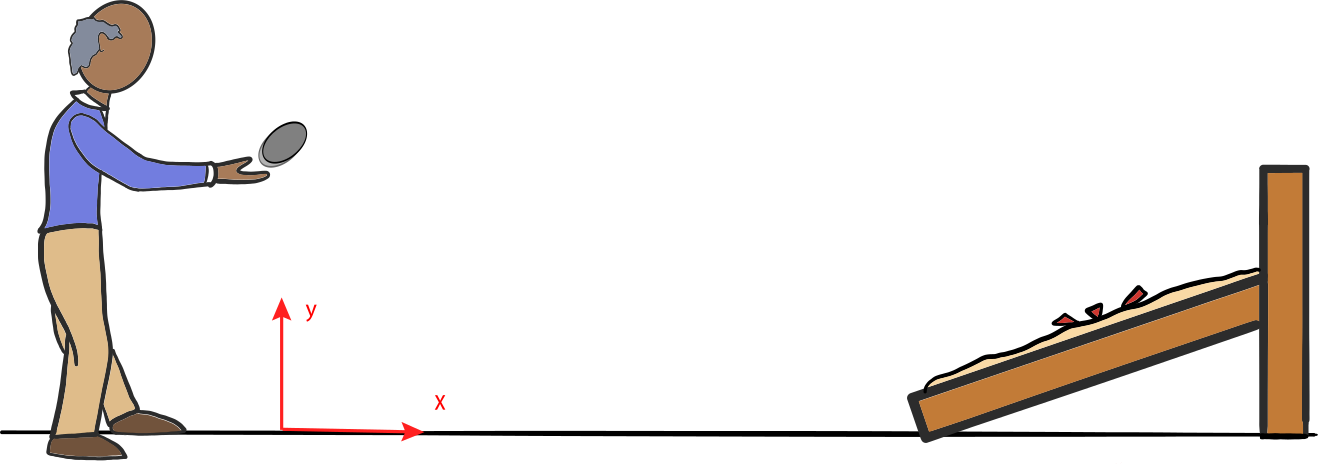
Figure 1: We place our coordinate system on the ground just below the spot where the disk leaves the hand of the man and begins its parabolic motion.
Now, like any projectile, the metal disk follows a parabolic motion (assuming that there is no air friction). This means that along X, the disk has constant speed, and along Y, it has constant gravitational acceleration. Thus, the horizontal distance is given by
\begin{equation}
d=v_x t,
\label{Tejo_distanciaX}
\end{equation}
where \(v_x\) is the velocity along X and \(t\) is the time of the motion. So, to find the horizontal distance, we need to find the velocity along X and the time. To find the velocity along X, first, notice the triangle formed by the initial velocity and its two components (the velocity along X and the velocity along Y). See figure 2.
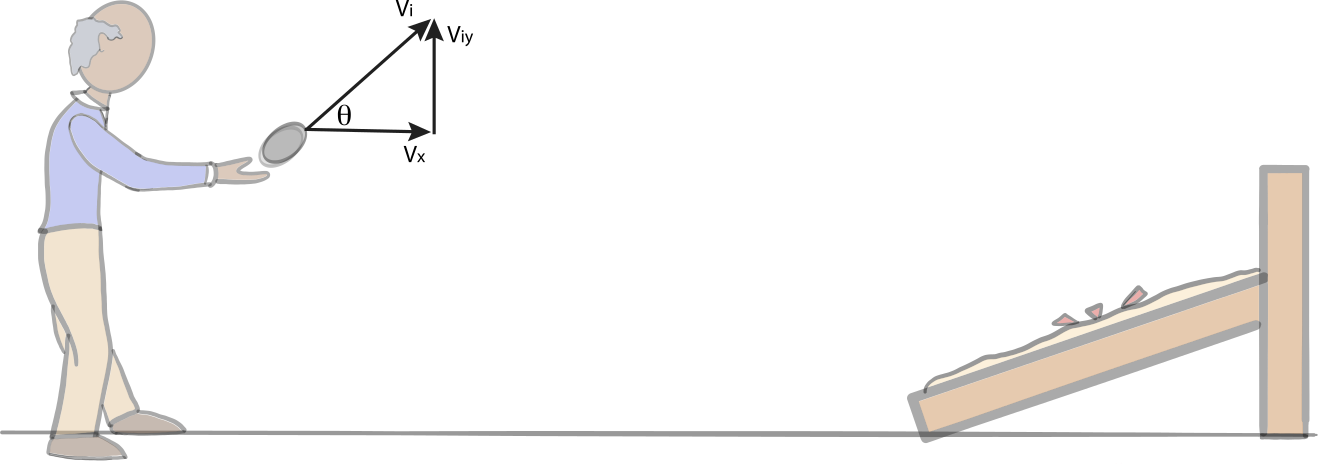
Figure 2: The initial velocity of the disk with its components along the X and Y-axis. The angle \(\theta\) between the direction of the velocity and the horizontal axis is also shown.
We know the initial angle, which is 45º, but we will only replace the numerical values at the end of the problem. So, it is clear from this drawing that the magnitude of the X-velocity is
\begin{equation}
v_x=v \cos \theta.
\label{Tejo_velocidadX}
\end{equation}
We can then insert this in equation \eqref{Tejo_distanciaX} to get
\begin{equation}
d = v \cos \theta \;t.
\label{Tejo_distanciaXconVel}
\end{equation}
All that we need to do now is find the time \(t\). To do this, we need to write the equation of motion along Y. As we said earlier, in Y the disk follows a motion with constant gravitational acceleration. In general, the equation for this kind of motion is
\begin{equation}
y_f \, \hat{\textbf{j}} = y_i \, \hat{\textbf{j}} + v_{i_y} t \, \hat{\textbf{j}} – \frac{1}{2} g t^2 \, \hat{\textbf{j}},
\label{Tejo_PosicionY}
\end{equation}
where \(y_i \, \hat{\textbf{j}}\) is the initial position in Y (it is positive according to our coordinate system), \(v_{i_y} \, \hat{\textbf{j}}\) is the initial velocity in Y (it is also positive according to our system), \(g \, \hat{\textbf{j}}\) is the gravitational acceleration (negative according to the coordinate system used), \(t\) is the time of motion and \(y_f \, \hat{\textbf{j}}\) is the final position (also positive). Besides the time, the only other variable that we don’t know yet is \(v_{i_y}\), but we can find this one using the same triangle that we used earlier (see the figure above). From that triangle, it follows that
\begin{equation}
v_{i_y}=v \sin \theta.
\label{Tejo_velocidadY}
\end{equation}
Let’s then insert this result in equation \eqref{Tejo_PosicionY} to find
\begin{equation}
y_f \, \hat{\textbf{j}} = y_i \, \hat{\textbf{j}} + v \sin \theta t \, \hat{\textbf{j}} – \frac{1}{2} g t^2 \, \hat{\textbf{j}}.
\label{Tejo_PosicionYConVel}
\end{equation}
Let’s focus on just the magnitude to get
\begin{equation}
y_f = y_i + v \sin \theta t – \frac{1}{2} g t^2.
\label{Tejo_PosicionYMagnitud}
\end{equation}
If we leave everything on the right side and rearrange the terms, we get
\begin{equation}
0 = – \left(\frac{1}{2} g\right) t^2 + (v \sin \theta) t + (y_i – y_f) .
\label{Tejo_ecuacionTiempo}
\end{equation}
The only variable we don’t know here is the time \(t\). We can find it using this equation because this is a quadratic equation in \(t\). In particular, from this equation it follows that \(t\) is given by
\begin{equation}
t = \frac{-(v \sin \theta) \pm \sqrt{(v \sin \theta)^2 – 4\left(-\frac{1}{2} g\right)(y_i – y_f)}}{2\left(-\frac{1}{2} g\right)},
\label{Tejo_solucionTiempo}
\end{equation}
from which we get a positive and a negative solution (but only the positive one makes sense in the present case because the negative is for times before the throw). Using that \(y_f = 0.3\) m, \(y_i=1\) m, \(g = 9.8\) m/s\(^2\), \(v=5\) m/s and \(\theta=45^\circ\), we get the positive solution of the quadratic equation:
\begin{equation}
t = 0.88 \, \text{s}.
\label{Tejo_tiempoResultado}
\end{equation}
Finally, we can use this time in equation \eqref{Tejo_distanciaXconVel} to get the horizontal distance that we were looking for. We also need to use \(v=5\) m/s and \(\theta=45^\circ\):
\begin{equation}
d = 3.12 \, \text{m}.
\end{equation}
(b) To find the maximum height of the disk, we need to find the time that it takes the disk to reach the point of maximum height. Once we know this time, we can use it in equation \eqref{Tejo_PosicionYMagnitud} to find the Y-position of the disk at that time. Given our coordinate system, that position will then be the maximum height (if we had used another system, for example one whose origin is at the throwing hand, then \(y_f\) would not give us the maximum height; instead, it would only give us the height with respect to the hand).
To find the time it takes to reach the maximum height, we can use the equation for the velocity in Y because at its maximum height the velocity is zero (at the maximum height, the disk is not moving upwards or moving downwards). Since this is a motion with constant acceleration, we get
\begin{equation}
\vec{v}_{f}=\vec{v}_{i} + \vec{a}t.
\label{Tejo_velocidadEcuacionGeneral}
\end{equation}
In this case, the initial velocity is positive, the acceleration is negative and given by \(g\), and the velocity at the highest point is 0:
\begin{equation}
0 \, \hat{\textbf{j}} = v_{i_y} \, \hat{\textbf{j}} – g t_{mh} \, \hat{\textbf{j}},
\end{equation}
where \(t_{mh}\) is the time of maximum height. If we only focus on the magnitudes and move \(gt_{mh}\) to the left side, we get
\begin{equation}
gt_{mh}=v_{i_y}.
\end{equation}
Now, let’s use that \(v_{i_y}= v \sin \theta\) and divide by \(g\) to get
\begin{equation}
t_{mh} = \frac{{(v \sin \theta)}}{g}.
\end{equation}
We can then insert this time in equation \eqref{Tejo_PosicionYMagnitud}:
\begin{equation}
y_f = y_i + v \sin \theta \left(\frac{v \sin \theta}{g} \right) – \frac{1}{2} g \left(\frac{v \sin \theta}{g} \right)^2.
\label{Tejo_PosicionYHMax}
\end{equation}
Finally, let’s insert the numerical values here
\begin{equation}
y_f = {(1\, \text{m})} + {(5 \, \text{m/s})} \sin {(45^\circ)} \left(\frac{{(5 \, \text{m/s})} \sin {(45^\circ)}}{{(9.8 \, \text{m/s}^2)}} \right) – \frac{1}{2} {(9.8 \, \text{m/s}^2)} \left(\frac{{(5 \, \text{m/s})} \sin {(45^\circ)}}{{(9.8 \, \text{m/s}^2)}} \right)^2,
\label{Tejo_PosicionYHMaxValores}
\end{equation}
to get
\begin{equation}
y_f = 1.64 \, \text{m}.
\end{equation}
This is the maximum height. Notice that we could have found the maximum height directly using equation \(\left(h_{max}=\frac{{v_{i_y}}^2}{2g}\right)\), but it is easier to derive the result from the basic equations instead of memorizing all these additional formulas.
(c) To find the velocity of the disk just before it hits the wick, we need to find the x-velocity and the y-velocity at that point. Once we know these, we can find the magnitude and direction of the total velocity because we know that
\begin{equation}
v_f = \sqrt{ (v_x)^2 + (v_{f_y})^2 },
\label{Tejo_velocidadFinalMagnitud}
\end{equation}
which we can see in figure 3.

Figure 3: Velocity of the disk as it arrives at its target \(v_f\) with its components along the X and Y-axis. The angle between the horizontal and the final velocity is also shown.
In the drawing, the angle will give us the direction of the final velocity.
We already know the x-velocity, since it is the same one for all the motion. So, all we need to do is find the final velocity in Y, and to this, we can use equation \eqref{Tejo_velocidadEcuacionGeneral} again.
The initial velocity in Y is positive. The acceleration is given by \(g\) and is negative, and so we get
\begin{equation}
\vec{v}_f= v_{i_y} \, \hat{\textbf{j}} – g t \, \hat{\textbf{j}},
\label{Tejo_velocidadFinal}
\end{equation}
where t is the time of motion.
From (a), we know that the time it takes the disk to reach the wick is given by equation \eqref{Tejo_tiempoResultado} (which is \(t=0.88\) s). And we can find the initial speed in Y, which is given by \(v \sin \theta\). So equation \eqref{Tejo_velocidadFinal} gives us:
\begin{equation}
\vec{v}_{fy} = (5\,\text{m}/\text{s}) \sin (45^{\circ})\, \hat{\textbf{j}}-g (0.88 \, \textit{s}) \, \hat{\textbf{j}}=- 5.12 \, \text{m/s} \, \hat{\textbf{j}}.
\end{equation}
Notice that the negative sign indicates that the velocity is negative along Y because the disk is falling at that point. The magnitude of this velocity is of course \(v_{f_y}= 5.12\) m/s. So let’s use this and \(v_x\) (given by \(v \cos \theta\)) in equation \eqref{Tejo_velocidadFinalMagnitud}:
\begin{equation}
v_f = \sqrt{ ({3.53 \, \text{m}/\text{s}})^2 + ({5.12 \, \text{m}/\text{s}})^2 }
\label{Tejo_velocidadFinalMagnitud2}
\end{equation}
to get
\begin{equation}
v_f = 6.21 \, \text{m/s}.
\end{equation}
This is the magnitude of the velocity when the disk reaches the wick. Finally, from the last triangle, it is clear that
\begin{equation}
\tan \alpha = \frac{v_{f_y}}{v_x}.
\end{equation}
And so the angle is:
\begin{equation}
\alpha = 55.42^\circ.
\end{equation}
This is the direction of the velocity when the disk reaches the wick.



Leave A Comment