

Two baby pandas play with a toy, as baby pandas are wont to do. Assuming the system acts as an ideal pulley, what will happen if a third baby panda jumps on one side of the rope? Describe the baby pandas’ motion based on the prompts below:
(a) Calculate the acceleration of the pandas in terms of \(g\).
(b) Find the tension on the rope in terms of the mass of one baby panda and \(g\).
Assume that all the baby pandas have the same mass.
a) Try to relate the net acceleration of the pandas on the right to the net acceleration of the panda on the left. With that relationship in mind, draw two free-body diagrams and use them to solve the problem.
b) With the answer obtained in part a), the tension can be found using the equations for the forces based on the free body diagrams.
a) Newton’s Second Law for the panda on the left implies:
\begin{equation*}
T-mg=ma_L.
\end{equation*}
And the same law for the pandas on the right entails that
\begin{equation*}
T-2mg=2ma_R.
\end{equation*}
Combining both equations and considering that the pandas’s accelerations are related by \( a_R = – a_L \), we get, after some algebra:
\begin{equation*}
a_L = \frac{g}{3}.
\end{equation*}
Then
\begin{equation*}
a_R = -\frac{g}{3},
\end{equation*}
because the right pandas are falling.
b) Replace one of the accelerations in the corresponding Newton’s Second Law equation. The result is:
\begin{equation*}
T = \frac{4mg}{3}.
\end{equation*}
For a more detailed explanation of any of these steps, click on “Detailed Solution”.
1. General Strategy for (a)
(a) The first part of the problem asks us to determine the acceleration of the pandas in terms of the gravitational constant \(g\). To approach the question, and as with all the problems involving forces and acceleration, we’ll start by making a free body diagram for the pandas. Then we will use Newton’s Second Law to relate the forces to the acceleration of the pandas.
2. Identify the forces and make a free body diagram
Let’s begin with the free body diagram. We’ll make a free body diagram for the panda on the left, and we’ll treat the two pandas on the right as if they were a single system. (When solving a problem, we can always group two or more objects into a single system if their motion is related. If the two objects do not move in the exact same manner, then doing this may not be convenient).
We know that for the panda on the left and for the pandas on the right, there is a tension force directed upwards in both cases. The magnitude of the tension on both sides is the same since we are considering that the pulley on the top is frictionless and the rope does not stretch. The other force we can identify is the weight of each panda which is directed downwards and has magnitude \(mg\), where \(m\) is the mass of one panda and \(g\) is the gravitational acceleration on Earth. Hence, the free body diagram for the panda on the left is shown in Figure 1.
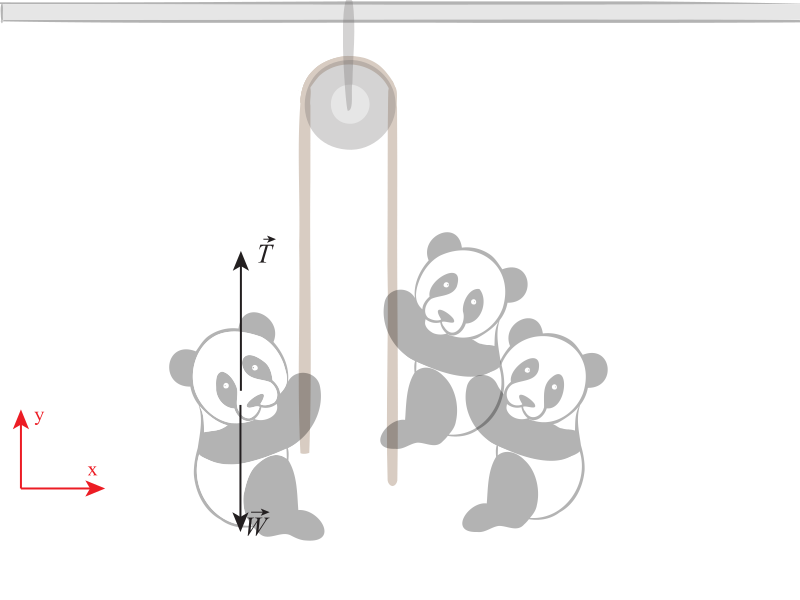
Figure 1: Force diagram for the left panda. The forces exerted on it are the tension \(\vec{T}\) and the weight \(\vec{W}=-mg\,\hat{\textbf{j}}\). The coordinate system is chosen with the positive Y axis going upwards.
For the other two pandas, we can treat them as a single system with a total weight \( W_T \) given by the combined weight of both pandas. For this system of two pandas, there is also upward tension. Thus, the force diagram is shown in Figure 2.
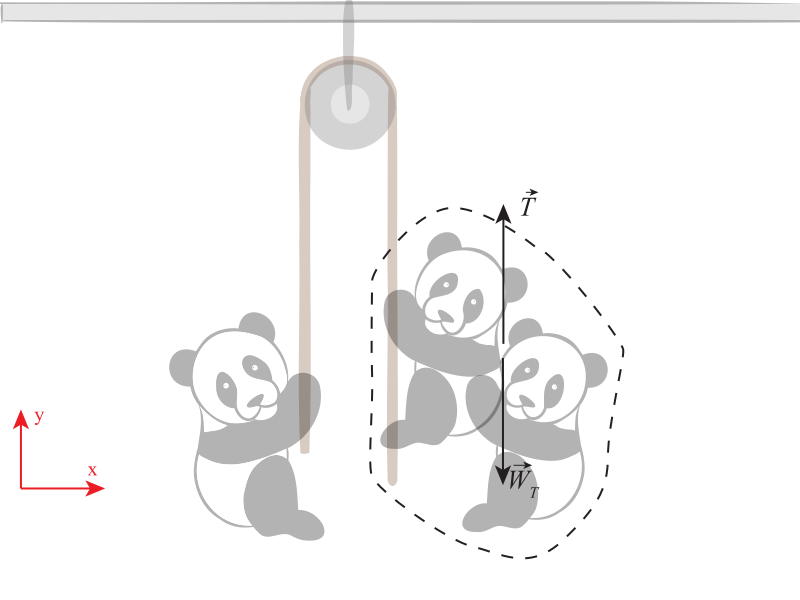
Figure 2: Force diagram for the right pandas. The forces exerted on them are the tension \(\vec{T}\) and the total weight \(\vec{W}_T=-mg\,\hat{\textbf{j}}-mg\,\hat{\textbf{j}}\). The coordinate system is chosen with the positive Y axis going upwards.
Notice that the tension on both sides is exactly the same with the same direction (positive along the \({y-}\) axis) and the same magnitude.
3. Newton’s Second Law in the \({y-}\)direction
We’ll use Newton’s Second Law along the \({y-}\)axis for the panda on the left to write
\begin{equation}
\label{newtonl}
T\,\hat{\textbf{j}}-mg\,\hat{\textbf{j}}=ma_{L}\,\hat{\textbf{j}},
\end{equation}
where \(a_L\) is the acceleration of the panda on the left. Dropping the vector notation because all the quantities point along the same axis, we get from equation \eqref{newtonl}
\begin{equation}
\label{newtonl2}
T-mg=ma_L.
\end{equation}
We can do the same for the pandas on the right and write Newton’s Second Law in the \({y-}\)direction as
\begin{equation}
\label{newtonr}
T\,\hat{\textbf{j}}-mg\,\hat{\textbf{j}}-mg\,\hat{\textbf{j}}=(m+m)a_R\,\hat{\textbf{j}},
\end{equation}
where on the right-hand side of the equation above, we wrote the total mass of the pandas \(m+m\) and their acceleration, denoted by \(a_R\). Dropping the vector notation because all the quantities are along the same axis, we get, from equation \eqref{newtonr},
\begin{equation}
\label{newtonr2}
T-2mg=2ma_R,
\end{equation}
where we have summed the weights to get \(-2mg\).
4. Solve for the unknown variables by manipulating the equations
So far, we have two equations and three unknowns: the tension \(T\), the acceleration \(a_L\), and the acceleration \(a_R\). Thus, for us to be able to solve the problem, we need an extra equation involving these unknowns. This additional equation will be a relationship between the acceleration of the panda on the left and the pandas on the right.
Notice that the pandas are hanging on the same (ideal) rope, which passes through a simple pulley. It is easy, then, to see that if the pandas on the right move downward, the panda on the left must go upward and vice-versa. Furthermore, if the pandas on the right fall 2 meters, the panda on the left will go up this same 2 meters. The same idea applies to the velocity and acceleration. Taking into account that the acceleration is a vector, we know that the magnitudes of the accelerations \(a_R\) and \(a_L\) must be the same, but opposite in direction. (Again, because if the pandas on the right accelerate upwards, the panda on the left must accelerates downward, and vice-versa). This leads us to write the intuitive yet useful relation
\begin{equation}
a_R\,\hat{\textbf{j}}=-a_L\,\hat{\textbf{j}}.
\end{equation}
Dropping the vector notation and focusing on the components, we get
\begin{equation}
\label{ligadura}
a_R=-a_L.
\end{equation}
We can now use the relation given in equation \eqref{ligadura} together with equations \eqref{newtonl2} and \eqref{newtonr2} to solve for the acceleration. Let’s start by solving for \(T\) in equation \eqref{newtonl2} to get
\begin{equation}
\label{newtonl3}
T=mg+ma_L.
\end{equation}
Using this result in equation \eqref{newtonr2}, we get
\begin{equation}
(mg+ma_L)-2mg=2ma_R.
\end{equation}
Now, in the equation above, let’s use the relation for the accelerations given by equation \eqref{ligadura}. Explicitly,
\begin{equation}
mg+ma_L-2mg=2m(-a_L).
\end{equation}
We can rearrange our terms in the equation above such that all the terms including \(a_L\) end up on the left and all the terms that are known are on the right. Namely,
\begin{equation}
ma_L+2ma_L=2mg-mg,
\end{equation}
which, after adding them together, is
\begin{equation}
3ma_L=mg.
\end{equation}
We can then solve for \(a_L\) to finally get
\begin{equation}
a_L=\frac{mg}{3m}.
\end{equation}
This simplifies further after cancelling out the mass:
\begin{equation}
\label{al}
a_L=\frac{g}{3}.
\end{equation}
Thus, the panda on the left moves upwards with an acceleration of magnitude \(g/3\). We can write this as
\begin{equation}
\label{alvector}
\vec{a}_L=\frac{g}{3}\,\hat{\textbf{j}}.
\end{equation}
Likewise, the pandas on the right move with an acceleration of the same magnitude (\(g/3\)) but in the opposite direction (using equation \eqref{ligadura}). In particular, we can write that acceleration as
\begin{equation}
\vec{a}_R=-\frac{g}{3}\,\hat{\textbf{j}}.
\end{equation}
5. General strategy for (b)
(b) For the last part of this problem, we need to calculate the tension on the rope. We can use equation \eqref{newtonl3} together with the result for the acceleration \(a_L\) given by equation \eqref{al} to obtain the tension.
6. Manipulate equations to solve for the unknown variables
If we use equation \eqref{newtonl3} together with the result for the acceleration \(a_L\) given by equation \eqref{al}, we obtain
\begin{equation}
T=mg+m\left(\frac{g}{3}\right).
\end{equation}
After performing the fraction sum, we get
\begin{equation}
T=\frac{4mg}{3}.
\end{equation}
Remember that the magnitude of the tension is the same all along the rope.

Leave A Comment