
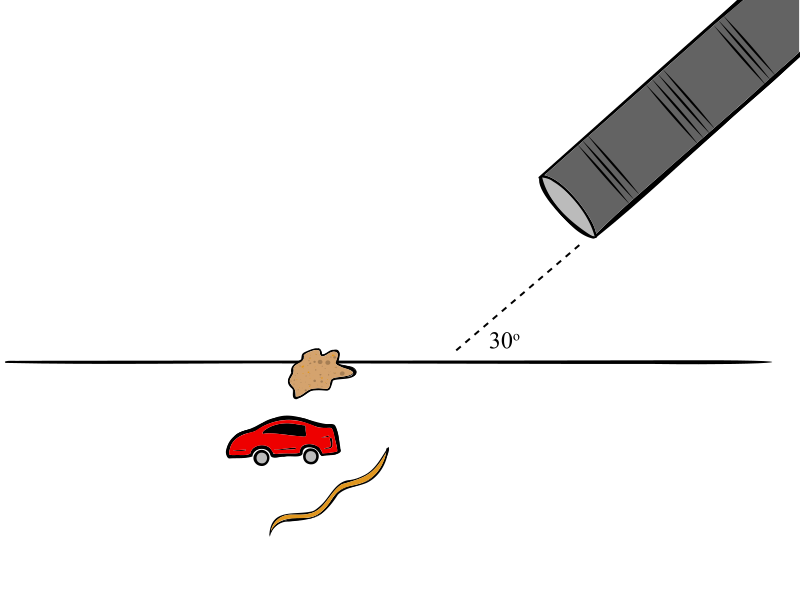
A parent with small children is trying to clean the family living room, and finds various stuff on the floor including a toy truck, a stale crouton, and a single strand of hair. If the mass of the strand of hair is 0.5 mg, the mass of the crouton is 2 g, and the mass of a plastic truck is 100 g, describe the acceleration of each object as it is suctioned by the parent’s vacuum cleaner with a force of 4 N. Assume the parent orients the vacuum hose such that the hose is suctioning at 30 degrees with respect to the floor.
(a) Calculate the components of the acceleration of the three masses along the vertical and horizontal axes immediately after they stop touching the floor and are in contact with the vacuum hose.
(b) Calculate the acceleration of the three objects if the vacuum cleaner starts suctioning perpendicular to the floor.
a) Draw a free body diagram, and compute each component of the acceleration. Note that the force exerted by the vacuum cleaner also has \({x-}\) and \({y-}\) components.
b) With the previous equations for \({x}\) and \({y}\), you can set the angle to \(90^\circ\).
a) By Newton’s Second Law along \({x}\), we have:
\begin{equation*}
F_s\cos(\theta)=ma_x,
\end{equation*}
and Newton’s Second Law along the \({y-}\)axis states:
\begin{equation*}
F_s\sin(\theta)-mg=ma_y.
\end{equation*}
For the strand of hair of mass \(m=0.5\,\text{mg}\), we obtain,
for the \({x-}\)axis,
\begin{equation*}
a_x\approx 6.93\times 10^{6}\,\text{m/s}^2.
\end{equation*}
For the \({y-}\)axis,
\begin{equation*}
a_y\approx 4\times 10^{6}\,\text{m/s}^2.
\end{equation*}
For the piece of bread crumb of mass \(m=2\,\text{g}\), we obtain,
for the \({x-}\)axis,
\begin{equation*}
a_x\approx 1.73\times 10^{3}\,\text{m/s}^2.
\end{equation*}
For the \({y-}\)axis, we get
\begin{equation*}
a_y=990.2\,\text{m/s}^2.
\end{equation*}
For the toy of mass \(m=100\,\text{g}\), we obtain,
for the \({x-}\)axis,
\begin{equation*}
a_x\approx 34.6\,\text{m/s}^2.
\end{equation*}
For the \({y-}\)axis, we obtain
\begin{equation*}
a_y\approx 10.2\,\text{m/s}^2.
\end{equation*}
b) If \(\theta = 90^\circ\), then for all three objects in the \({x-}\)direction, \(\cos (90^\circ)=0\). So
\begin{equation*}
a_x = 0.
\end{equation*}
For the strand of hair, we get
\begin{equation*}
a_y\approx 8\times 10^{6}\,\text{m/s}^2.
\end{equation*}
For the bread crumb, we obtain
\begin{equation*}
a_y=1990.2\,\text{m/s}^2.
\end{equation*}
Finally, for the toy, we have
\begin{equation*}
a_y\approx 30.2\,\text{m/s}^2.
\end{equation*}
For a more detailed explanation of any of these steps, click on “Detailed Solution”.
1. General Strategy for a)
a) We need to calculate the acceleration of the three masses just after they stop touching the floor. To approach this problem, we will start by making a free body diagram and identifying the forces exerted on a body of mass \(m\) just as the body loses contact with the floor. Then, we’ll use Newton’s Second Law along both axes to find an expression for the acceleration for that body. Finally, we will use this expression for each of the objects in the problem.
2. Identify the forces and make a free body diagram
Over each object there is a force \(F_s\) exerted by the vacuum cleaner with an inclination of \(\theta=30^{\circ}\) with respect to the floor. Also, we know that the weight of each object is given by \(mg\) and it is directed downwards (here \(g=9.8\,\text{m/s}^2\) is the gravitational acceleration of Earth). Notice that since we are considering the case where the object just lost contact with the floor, there will be no contact force \(\vec{N}\) over the object. (The floor is not touching the object at that moment.) Hence, the free body diagram is shown in Figure 1.
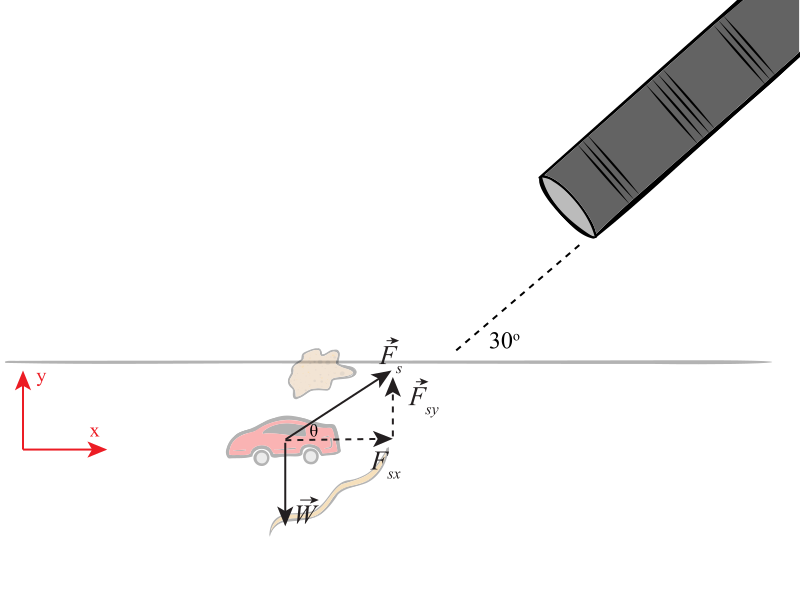
Figure 1: Free-body diagram for the objects as they lose contact with the floor. The forces shown are the weight \(\vec{W}=-mg\,\hat{\textbf{j}}\) and the suction force in the same direction as the vacuum cleaner tube. The coordinate system is chosen so that the positive X axis points in the direction of the floor and the Y axis points upwards.
From the figure, we see that we can write the component along the \({x-}\)axis as \(F_{sx}=F_s\cos(\theta)\) and the component along the \({y-}\)axis as \(F_{sy}=F_s\sin(\theta)\). Clearly, given the coordinate system chosen, the \({x-}\)component and \({y-}\)components for \(F_s\) are positive.
3. Newton’s Second Law along the \({x-}\)axis
Now, we can write Newton’s Second Law for the \({x-}\)axis as
\begin{equation}
F_s\cos(\theta)\,\hat{\textbf{i}}=ma_x\,\hat{\textbf{i}},
\end{equation}
where we noted that the force is positive, which means that the acceleration is also positive, and (\(a_x\) is the acceleration of the object along the \({x-}\)axis. After dropping the vector notation and focusing on the magnitudes, this equation becomes
\begin{equation}
F_s\cos(\theta)=ma_x.
\end{equation}
After solving for \(a_x\) in the equation, we obtain
\begin{equation}
\label{ax}
a_x=\frac{F_s\cos(\theta)}{m}.
\end{equation}
The last step remains to plug in numerical values (which we will do later.)
4. Newton’s Second Law along the \({y-}\)axis
Meanwhile, let’s write Newton’s Second Law along the \({y-}\)axis in order to obtain the acceleration along this axis, \(a_y\). Using Figure 1 as a reference, we get
\begin{equation}
F_s\sin(\theta)\,\hat{\textbf{j}}-mg\,\hat{\textbf{j}}=ma_y\,\hat{\textbf{j}},
\end{equation}
since the \({y-}\)component of the vacuum’s force is positive, the weight is negative, and we assume that the vertical acceleration is also positive. After dropping the vector notation and focusing on the magnitudes, this becomes
\begin{equation}
F_s\sin(\theta)-mg=ma_y.
\end{equation}
After solving for \(a_y\) in the equation above, we get
\begin{equation}
a_y=\frac{F_s\sin(\theta)}{m}-\frac{mg}{m}.
\end{equation}
After simplifying the expression by canceling the mass in the second term, we get
\begin{equation}
\label{ay}
a_y=\frac{F_s\sin(\theta)}{m}-g.
\end{equation}
5. Plug in numerical values
We can now use equations \eqref{ax} and \eqref{ay} to plug in explicit numerical values for the accelerations of each object.
For the strand of hair of mass \(m=0.5\,\text{mg}=5\times10^{-7}\,\text{kg}\), we obtain,
for the \({x-}\)axis,
\begin{equation}
a_x=\frac{(4\,\text{N})\cos(30^{\circ})}{5\times10^{-7}\,\text{kg}},
\end{equation}
\begin{equation}
a_x\approx 6.93\times 10^{6}\,\text{m/s}^2.
\end{equation}
For the \({y-}\)axis, we obtain
\begin{equation}
a_y=\frac{(4\,\text{N})\sin(30^{\circ})}{5\times10^{-7}\,\text{kg}}-9.8\,\text{m/s}^2,
\end{equation}
\begin{equation}
a_y\approx 4\times 10^{6}\,\text{m/s}^2.
\end{equation}
For the piece of bread crumb of mass \(m=2\,\text{g}=2\times10^{-3}\,\text{kg}\), we obtain,
for the \({x-}\)axis,
\begin{equation}
a_x=\frac{(4\,\text{N})\cos(30^{\circ})}{2\times10^{-3}\,\text{kg}},
\end{equation}
\begin{equation}
a_x\approx 1.73\times 10^{3}\,\text{m/s}^2.
\end{equation}
For the \({y-}\)axis, we get
\begin{equation}
a_y=\frac{(4\,\text{N})\sin(30^{\circ})}{2\times10^{-3}\,\text{kg}}-9.8\,\text{m/s}^2,
\end{equation}
\begin{equation}
a_y=990.2\,\text{m/s}^2.
\end{equation}
For the toy of mass \(m=100\,\text{g}=0.1\,\text{kg}\), we obtain,
for the \({x}\)axis,
\begin{equation}
a_x=\frac{(4\,\text{N})\cos(30^{\circ})}{0.1\,\text{kg}},
\end{equation}
\begin{equation}
a_x\approx 34.6\,\text{m/s}^2.
\end{equation}
For the \({y-}\)axis, we obtain
\begin{equation}
a_y=\frac{(4\,\text{N})\sin(30^{\circ})}{0.1\,\text{kg}}-9.8\,\text{m/s}^2,
\end{equation}
\begin{equation}
a_y\approx 10.2\,\text{m/s}^2.
\end{equation}
6. General strategy for b)
b) If the vacuum hose is perpendicular to the floor, it is comparable to the situation in which the angle is \(\theta=90^{\circ}\), as shown in the following figure:

Figure 2: Free-body diagram for the objects as they lose contact with the floor. The forces shown are the weight \(\vec{W}=-mg\,\hat{\textbf{j}}\) and the suction force in the same direction as the vacuum cleaner tube. The coordinate system is chosen so that the positive X axis points in the direction of the tube and the Y axis points upwards, in the direction of the tube.
7. Adapt the previous equations to the new situation
Thus, equation \eqref{ax} (which is a general equation for any angle) becomes
\begin{equation}
a_x=\frac{F_s\cos(90^{\circ})}{m}=0,
\end{equation}
as we expected because now all the forces are acting along the \({y-}\)axis. Now, equation \eqref{ay} (which is also an equation for any angle) becomes
\begin{equation}
a_y=\frac{F_s\sin(90^{\circ})}{m}-g,
\end{equation}
which simplifies to
\begin{equation}
\label{ay2}
a_y=\frac{F_s}{m}-g,
\end{equation}
since sine of 90 degrees is one. We can then use the expression given in equation \eqref{ay2} to calculate the acceleration along the \({y-}\)axis for the three objects.
8. Insert numerical values
For the strand of hair, we get
\begin{equation}
a_y=\frac{4\,\text{N}}{5\times10^{-7}\,\text{kg}}-9.8\,\text{m/s}^2,
\end{equation}
\begin{equation}
a_y\approx 8\times 10^{6}\,\text{m/s}^2.
\end{equation}
For the bread crumb, we obtain
\begin{equation}
a_y=\frac{4\,\text{N}}{2\times10^{-3}\,\text{kg}}-9.8\,\text{m/s}^2,
\end{equation}
\begin{equation}
a_y=1990.2\,\text{m/s}^2.
\end{equation}
Finally, for the toy, we have
\begin{equation}
a_y=\frac{4\,\text{N}}{0.1\,\text{kg}}-9.8\,\text{m/s}^2,
\end{equation}
\begin{equation}
a_y\approx 30.2\,\text{m/s}^2.
\end{equation}

Leave A Comment