

Frank and Valerie are playing table tennis, and are bouncing the ping pong ball back and forth. At one point in their game, Valerie hits the ping pong ball with an initial speed of 6 m/s (at the exact height of the table), and it takes 2.1 seconds for the ping pong ball to reach the edge of the other side.) Frank and Valerie take the sport very seriously, and purchased an official table; game regulations dictate that the length of the table length must be exactly 2.74 meters.)
(a) At what angle did Valerie hit the ball?
(b) Find the maximum height that the ball reaches over the table.
(a) Try to find the time for a complete parabolic motion. Then use the horizontal distance equation and replace the time that you’ve just found.
(b) Try to find the time for an object to reach a maximum height. Then use the equation of motion to find the maximum height.
(a) Along Y, the ball has constant acceleration, given by the acceleration of gravity. The equation of motion is, in general,
\begin{equation*}
\vec{y}_f = \vec{y}_i + \vec{v}_{iy} t + \frac{1}{2}\vec{g} t^2,
\end{equation*}
where \(v_{iy}=v_i \sin \theta \). Solving for \(t\), we get:
\begin{equation*}
t = \frac{2 v_i \sin \theta}{g}.
\end{equation*}
For the motion along X, we have:
\begin{equation*}
d_x = v_x t = v_i \cos \theta t.
\end{equation*}
Using the time found before and solving for \(\theta\), we get:
\begin{equation*}
\theta = \frac{1}{2} \arcsin \left( \frac{d_x g}{{v_i}^2} \right),
\end{equation*}
and with numerical values:
\begin{equation*}
\theta = 24.12^\circ.
\end{equation*}
(b) Now, for the equation of motion along Y, we have:
\begin{equation*}
\vec{y}_f = \vec{y}_i + \vec{v}_i t + \frac{1}{2}\vec{g} t^2,
\end{equation*}
and with the velocity equation:
\begin{equation*}
\vec{v}_f=\vec{v}_{iy}+\vec{a}t,
\end{equation*}
it’s possible to combine both by solving \(t\) for the second one and replacing it in the first one. After using some algebra and replacing the numerical values, we get:
\begin{equation*}
{y}_{max} = \frac{1}{2} \frac{{v_{iy}}^2}{g} = 0.3 \, \text{m}.
\end{equation*}
(a) To find the angle that Valerie hits the ball, we need to relate that angle to the other variables (such as the length of the table and the initial speed). The key is to find an expression for the total horizontal distance that a projectile travels. As we will see, that distance relates the initial angle, the initial speed, and the total horizontal distance.
Let’s start by placing a coordinate system with a horizontal X axis pointing in the direction of the ball’s motion (see figure 1).

Figure 1: We put the coordinate system at the edge of the table with the X axis pointing to the left along the ball’s trajectory.
Notice that we put the origin on the table so that the initial and final height of the ball is zero (had we placed the origin on the floor, the initial and final heights would have been different from zero, but the final result wouldn’t have changed). Now, along X, the ball has constant speed, and so the total horizontal distance is given by
\begin{equation}
\label{Table_distancia}
d_x = v_x t,
\end{equation}
where \(v_x\) is the speed along X, and \( t\) is the time for the whole trajectory. The speed along X is related to the angle and the initial speed, as indicated in figure 2.
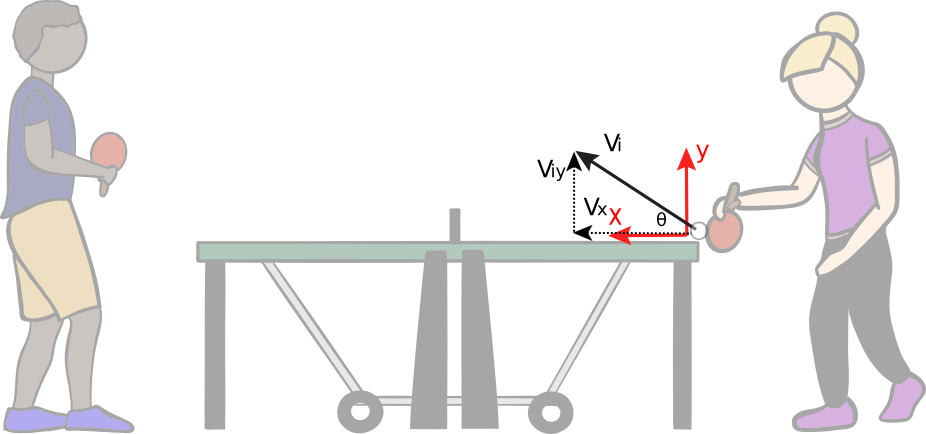
Figure 2: The initial velocity vector is decomposed into its components along the X and Y axes.
Hence, we see that
\begin{equation}
v_x = v_i \cos \theta,
\end{equation}
and so equation \eqref{Table_distancia} becomes
\begin{equation}
\label{Table_dxConVCosTheta}
d_x = v_i \cos \theta \, t.
\end{equation}
We need to find the angle, and we know both \(d_x\) (which is given by the table’s length) and \(v_i\). So to find \(\theta\) from this equation, we still need to find the time. And to find the time, we should take into account the motion along Y.
Along Y, the ball has constant acceleration, given by the acceleration of gravity. The equation of motion is, in general,
\begin{equation}
\vec{y}_f = \vec{y}_i + \vec{v}_i t + \frac{1}{2}\vec{g} t^2,
\end{equation}
where \(\vec{y}_f\) is the final position, \(\vec{y}_i\) the initial position, \(\vec{v}_i\) the initial velocity along Y, and \(\vec{g}\) the gravitational acceleration.
According to our system, the gravitational acceleration is negative along Y, the initial and the final positions are zero, and the initial velocity along Y is positive. So we get
\begin{equation}
0 \, \hat{\textbf{j}} = 0 \, \hat{\textbf{j}} + v_{iy} t\, \hat{\textbf{j}} – \frac{1}{2} gt^2 \, \hat{\textbf{j}}.
\end{equation}
If we rearrange the terms and focus on the magnitudes, we get
\begin{equation}
\frac{1}{2}gt^2 = v_{iy} t.
\end{equation}
If we divide by \(t\) and \(g\), and multiply by \(2\), we get
\begin{equation}
t = \frac{2 v_{iy}}{g}
\end{equation}
So this equation gives us the time in terms of \(v_{iy}\). To proceed, let’s use the last figure above to write
\begin{equation}
\label{vsintheta}
v_{iy} = v_i \sin \theta,
\end{equation}
and so we get
\begin{equation}
t = \frac{2 (v_i \sin \theta)}{g}.
\end{equation}
Now we can use this expression for the time in equation \eqref{Table_dxConVCosTheta}. This yields
\begin{equation}
d_x = v_i \cos \theta \left( \frac{2 v_i \sin \theta}{g} \right).
\end{equation}
Now use the trigonometric identity \( 2 \sin \theta \cos \theta = \sin (2 \theta) \). If we use that identity here, we get
\begin{equation}
d_x = \frac{{v_i}^2 \sin (2 \theta )}{g}.
\end{equation}
This is a well-known expression that tells us the maximum horizontal distance of a projectile that starts and ends at the same height. Notice that it only depends on the initial angle and the initial speed.
So, from here, we can find the angle. First, multiply by \(g\) and divide by \({v_i}^2\) to get
\begin{equation}
\frac{d_x g}{{v_i}^2} = \sin ( 2 \theta ).
\end{equation}
Then apply the \(\arcsin\) function:
\begin{equation}
\arcsin \left( \frac{d_x g}{{v_i}^2} \right) = 2 \theta.
\end{equation}
Now divide by 2 to get
\begin{equation}
\frac{1}{2} \arcsin \left( \frac{d_x g}{{v_i}^2} \right) = \theta.
\end{equation}
Finally, we can insert the numerical values here:
\begin{equation}
\frac{1}{2} \arcsin \left( \frac{(2.74 \, \text{m}) (9.8 \, \text{m/s}^2)}{(6 \, \text{m/s})^2} \right) = \theta.
\end{equation}
The result is
\begin{equation}
\theta = 24.12^\circ.
\end{equation}
(b) Now we need to find the maximum height of the ball. The height is given by the position on Y, and as we explained before, the equation of motion along Y is
\begin{equation}
\vec{y}_f = \vec{y}_i + \vec{v}_i t + \frac{1}{2}\vec{g} t^2
\label{EqinY}
\end{equation}
If we want to find the maximum height, we need to plug the time for maximum height into the equation. That is,
\begin{equation}
\vec{y}_{max} = \vec{y}_i + \vec{v}_i {t_{max}} + \frac{1}{2}\vec{g} {t^2_{max}},
\label{EqinY1}
\end{equation}
Now, according to our system, the initial speed is positive along Y, the initial position on Y is zero, and the gravitational acceleration is negative. So we get
\begin{equation}
{y}_{max} \, \hat{\textbf{j}} = v_{iy} {t_{max}}\, \hat{\textbf{j}} – \frac{1}{2} g{t^2_{max}} \, \hat{\textbf{j}}.
\end{equation}
If we focus on the magnitudes, we get
\begin{equation}
\label{maximumheight}
{y}_{max} = v_{iy} {t_{max}} – \frac{1}{2} g{t^2_{max}} .
\end{equation}
Recall that the initial velocity along Y is given by \(v_{iy}=v_i \sin \theta\) (this was equation \eqref{vsintheta}). We already found the angle in (a), so we can easily find this speed. But let’s do that later. For now, let’s focus on finding the time of maximum height that we need in order to use equation \eqref{maximumheight}.
The key to finding this time lies in the fact that when a projectile is at the point of maximum height, its vertical velocity is zero (at that point, the object is not rising or going down). So consider the equation for the velocity of an object with uniform acceleration. It is
\begin{equation}
\vec{v}_f=\vec{v}_{iy}+\vec{a}t.
\end{equation}
According to our coordinate system, the initial velocity along Y is positive and the gravitational acceleration is negative, so we can write this equation as
\begin{equation}
\vec{v}_f={v_{iy}} \, \hat{\textbf{j}}-gt \, \hat{\textbf{j}}.
\end{equation}
We can now use the fact that at the time of maximum height, the vertical velocity is zero:
\begin{equation}
0 \, \hat{\textbf{j}}=v_{iy} \, \hat{\textbf{j}}-g{t_{max}} \, \hat{\textbf{j}}.
\end{equation}
Let’s focus on the magnitudes and rearrange the equation to get
\begin{equation}
{v_{iy}} = gt_{max}.
\end{equation}
Dividing by \(g\), we get
\begin{equation}
\frac{{v_{iy}}}{g} = t_{max}.
\end{equation}
So we’ve found an expression for the time of maximum height. Insert it in \eqref{maximumheight} to get
\begin{equation}
\label{maximumheight2}
{y}_{max} = {v_{iy}} \left( \frac{{v_{iy}}}{g}\right) – \frac{1}{2} g\left( \frac{{v_{iy}}}{g}\right)^2.
\end{equation}
Manipulate the two terms on the right side a bit to get
\begin{equation}
\label{maximumheight3}
{y}_{max} = \frac{{v_{iy}}^2}{g} – \frac{1}{2} \frac{{v_{iy}}^2}{g}.
\end{equation}
Notice that the two terms on the right can be added, and if we do that, we find
\begin{equation}
\label{maximumheight4}
{y}_{max} = \frac{1}{2} \frac{{v_{iy}}^2}{g}.
\end{equation}
This is a well-known equation for the point of maximum height of a projectile. It only depends on the initial vertical speed (of course, if the initial height is not zero, then we have to add it to equation \eqref{maximumheight4}).
Now, let’s use equation \eqref{vsintheta} to write this height in terms of the angle and the initial speed:
\begin{equation}
\label{maximumheight5}
{y}_{max} = \frac{1}{2} \frac{{(v_i \sin \theta)}^2}{g}.
\end{equation}
Finally, insert the numerical values here
\begin{equation}
\label{maximumheight6}
{y}_{max} = \frac{1}{2} \frac{{((6\, \text{m/s}) \sin (24.12^\circ))}^2}{g}
\end{equation}
to get
\begin{equation}
y_{max} = 0.3 \, \text{m}.
\end{equation}



Leave A Comment