

A stunt rider wants to jump from one hill to another, and the second hill is 10 meters higher than the first. To pull off her trick, she needs to get on top of the other hill with no speed in the vertical direction. (Assume air resistance is negligible.)
(a) Calculate the time that it takes for the stunt rider to do the trick.
(b) Find the initial velocity along the Y-axis required for the biker to execute the trick properly and safely.
(c) Assuming that the initial angle for the jump is 45º, calculate the total distance between the crests of the two hills.
(a) You may need to combine two equations to find the time that it takes for the biker to do the trick.
(b) Use the equation of velocity with the time found in (a).
(c) Find the X component of the velocity and the distance with the time found in (a). Then find the total distance by combining the known height.
(a) Along the Y component, the equation of motion is that of uniform acceleration, and so the speed as a function of time is given by:
\begin{equation*}
\vec{v}_y = \vec{a}_y t + \vec{v}_{iy},
\end{equation*}
The equation of motion along Y is that of uniform acceleration:
\begin{equation*}
\vec{y}_f = – \frac{1}{2} \vec{g} t^2 + \vec{v}_{i_y}t + \vec{y}_i.
\end{equation*}
Solving for \(v_{iy}\) in the first one and replacing it in the second one. Then solving for \(t\) and using the numerical values, we get:
\begin{equation*}
t = 1.43 \, \text{s}.
\end{equation*}
(b) Now that we know the time, it’s easy to find the initial velocity along Y. We can simply use the equation of velocity using the time found in (a). The result is
\begin{equation*}
v_{i_y} = gt=14 \, \text{m/s}.
\end{equation*}
(c) The total distance is the hypotenuse of a right triangle, so
\begin{equation*}
d_T = \sqrt{ (d_x)^2 + (d_y)^2},
\end{equation*}
where \(d_x = v_x t\). The X component of the velocity is:
\begin{equation*}
v_x = \frac{v_{i_y}}{\tan \theta}.
\end{equation*}
Then, \(dx = 20 \, \text{m}\) using the time found in (a). So, the result is:
\begin{equation*}
d_T = 22.36 \, \text{m}.
\end{equation*}
For a more detailed explanation of any of these steps, click on “Detailed Solution”.
(a) To calculate the time that it takes for the stunt biker to perform the trick, we should start by identifying the biker’s type of motion. Since there is no air resistance, we can assume that the biker follows a parabolic motion, which means that she has horizontal constant velocity and vertical uniform acceleration (due to gravity). Let’s start by placing a coordinate system where the origin is on top of the first hill and the Y axis is pointing vertically (see figure 1).

Figure 1: We place the coordinate system on the first hill.
Now, to find the time of the total jump, notice that the final velocity along Y is zero (in the prompt they ask us to assume this). When we have a parabolic motion (or any free fall motion), the velocity along Y is zero only if the object reaches the point of maximum height. This is easy to understand because, during a parabolic motion, the object will always be going upwards with some speed or going downwards with some speed. Only when the object is at the maximum height is it neither raising nor falling, and so it has no vertical speed in that instant.
Since we know the final vertical speed (zero), we need to use an equation that relates this information to other variables. One way of proceeding is to use the equation \( t = \sqrt{\frac{2(h_f – h_i)}{g}}\), which tells us the time that it takes for an object to reach the point of maximum height. However, it is often hard to remember this and other similar equations, and so we will derive the equation from some more basic ones.
Along Y, the equation of motion is that of uniform acceleration, and so the speed as a function of time is given by
\begin{equation}
\vec{v}_y = \vec{a}_y t + \vec{v}_{iy},
\end{equation}
where \(\vec{a}\) is the acceleration along Y, \(\vec{v}_{iy}\) the initial velocity along Y, and \(\vec{v}_y\) the velocity along Y at time \(t\). Now, in this case, according to our system of coordinates, we know that the initial velocity is positive along Y (although we do not know the magnitude) and that the gravitational acceleration is negative along Y. We also know that the final speed must be zero at the time the biker reaches the second hill. So, we can rewrite the previous equation as
\begin{equation}
0 \, \hat{\textbf{j}} = – g t \, \hat{\textbf{j}} + v_{iy} \, \hat{\textbf{j}}.
\end{equation}
Let’s rearrange this equation and focus only on the magnitudes in order to get
\begin{equation}
\label{Biker_vel}
gt = v_{i_y}.
\end{equation}
Finally, if we divide by \(g\), we get an equation for the time of maximum height in terms of the initial Y speed and \(g\):
\begin{equation}
\label{Biker_tiempo}
t = \frac{v_{i_y}}{g}.
\end{equation}
This is the equation for the time that an object in parabolic motion takes to reach the maximum height. Now, we can’t find the time from this equation yet because we don’t know the initial speed along Y. To find this, we’ll have to use more information.
Let’s use the fact that the equation of motion along Y is that of uniform acceleration:
\begin{equation}
\label{Biker_yf}
y_f \, \hat{\textbf{j}} = – \frac{1}{2} g t^2 \, \hat{\textbf{j}} + v_{i_y}t \, \hat{\textbf{j}} + y_i \, \hat{\textbf{j}}.
\end{equation}
where we used the fact that according to our coordinate system, the gravitational acceleration is negative along Y, the initial velocity along Y is positive, and the final position along Y is also positive. According to our system of coordinates, the initial position along Y is zero, and the final position is 10 meters on the positive Y axis. Hence, the previous equation becomes
\begin{equation}
10 \, \text{m} \, \hat{\textbf{j}} = – \frac{1}{2} g t^2 \, \hat{\textbf{j}} + v_{i_y}t \, \hat{\textbf{j}} + 0 \, \hat{\textbf{j}}.
\end{equation}
If we focus on the magnitudes only, we get
\begin{equation}
\label{Biker_yfNumerosMag}
10 \, \text{m} = – \frac{1}{2} g t^2 + v_{i_y}t.
\end{equation}
Now, this equation relates the time and the initial velocity along Y, and so we could use the result of equation \eqref{Biker_yfNumerosMag} to find an expression for one of these variables. In particular, use equation \eqref{Biker_tiempo} in the previous equation to get
\begin{equation}
10 \, \text{m} = – \frac{1}{2} g \left( \frac{v_{i_y}}{g} \right)^2 + v_{i_y}\left( \frac{v_{i_y}}{g} \right).
\end{equation}
From here, we can find \(v_{i_y}\). First, take common factor of \( v_{i_y}\) on the right to get
\begin{equation}
10 \, \text{m} = v_{i_y}^2 \left( – \frac{1}{2g} + \frac{1}{g} \right).
\end{equation}
Then add the common terms,
\begin{equation}
10 \, \text{m} = v_{i_y}^2 \left( \frac{1}{2g} \right),
\end{equation}
and multiply by \(2g \) to get \(v_{i_y}\) in terms of known variables:
\begin{equation}
\sqrt{(2 g) 10 \, \text{m}} = v_{i_y}.
\end{equation}
Now we can use this equation in \eqref{Biker_tiempo} to find the time:
\begin{equation}
t = \frac{\sqrt{(2 g) 10 \, \text{m}}}{g}.
\end{equation}
Insert the numerical values
\begin{equation}
t = \frac{\sqrt{2 (9.8 \, \text{m/s}^2) (10 \, \text{m})}}{(9.8 \, \text{m/s}^2)}
\end{equation}
to get
\begin{equation}
t = 1.43 \, \text{s}.
\end{equation}
(b) Now that we know the time, it’s easy to find the initial velocity along Y. We can simply use equation \eqref{Biker_vel} using the time found in (a). The result is
\begin{equation}
v_{i_y} = gt=14 \, \text{m/s}.
\end{equation}
(c) To find the total distances between the tops of both hills, notice that such distance is given by the total distance of X and the total distance of Y, as illustrated in figure 2.
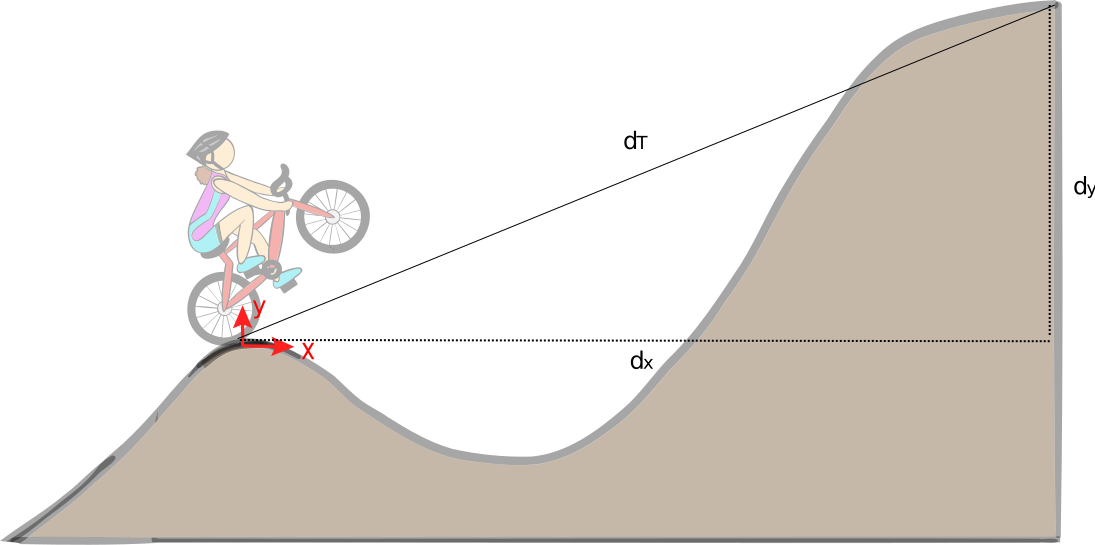
Figure 2: The total distance between the top of the hills \(d_T\) is shown. It can be calculated using the horizontal distance \(d_x\) and the vertical distance \(d_y\) between the top of the hills.
It’s clear that the total distance is the hypotenuse of a right triangle, so
\begin{equation}
\label{Biker_distanciasTotales}
d_T = \sqrt{ (d_x)^2 + (d_y)^2}.
\end{equation}
We already know the vertical distance, which is 10 meters. Thus, all we need to find is the total horizontal distance. Along X, the biker has constant speed, and so the total distance is simply given by
\begin{equation}
\label{Biker_distanciaX}
d_x = v_x t.
\end{equation}
We know the time (found in (a)), but we don’t know \(v_x\). To find \(v_x\), we have to use more information. They tell us that the initial angle for the jump is of 45 degrees. With that angle and the velocity along Y, we can find the velocity along X. To do this, consider figure 3, which illustrates the initial velocity and its components along X and Y.
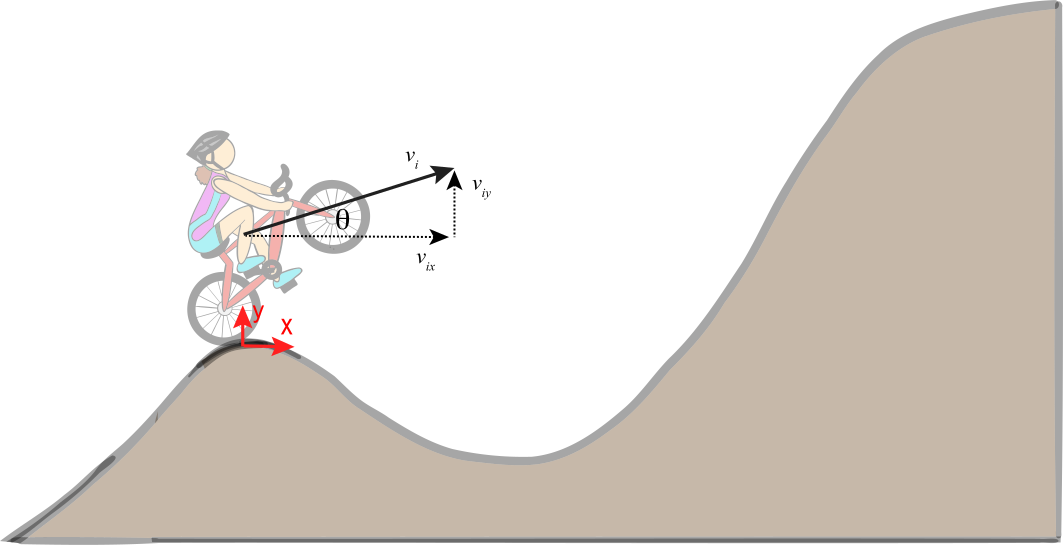
Figure 3: Magnitudes of the components of the initial velocity.
From here, it is clear that
\begin{equation}
\frac{v_{i_y}}{v_x} = \tan \theta.
\end{equation}
Thus,
\begin{equation}
v_x = \frac{v_{i_y}}{\tan \theta}.
\end{equation}
Since we know the initial velocity along Y and the angle, we can then use this in equation \eqref{Biker_distanciaX} to find \(d_x\):
\begin{equation}
d_x = \frac{v_{i_y} t}{ \tan \theta} .
\end{equation}
Let’s put in the numerical values:
\begin{equation}
d_x = \frac{(14 \, \text{m/s}) (1.43 \, \text{s})}{\tan (45^\circ)}.
\end{equation}
So
\begin{equation}
d_x = 20 \, \text{m}.
\end{equation}
Finally, use this in equation \eqref{Biker_distanciasTotales} to find the total distance:
\begin{equation}
d_T = \sqrt{ (20 \, \text{m})^2 + (10 \, \text{m})^2}.
\end{equation}
The result is
\begin{equation}
d_T = 22.36 \, \text{m}.
\end{equation}



Leave A Comment