
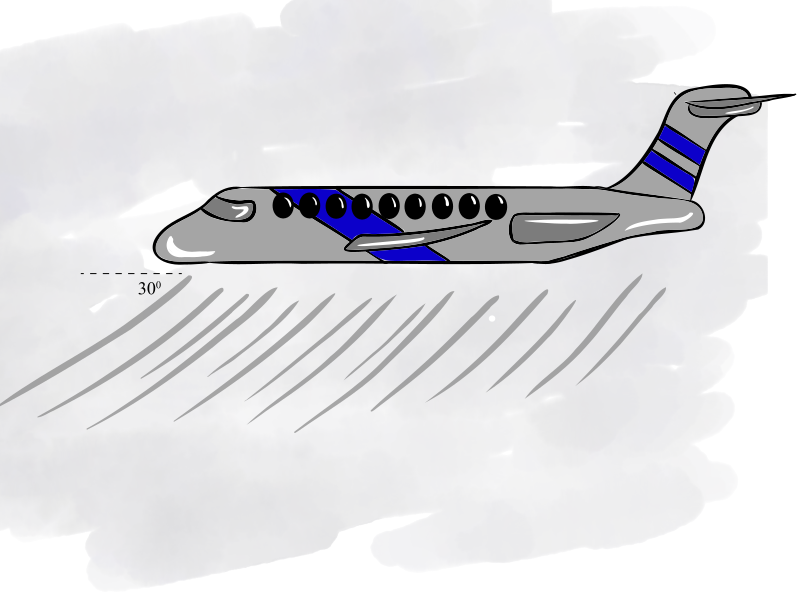
A commercial airliner heading to Hawaii cruises at 36000 ft (~11000 m) above the pacific ocean, maintaining a constant speed of \(257 \,\text{m}/\text{s}\) as shown by the in-flight data sensors. The plane suddenly enters a turbulent area, with winds averaging \(60 \,\text{m}/\text{s}\) and directed at a 30 degree angle with respect to the plane trajectory (see the figure).
(a) Calculate the speed of the airplane as measured from the ground.
(b) What is the distance between the trajectory in the case the plane encounters the winds for a full minute, and the trajectory in the case there is no wind at all? What if the plane encounters the winds for a full hour?
a) With the corresponding coordinate system, define the relative velocities respect to the air and to the ground.
b) Try to find the difference of the positions with the equation of motion for an object that travels with constant speed for each position.
a) The equation for the velocity of the airplane relative to the air is:
\begin{equation*}
\vec{v}_{P/A}=\vec{v}_{P/G}-\vec{v}_{A/G},
\end{equation*}
where \(\vec{v}_{P/A}\) is the velocity of the airplane relative to the air, \(\vec{v}_{P/G}\) is the velocity of the airplane relative to the ground, and \(\vec{v}_{A/G}\) is the air’s velocity relative to the ground. With the given values, \(\vec{v}_{P/A}\) is equal to \(257\,\text{m/s}\,\hat{\textbf{i}}\), and \(\vec{v}_{A/G}\) actually is:
\begin{equation*}
\vec{v}_{A/G}=(-60\,\text{m/s})\cos(30^{\circ})\,\hat{\textbf{i}}+(60\,\text{m/s})\sin(30^{\circ})\,\hat{\textbf{j}}.
\end{equation*}
Then, solving for \(\vec{v}_{P/G}\) in the first equation, we get:
\begin{equation*}
\vec{v}_{P/G}\approx 205\,\text{m/s}\,\hat{\textbf{i}}+30\,\text{m/s}\,\hat{\textbf{j}}.
\end{equation*}
The speed of the plane measured from the ground is then the magnitude of this vector, explicitly,
\begin{equation*}
|\vec{v}_{P/G}|\approx 207\,\text{m/s}.
\end{equation*}
b) The distance between the no-wind trajectory and the real (wind) trajectory of the plane is then the difference of positions given by
\begin{equation*}
\Delta \vec{x}=\vec{x}_{P/G}-\vec{x}_{P/A}.
\end{equation*}
Each \(\vec{x}\) variable can be written as \(\vec{v} t\).
Using the numerical values in SI units \(t=1\,\text{minute}=60\,\text{s}\), we get
\begin{equation*}
\Delta \vec{x}\approx -3120\,\text{m}\,\hat{\textbf{i}}+1800\,\text{m}\,\hat{\textbf{j}}.
\end{equation*}
Thus, the plane will have a displacement along the X axis and the Y axis. The magnitude of this displacement is the distance, and it will be
\begin{equation*}
|\Delta \vec{x}|\approx 3602\,\text{m}.
\end{equation*}
For 1 hour (\(t=3600\,\text{s}\)), we obtain:
\begin{equation*}
\Delta \vec{x}\approx -187200\,\text{m}\,\hat{\textbf{i}}+108000\,\text{m}\,\hat{\textbf{j}}.
\end{equation*}
The magnitude of this displacement will be
\begin{equation*}
|\Delta \vec{x}|\approx 216120\,\text{m}\approx 216.1\,\text{km}.
\end{equation*}
For a more detailed explanation of any of these steps, click on “Detailed Solution”.
a) We’ve been asked to calculate the velocity of the plane with respect to the ground, \(\vec{v}_{P/G}\), and we are given the speed of the plane measured by the in-flight sensors. These sensors measure the velocity of the plane with respect to the air, \(\vec{v}_{P/A}\), which has a magnitude of \(257\,\text{m/s}\) in the turbulent area.
In general, the relative velocity between two objects A and B is given by the difference between A’s and B’s velocity with respect to the ground:
\begin{equation}
\vec{v}_{A/B}=\vec{v}_{A/G}-\vec{v}_{B/G},
\end{equation}
where \(\vec{v}_{A/B}\) is the velocity of A relative to B, \(\vec{v}_{A/G}\) is the velocity of A relative to the ground, and \(\vec{v}_{B/G}\) is B’s velocity relative to the ground. For the case of the airplane and the air, we can then write this equation as
\begin{equation}
\label{relative1}
\vec{v}_{P/A}=\vec{v}_{P/G}-\vec{v}_{A/G},
\end{equation}
where \(\vec{v}_{P/A}\) is the velocity of the airplane relative to the air, \(\vec{v}_{P/G}\) is the velocity of the airplane relative to the ground, and \(\vec{v}_{A/G}\) is the air’s velocity relative to the ground. Since we’ve been asked to calculate \(\vec{v}_{P/G}\) (the velocity of the plane with respect to the ground), then we can rewrite this equation in this manner:
\begin{equation}
\label{relative}
\vec{v}_{P/G}=\vec{v}_{A/G}+\vec{v}_{P/A},
\end{equation}
So, to continue, we need to find an explicit expression for \(\vec{v}_{P/A}\) and \(\vec{v}_{A/G}\). To do that, we start by choosing a coordinate system.
Let’s suppose that initially the plane is moving along the positive X axis, as shown in figure 1.
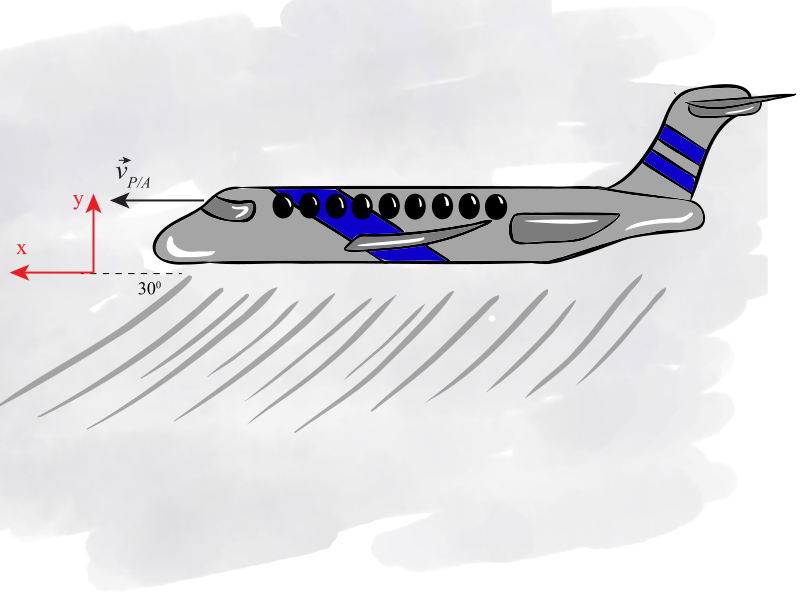
Figure 1: Coordinate system for the plane moving with velocity \(\vec{v}_{P/A}\) respect to the air.
Then, the velocity vector of the plane with respect to the air is
\begin{equation}
\label{vpa}
\vec{v}_{P/A}=257\,\text{m/s}\,\hat{\textbf{i}}.
\end{equation}
We know that \(\vec{v}_{A/G}\) (the velocity of the air with respect to the ground) has a magnitude of \(60\,\text{m/s}\) and traces an angle of \(30^{\circ}\) with respect to the plane’s trajectory, as indicated in figure 2.
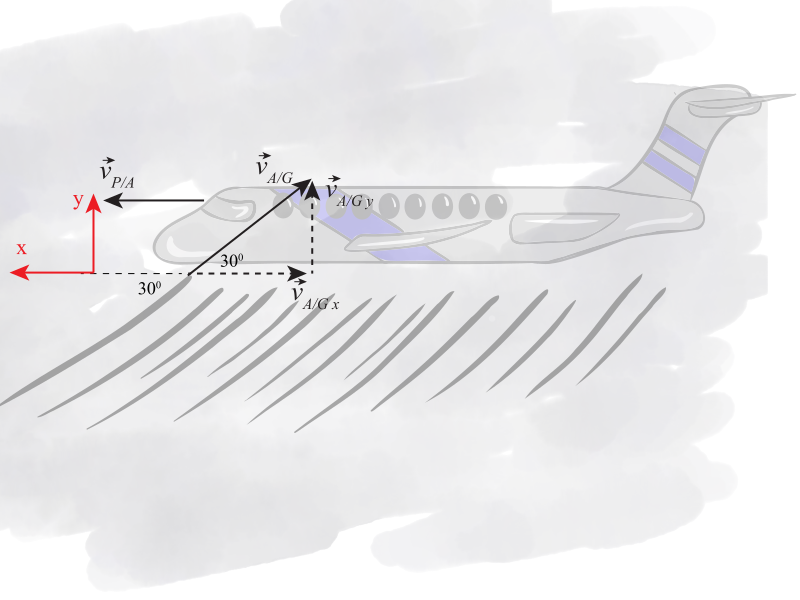
Figure 2: Complete coordinate system for the relative velocities.
Thus, we can write the velocity of the air with respect to the ground in terms of X and Y components:
\begin{equation}
\label{vdg2}
\vec{v}_{A/G}={v}_{{A/G}_x}\,\hat{\textbf{i}}+{v}_{{A/G}_y}\,\hat{\textbf{j}}.
\end{equation}
Using simple trigonometry and the numerical values, we get
\begin{equation}
\label{vag}
\vec{v}_{A/G}=(-60\,\text{m/s})\cos(30^{\circ})\,\hat{\textbf{i}}+(60\,\text{m/s})\sin(30^{\circ})\,\hat{\textbf{j}}.
\end{equation}
(The negative sign in the horizontal component corresponds to the wind going in the opposite direction of the coordinate axis, as shown in Figure 2.)
Hence, we can use equation \eqref{relative} and the explicit results given in equations \eqref{vpa} and \eqref{vag} to find the velocity of the plane with respect to the ground, namely
\begin{equation}
\vec{v}_{P/G}=\left((-60\,\text{m/s})\cos(30^{\circ})\,\hat{\textbf{i}}+(60\,\text{m/s})\sin(30^{\circ})\,\hat{\textbf{j}}\right)+257\,\text{m/s}\,\hat{\textbf{i}}.
\end{equation}
After performing the vector sum, this yields
\begin{equation}
\vec{v}_{P/G}\approx 205\,\text{m/s}\,\hat{\textbf{i}}+30\,\text{m/s}\,\hat{\textbf{j}}.
\end{equation}
The speed of the plane measured from the ground is then the magnitude of this vector, explicitly,
\begin{equation}
|\vec{v}_{P/G}|=\sqrt{(205\,\text{m/s})^2+(30\,\text{m/s})^2},
\end{equation}
\begin{equation}
|\vec{v}_{P/G}|\approx 207\,\text{m/s}.
\end{equation}
b) For the final part of the problem, they ask us to calculate the distance between the real trajectory (with wind for a full minute) and the trajectory if there was no wind. To find this distance, we need to calculate the plane’s position using the velocity measured with respect to the air and compare this position to the one that the plane would have if there was no wind. The kinematic equation for the position in terms of time for a motion with constant velocity is just \(\vec{x}=\vec{v}t\). So, taking into account the velocity of the plane with respect to the air, the position is
\begin{equation}
\label{xpa}
\vec{x}_{P/A}=\vec{v}_{P/A}t.
\end{equation}
And the position, assuming that there is no wind, is given by the velocity of the plane with respect to the ground (in the case where there is no wind, \(\vec{x}_{P/A}\) is the same as \(\vec{x}_{P/G}\), as can be seeing from equation \eqref{relative}). Hence, in the case of there being no wind, we get
\begin{equation}
\label{xpg}
\vec{x}_{P/G}=\vec{v}_{P/G}t.
\end{equation}
The distance between the no-wind trajectory and the real (wind) trajectory of the plane is then the difference given by
\begin{equation}
\Delta \vec{x}=\vec{x}_{P/G}-\vec{x}_{P/A}.
\end{equation}
Using the explicit expressions for the positions, given by equations \eqref{xpa} and \eqref{xpg}, we obtain
\begin{equation}
\label{desv}
\Delta \vec{x}=\vec{v}_{P/G}t-\vec{v}_{P/A}t.
\end{equation}
Using the numerical values in SI units \(t=1\,\text{minute}=60\,\text{s}\), we get
\begin{equation}
\Delta \vec{x}=(205\,\text{m/s}\,\hat{\textbf{i}}+30\,\text{m/s}\,\hat{\textbf{j}})(60\,\text{s})-(257\,\text{m/s}\,\hat{\textbf{i}})(60\,\text{s}),
\end{equation}
\begin{equation}
\Delta \vec{x}\approx -3120\,\text{m}\,\hat{\textbf{i}}+1800\,\text{m}\,\hat{\textbf{j}}.
\end{equation}
Thus, the plane will have a displacement along the X axis and the Y axis. The magnitude of this displacement is the distance, and it will be
\begin{equation}
|\Delta \vec{x}|=\sqrt{(-3120\,\text{m})^2+(1800\,\text{m})^2},
\end{equation}
\begin{equation}
|\Delta \vec{x}|\approx 3602\,\text{m}.
\end{equation}
We can also make this calculation for 1 hour if we take \(t=3600\,\text{s}\) in equation \eqref{desv}. Explicitly,
\begin{equation}
\Delta \vec{x}=(205\,\text{m/s}\,\hat{\textbf{i}}+30\,\text{m/s}\,\hat{\textbf{j}})(3600\,\text{s})-(257\,\text{m/s}\,\hat{\textbf{i}})(3600\,\text{s}),
\end{equation}
\begin{equation}
\Delta \vec{x}\approx -187200\,\text{m}\,\hat{\textbf{i}}+108000\,\text{m}\,\hat{\textbf{j}}.
\end{equation}
Again, the plane will have a displacement along the X axis and the Y axis. The magnitude of this displacement will be
\begin{equation}
|\Delta \vec{x}|=\sqrt{(-187200\,\text{m})^2+(108000\,\text{m})^2},
\end{equation}
\begin{equation}
|\Delta \vec{x}|\approx 216120\,\text{m}\approx 216.1\,\text{km},
\end{equation}
which is a considerable number. It is equivalent to the distance between Venice and Milan!



Leave A Comment