

Teo releases a 0.050 kg tennis ball from the top of the One WTC Tower (541 m). A witness watches as the ball drop to the ground, bounces once, bounces again, and finally reaches a height of 20 m after the third bounce.
a) Calculate the percentage of mechanical energy the ball loses each time it hits the ground (assume the percentage is the same for all bounces).
b) Teo decides to make the experiment more interesting, and places a trampoline by the tower. He figures that by doing this, the percentage of energy loss will be reduced in half. This time, he throws the ball downwards (instead of releasing it) and measures the height of the ball after the first bounce to be exactly the same as the initial height. Calculate the initial speed Teo gave to the ball.
a) Define the ball’s final energy as a function of its initial energy and a constant; this constant will represent the percentage of dissipated mechanical energy.
b) Similar to part (a). Apply Conservation of Energy to solve for the final speed.
a) The energy after the first bounce is simply:
\begin{equation*}
E_{m_1} = E_{m_i} (1 – P),
\end{equation*}
and for the thrid bounce:
\begin{equation*}
E_{m_3} = (m g h_i) (1-P)^3.
\end{equation*}
Each mechanical energy after the \({j-th}\) bounce is \(E_{m_j} = mgh_j\) for each \(j\) case. Substituting the potential energy, solving for \(P\), and using some algebra, we get:
\begin{equation*}
P = 1 – \sqrt[3]{ \frac{h_f}{h_i} },
\end{equation*}
which, with numerical values, is:
\begin{equation*}
P = 0.667.
\end{equation*}
b) Note that the mechanical energy dissipated is not \(P\), but is instead \(P/2\). Applying Conservation of Energy, we get:
\begin{equation*}
(mgh_i) = \left( \frac{1}{2} m v^2 + mgh_i \right) \left(1-\frac{P}{2}\right).
\end{equation*}
Solving for \(v\), and using some algebra, we obtained:
\begin{equation*}
v = \sqrt{2gh_i\left( \frac{1}{\left(1-\frac{P}{2}\right)} – 1\right)},
\end{equation*}
which, with numerical values, is:
\begin{equation*}
v = 72.77 \, \text{m/s}.
\end{equation*}
For a more detailed explanation of any of these steps, click on “Detailed Solution”.
(a) An easy way of finding the percentage of energy lost for each bounce goes as follows. Suppose that the percentage of energy that is lost in the first bounce is \(P\). Hence, the percentage of energy that is retained is \(1-P\). For example, if the energy that is lost is 30 percent of the initial energy, then the energy that is retained is 70 percent. So if the initial energy is \(E_{m_i}\), then the energy after the first bounce is simply
\begin{equation}
\label{Building_PrimerRebote}
E_{m_1} = E_{m_i} (1 – P).
\end{equation}
From here we cannot yet find \(P\) because we need \(E_{m_1}\). So we need more equations.
When the ball bounces for a second time, it will again loose some energy. The reasoning is the same as above, and the percentage of energy loss is the same for every bounce (as they said in the prompt). So the energy after the second bounce will be given by
\begin{equation}
E_{m_2} = E_{m_1} (1 – P),
\end{equation}
where, recall, \(E_{m_1}\) is the energy after the first bounce. Using \eqref{Building_PrimerRebote}, we can write this equation as
\begin{equation}
\label{Building_SegundoRebote}
E_{m_2} = E_{m_i} (1 – P) (1-P).
\end{equation}
But this is not enough, since we do not know \(E_{m_2}\). Let’s keep on going.
When the ball bounces a third time, it will loose energy again. So the energy after the third bounce is
\begin{equation}
E_{m_3} = E_{m_2} (1 – P).
\end{equation}
If we use \eqref{Building_SegundoRebote} here, we get
\begin{equation}
\label{Building_TercerRebote}
E_{m_2} = E_{m_i} (1 – P) (1-P)(1-P).
\end{equation}
Or, equivalently
\begin{equation}
\label{Building_TercerReboteALaTres}
E_{m_2} = E_{m_i} (1 – P)^3.
\end{equation}
Since we know the initial height and the final height, we can easily find \(P\) from here. Initially the ball only has gravitational potential energy, since the ball is not moving and so there is no kinetic energy ( \(\frac{1}{2} mv^2 =0 \) because \(v =0\)). Hence, initially the mechanical energy is
\begin{equation}
E_{m_i} = mgh_i,
\end{equation}
where \(h_i\) is the initial height (that we know). Clearly, we are measuring the heights with respect to the floor, and so we are using this coordinate system:
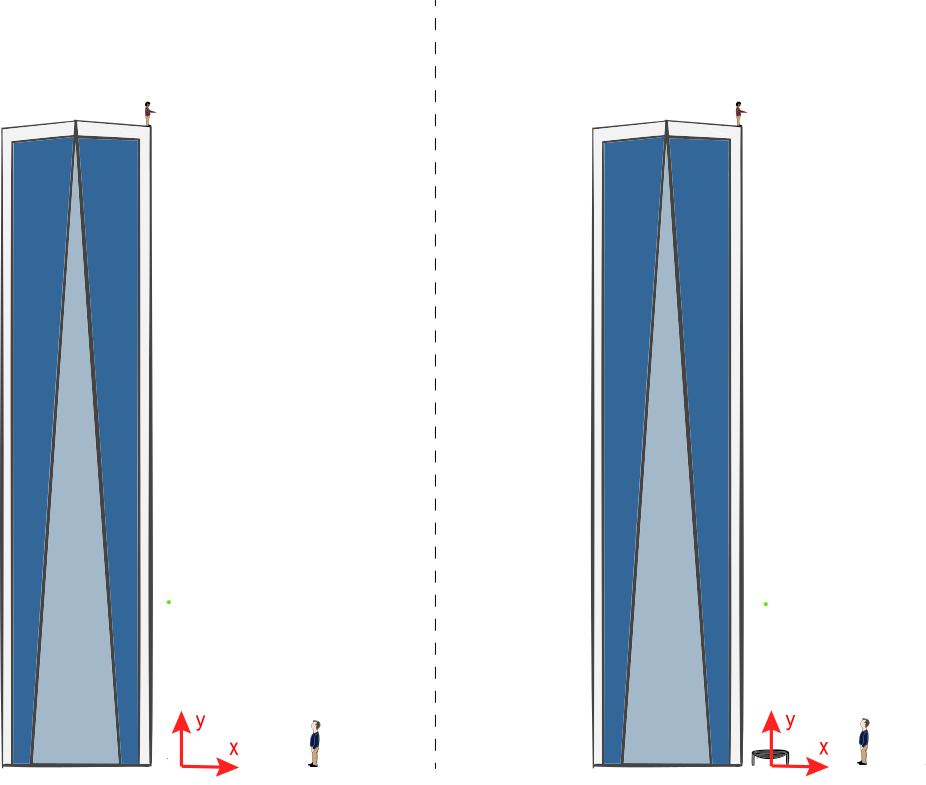
We place the coordinate system on the ground. On the left without the trampoline and on the right with it.
\begin{equation}
\label{Building_AquiVaETres}
E_{m_3} = (m g h_i) (1-P)^3.
\end{equation}
All that remains to do is to find \(E_{m_3}\). When the ball reaches 20 meters, the ball is at the point of maximum height, which means it has no speed. So, again, there is only gravitational potential energy:
\begin{equation}
E_{m_3} = m g h_f,
\end{equation}
where \(h_f\) is the final height, which we also know. If we use this in equation \eqref{Building_TercerReboteALaTres}, we get
\begin{equation}
(m g h_f) = m g h_i (1-P)^3.
\end{equation}
If we divide by \(mg\) in both sides, we get
\begin{equation}
h_f = h_i (1-P)^3.
\end{equation}
Now divide by \(h_i\), to get
\begin{equation}
\frac{h_f}{h_i} = (1-P)^3.
\end{equation}
The cubic root of the last expression gives us
\begin{equation}
\sqrt[3]{ \frac{h_f}{h_i} } = 1 – P.
\end{equation}
So, after rearranging terms, we get
\begin{equation}
P = 1 – \sqrt[3]{ \frac{h_f}{h_i} }.
\end{equation}
Finally, insert here the numerical values:
\begin{equation}
P = 1 – \sqrt[3]{ \frac{(20 \, \text{m})}{(541 \, \text{m})} }
\end{equation}
to get
\begin{equation}
P = 0.667.
\end{equation}
(b) The percentage of energy loss is half of the one found in (a). Now, the ball is not released but it is thrown with some initial speed downwards. This is the speed that we need to find. The reasoning is very similar to the one in (a). The mechanical energy after the first bounce is simply
\begin{equation}
E_{m_1} = E_{m_i} (1-P’),
\end{equation}
where \(P’\) is the new percentage of energy that is lost. They tell us that it is half of \(P\), and so we can write
\begin{equation}
\label{Building_EnergiaSegundaParte}
E_{m_1} = E_{m_i} \left(1- \left(\frac{P}{2}\right)\right).
\end{equation}
Now, in order to find the initial speed with this equation we need to write explicitly the initial and final mechanical energies.
Since the ball has some initial speed, the initial mechanical energy consists of both kinetic energy and gravitational potential energy:
\begin{equation}
E_{m_i} = \frac{1}{2} m v^2 + mgh_i.
\end{equation}
So equation \eqref{Building_EnergiaSegundaParte} becomes
\begin{equation}
\label{Building_energiaParaReemplazar}
E_{m_1} = \left( \frac{1}{2} m v^2 + mgh_i \right) \left(1-\frac{P}{2}\right).
\end{equation}
After bouncing, they tell us that the final height is the same as the initial height. At that point of maximum height, the ball has no speed, which means it has no kinetic energy. Therefore, all the mechanical energy is potential energy:
\begin{equation}
E_{m_1} = mg h_1.
\end{equation}
But they say that the final height is the same as the initial height, so
\begin{equation}
E_{m_1} = mg h_i.
\end{equation}
Use this in equation \eqref{Building_energiaParaReemplazar} to get
\begin{equation}
(mgh_i) = \left( \frac{1}{2} m v^2 + mgh_i \right) \left(1-\frac{P}{2}\right).
\end{equation}
From this equation we can then find \(v\), since we know all the other variables. First, divide by \(\left(1-\frac{P}{2}\right)\) to get
\begin{equation}
\frac{mgh_i}{\left(1-\frac{P}{2}\right)} = \frac{1}{2} m v^2 + mgh_i .
\end{equation}
Then, move the \(mgh_i\) term to the other side. This gives us
\begin{equation}
\frac{mgh_i}{\left(1-\frac{P}{2}\right)} – mgh_i = \frac{1}{2} m v^2 .
\end{equation}
We can now take common factor of \(mgh_i\):
\begin{equation}
mgh_i\left( \frac{1}{\left(1-\frac{P}{2}\right)} – 1\right) = \frac{1}{2} m v^2.
\end{equation}
Now multiply everything by \(2/m\):
\begin{equation}
2gh_i\left( \frac{1}{\left(1-\frac{P}{2}\right)} – 1\right) = v^2.
\end{equation}
Finally, take the square root of the expression:
\begin{equation}
\sqrt{2gh_i\left( \frac{1}{\left(1-\frac{P}{2}\right)} – 1\right)} = v.
\end{equation}
If we insert the numerical values, we get
\begin{equation}
\sqrt{2(9.8 \, \text{m/s}^2)(540 \, \text{m})\left( \frac{1}{\left(1-\frac{0.667}{2}\right)} – 1\right)} = v.
\end{equation}
The result is
\begin{equation}
v = 72.77 \, \text{m/s}.
\end{equation}


Leave A Comment