

Sophia is returning home from the grocery store with two bags in hand (each of mass 1.0 kg.) Determined to make her ride as smooth as possible, she is riding her signature red skateboard with her purple hair streaming out of a black helmet. She initially skateboards in a straight line at a constant speed of \(9.8 \, \text{m/s}\) Her right arm begins to cramp, and she throws one of the bags backwards in such a way that the bag has a velocity of zero with respect to the ground. Just after throwing the bag, Sophia finds herself going faster at a new speed of \(10.2 \, \text{m/s}\).
a) What is Sophia’s mass? (Ignore the mass of the skateboard and the friction).
b) What would Sophia’s final speed have been if she had thrown both bags at the same time? Would you change your answer if she had thrown one bag after the other one? In all cases, assume the bag’s final velocity is zero.
a) Apply Conservation of Momentum. Consider there are three objects; we know two objects’ masses, and the third object’s mass is unknown.
b) Same hint as part (a), but the unknown variable is velocity rather than mass.
a) Conservation of Momentum \(\vec{P}_i=\vec{P}_f\) can be written as:
\begin{equation*}
m_{b1} {v}_{{b1}_i}+m_{b2}{v}_{{b2}_i} + m_{s}{v}_{{s}_i} = m_{b1}{v}_{{b1}_f}+m_{s}{v}_{{s}_f}.
\end{equation*}
Using some algebra to solve for \(m_s\), we get:
\begin{equation*}
m_{s}=m_{b1}\frac{(v_f-2v_i)}{(v_i-v_f)},
\end{equation*}
Plugging in numerical values yields:
\begin{equation}
m_{s}=23.5 \, \text{kg}.
\end{equation}
b) In this case, Conservation of Momentum gives us:
\begin{equation*}
m_{b1} {v}_{{b1}_i}+m_{b2}{v}_{{b2}_i} + m_{s}{v}_{{s}_i} = m_{s}{v}_{{s}_f}.
\end{equation*}
Solving for \(v_f\):
\begin{equation*}
v_f=\frac{2m_{b1}v_i}{m_s}+v_i,
\end{equation*}
or
\begin{equation*}
v_f=10.63 \, \text{m/s}.
\end{equation*}
For a more detailed explanation of any of these steps, click on “Detailed Solution”.
a) Using the mass of the two bags, as well as Sophia’s initial and final speed, we are asked to find Sophia’s mass. In order to do this, we’ll have to use the conservation of linear momentum.
The linear momentum of a system is conserved in the absence of external forces. In this case, let the system consist of Sophia and her two bags (we are told to ignore the skateboard’s mass). Notice that if we were to choose only Sophia to be the system, then her linear momentum would not be conserved because there would be external forces, such as the force the bags produce on her hands while she moves. By treating Sophia and the bags as a single system, we make sure that the forces between the bags and the hands are only internal forces of the system, and so they do not change the linear momentum (of the system).
Notice that in the direction of motion, there are no external forces over the system (they tell us to ignore the friction). Hence, the momentum along the direction of motion is conserved;
\begin{equation}
\label{first}
\vec{P}_i=\vec{P}_f,
\end{equation}
where \(\vec{P}_i\) is the initial momentum and \(\vec{P}_f\) the final momentum of the system. Both the initial and final momenta of the system are determined by the masses of the different objects of the system and their velocities. In particular, the initial momentum of the system is given by the sum of the initial momentum of each bag, and Sophia:
\begin{equation}
\label{initialMom1}
\vec{P}_i=m_{b1} \vec{v}_{{b1}_i}+m_{b2} \vec{v}_{{b2}_i}+m_{s} \vec{v}_{{s}_i},
\end{equation}
where the subscript ‘\(b_1\)’ refers to the first bag, ‘\(b_2\)’ refers to the second bag and ‘\(s\)’ to Sophia (the initial velocities of all the objects are the same, but it is helpful to study the velocity of each object individually and so we use different labels). Similarly, for the final momentum we have:
\begin{equation}
\label{finalMom11}
\vec{P}_f=m_{b1} \vec{v}_{{b1}_f}+m_{b2} \vec{v}_{{b2}_f}+m_{s} \vec{v}_{{s}_f}.
\end{equation}
If we use \eqref{finalMom11} for the final momentum and \eqref{initialMom1} for the initial momentum in equation \eqref{first}, we then get
\begin{equation}
\label{conservMom}
m_{b1} \vec{v}_{{b1}_i}+m_{b2} \vec{v}_{{b2}_i}+m_{s} \vec{v}_{{s}_i} = m_{b1} \vec{v}_{{b1}_f}+m_{b2} \vec{v}_{{b2}_f}+m_{s} \vec{v}_{{s}_f}.
\end{equation}
Now, in order to express explicitly the different velocities, the next step is to consider a coordinate system. Suppose that we take the direction of motion to be the positive X axis, as illustrated in figure 1.
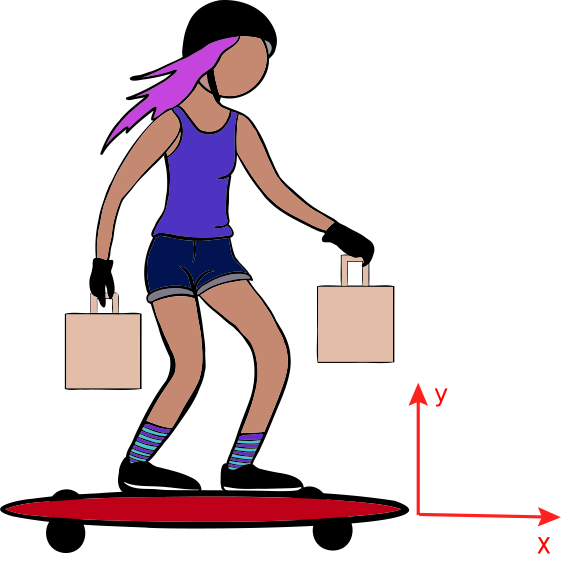
Figure 1: We place the coordinate system on the floor such that the X axis coincides with the direction of Sophia’s motion.
In this case, the initial velocities of all the objects are positive in X, and the final velocities of one bag and of Sophia are also positive in X. Furthermore, the final velocity of the bag she throws is zero (according to the prompt). Hence, \eqref{conservMom} becomes:
\begin{equation}
\label{conservMomUnit}
m_{b1} {v}_{{b1}_i}\,\hat{\textbf{i}}+m_{b2}{v}_{{b2}_i}\,\hat{\textbf{i}} + m_{s}{v}_{{s}_i} \,\hat{\textbf{i}} = m_{b1}{v}_{{b1}_f}\,\hat{\textbf{i}}+0 \,\hat{\textbf{i}}+m_{s}{v}_{{s}_f}\,\hat{\textbf{i}}.
\end{equation}
Focusing on the magnitudes, this equation states that
\begin{equation}
\label{conservMomUnitMagn}
m_{b1} {v}_{{b1}_i}+m_{b2}{v}_{{b2}_i} + m_{s}{v}_{{s}_i} = m_{b1}{v}_{{b1}_f}+m_{s}{v}_{{s}_f}.
\end{equation}
Now, since the initial speeds of the bags and Sophia are the same, we can just use \(v_i\) in the last equation. Also, the final speed of the bag that Sophia still holds is the same as the final speed of Sophia, and so we can simply use \(v_f\) for these. We then get
\begin{equation}
\label{conservMomUnitMagnV}
m_{b1} v_i+m_{b2}v_i + m_{s}v_i = m_{b1}v_f+m_{s}{v}_f.
\end{equation}
Notice that we know all of the variables here except for Sophia’s mass. Hence, we can use this equation to find the mass. First, move \(m_{s}{v}_f\) to the left and \(m_{b1} v_i+m_{b2}v_i\) to the right:
\begin{equation}
m_{s}v_i-m_{s}v_f=m_{b1}v_f-m_{b1}v_i-m_{b2}v_i.
\end{equation}
Let’s factorize \(m_s\) on the left, and use that \(m_{b1}=m_{b2}\) (because the bags have the same mass):
\begin{equation}
m_{s}(v_i-v_f)=m_{b1}v_f-2m_{b1}v_i.
\end{equation}
Let’s divide by \((v_i-v_f)\):
\begin{equation}
m_{s}=\frac{m_{b1}v_f-2m_{b1}v_i}{(v_i-v_f)}.
\end{equation}
We can factorize \(m_{b1}\):
\begin{equation}
m_{s}=m_{b1}\frac{(v_f-2v_i)}{(v_i-v_f)}.
\end{equation}
We can now insert the numerical values for the different variables in order to find Sophia’s mass:
\begin{equation}
m_{s}=\frac{{(1\, \text{kg})}({10.2 \,\text{m}/\text{s}}-2\times{9.8 \,\text{m}/\text{s}})}{{(9.8 \,\text{m}/\text{s})}-{(10.2 \,\text{m}/\text{s})}}.
\end{equation}
The result is
\begin{equation}
m_{s}=23.5 \,\text{kg}.
\end{equation}
b) In order to find Sophia’s final speed in the case were she throws the two bags and not just one, we can use the conservation of linear momentum along the X axis again. Indeed, we can use equation \eqref{conservMomUnitMagn} again except that the final speed of the first bag (labelled \(v_{b1_{f}}\)) is also zero because Sophia throws both bags at the same time:
\begin{equation}\label{conservationAngMomentum2}
m_{b1} {v}_{{b1}_i}+m_{b2}{v}_{{b2}_i} + m_{s}{v}_{{s}_i} = m_{s}{v}_{{s}_f}
\end{equation}
We can now use the fact that the initial speeds of the bags and Sophia are the same, and so we can use ‘\(v_i\)’ to represent this speed:
\begin{equation}\label{conservationAngMomentum3}
m_{b1} {v}_{i}+m_{b2}{v}_{i} + m_{s}{v}_{_i} = m_{s}{v}_{{s}_f}.
\end{equation}
And now use the fact that \(m_{b1}+m_{b2}=2m_{b1}\) because the masses of the two bags are the same:
\begin{equation}
\label{conservationAngMomentum4}
2m_{b1}v_i+m_sv_i=m_{s}v_f.
\end{equation}
If we divide by \(m_s\), we get an expression for \(v_{f}\):
\begin{equation}
\label{conservationAngMomentum5}
\frac{2m_{b1}v_i+m_sv_i}{m_s}=\frac{2m_{b1}v_i}{m_s}+v_i=v_f,
\end{equation}
where we distributed the ratio in two terms.
Finally, let’s insert the numerical values here:
\begin{equation}\label{conservationAngMomentum6}\frac{{2({1 \,\text{kg}})( {9.8 \,\text{m}/ \text{s}})}}{{23.5\,\text{kg}}}+ {9.8 \,\text{m}/ \text{s}}= v_f.\end{equation}
The result is
\begin{equation}
v_f=10.63 \,\text{m}/ \text{s}.
\end{equation}
This would be Sophia’s final speed if she had thrown the two bags (notice that it is a bit greater than the final speed in (a), when she only throws one bag).
Finally, we need to say if this final speed would be the same if she throws one bag first and then the other bag (as opposed to throwing both at the same time). But the order in which she throws the bags does not matter for the final speed. One easy way to see this is the following one.
Since the linear momentum is conserved along X, then the linear momentum in X at any instant of time is the same as the linear momentum at any other instant of time. So, suppose that at \(t_1\) she has the two bags, at \(t_2\) she throws one bag and at \(t_3\) she throws the second bag. Then, in order to find the speed after \(t_3\), we can just equate the linear momentum at that time with the linear momentum at \(t_1\) (we could do the same with the linear momentum at \(t_2\)). But if we do that, we get equation \eqref{conservMomUnitMagn} again. And so the answer for \(v_f\) will be the same as before. In short, throwing one bag and then the other gives the same speed as throwing both at the same time. All that matters for Sophia’s final speed, besides her own speed, is the initial and final speeds of the bags.


Leave A Comment