

Consider a fluid flowing through the Venturi tube shown in the picture. Find the \(\Delta h\) in terms of the initial speed and the radii.
Use the formula from hydrostatic pressure, then Bernoulli’s equation to relate the change of height with the velocities. Finally, use the continuity equation to find a relation between the velocities, to get the change of height with the known variables.
Since the pressure is:
\begin{equation*}
P = P_{\text{atm}} + \rho g h.
\end{equation*}
Then, the difference of pressures is:
\begin{equation*}
P_A – P_B = \rho g \Delta h.
\end{equation*}
By Bernoulli’s equation we have:
\begin{equation*}
P_A + \rho g h_A + \frac{1}{2} \rho v_A^2 = P_B + \rho g h_B + \frac{1}{2} \rho v_B^2,
\end{equation*}
and with the relation obtained before, we get:
\begin{equation*}
\rho g \Delta h = \frac{1}{2} \rho (v_B^2 – v_0^2).
\end{equation*}
By continuity’s equation, we can relate the velocities as:
\begin{equation*}
A_A v_A = A_B v_B,
\end{equation*}
where using the geometry of the cross-sectional areas we have:
\begin{equation*}
v_B = \left( \frac{r_A}{r_B} \right)^2 v_0.
\end{equation*}
Since \(r_A = R\) and \(r_B = \frac{R}{3}\), and replacing the velocity \(v_B\) found before we get, after some algebra:
\begin{equation*}
\Delta h= 40 \frac{v_0^2}{g}.
\end{equation*}
For a more detailed explanation of any of these steps, click on “Detailed Solution”.
In order to find the difference in height of the column in terms of the radii of the tube and the speed of the fluid, we should first compare the hydrostatic pressure at two points in the tube right below the columns. This will give us an expression relating the height difference in the columns with the pressure difference between both sections of the tube. We can then use the Bernoulli equation to relate this pressure difference (and thus the height difference in the columns) with the speeds at both regions of the tube. Finally, we should use the continuity equation to relate the fluid speed with the radius of the tube.
In order to write an expression for the height difference \(\Delta h\), let’s compare points \(A\) and \(B\), which are located right below the columns as shown in figure 1.
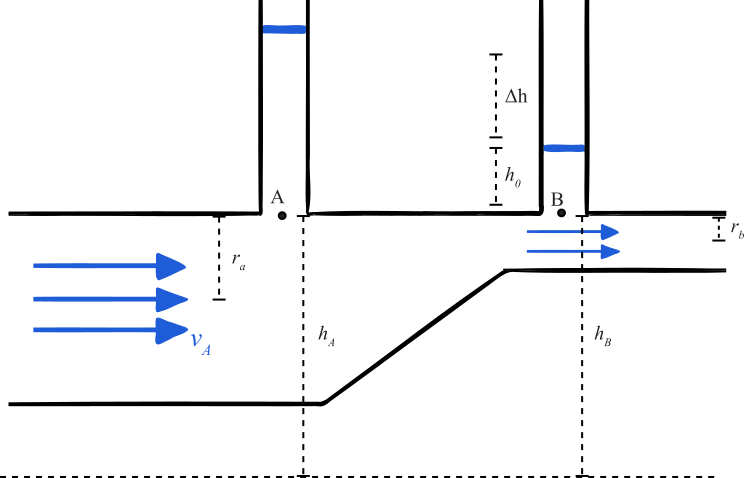
Figure 1: Water flowing from the left through the Venturi tube at velocity \(v_A\). At point B the fluid has a velocity of \(v_B\). The pressure difference between points A and B can be found from the difference in the height of the free surfaces above A and B \(\Delta h\). The heights of points A and B measured with respect to some coordinate system is also presented as \(h_A\) and \(h_B\) respectively.
The hydrostatic pressure at point A is given by the atmospheric pressure and the pressure exerted by the column of fluid. As shown in figure 1, the height of the column of liquid above point \(A\) is \(h_0 + \Delta h\). Hence, we can write the hydrostatic pressure at point \(A\) as
\begin{equation}
\label{EQ:PA}
P_A = P_{atm} + \rho g (h_0 + \Delta h) = P_{atm} + \rho g h_0 + \rho g \Delta h.
\end{equation}
Similarly, the height of the column of liquid above point \(B\) is \(h_0\). Therefore, the hydrostatic pressure at point \(B\) is given by
\begin{equation}
\label{EQ:PB}
P_B = P_{atm} + \rho g h_0.
\end{equation}
If we subtract eqs. \eqref{EQ:PA} and \eqref{EQ:PB}, we obtain
\begin{equation}
P_A – P_B = P_{atm} + \rho g h_0 + \rho g \Delta h \, – ( P_{atm} + \rho g h_0 ).
\end{equation}
The first two terms cancel out with the last two terms. This gives
\begin{equation}
\label{EQ:PAB1}
P_A – P_B = \rho g \Delta h.
\end{equation}
We now have an expression relating the height difference of the columns \(\Delta h\) with the difference in pressure between both sections of the tube. We should now relate this pressure difference with the speed of the fluid and the dimensions of the tube. In order to do this, we will use the Bernoulli equation.
The Bernoulli equation for points \(A\) and \(B\) is given by
\begin{equation}
P_A + \rho g h_A + \frac{1}{2} \rho v_A^2 = P_B + \rho g h_B + \frac{1}{2} \rho v_B^2,
\end{equation}
where \(P_A\) is the pressure at point \(A\), \(\rho\) is the density of the fluid, \(h_A\) is the height of point \(A\) relative to a fixed reference frame (as shown in the previous figure), and \( v_A\) is the flow speed at point \(A\). The variable names are analogous for point \(B\).
As shown in the second figure, \(h_A = h_B\). Hence, the the second terms on each side of the equation cancel out. This gives
\begin{equation}
P_A + \frac{1}{2} \rho v_A^2 = P_B + \frac{1}{2} \rho v_B^2,
\end{equation}
and after rearranging terms we get
\begin{equation}
P_A – P_B = \frac{1}{2} \rho v_B^2 – \frac{1}{2} \rho v_A^2
= \frac{1}{2} \rho (v_B^2 – v_A^2),
\end{equation}
and since \(v_A = v_0\), we obtain
\begin{equation}
P_A – P_B = \frac{1}{2} \rho (v_B^2 – v_0^2).
\end{equation}
We have obtained another equation for the difference in pressure between points \(A\) and \(B\). If we substitute eq. \eqref{EQ:PAB1} in this equation, we obtain
\begin{equation}
\rho g \Delta h = \frac{1}{2} \rho (v_B^2 – v_0^2).
\end{equation}
Cancelling out \(\rho\) gives
\begin{equation}
\label{EQ:B}
g \Delta h = \frac{1}{2} (v_B^2 – v_0^2),
\end{equation}
and after dividing by \(g\), we get
\begin{equation}
\Delta h = \frac{1}{2g} (v_B^2 – v_0^2)
\end{equation}
Now, the only unknown variable is \(v_B\), which we can write in terms of the other known variables by using the continuity equation.
The volume flow rate \(I\) of a fluid at a point \(P\) in a liquid flowing through a tube is given by
\begin{equation}
\label{EQ:I}
I_{V,P} = A_P v_P,
\end{equation}
where \(A_P\) is the cross-sectional area of the container and \(v_P\) is the speed of the fluid at point \(P\). Assuming that the motion of the fluid is constant at all points, the volume flow rate is constant. Therefore, for points A and B we have
\begin{equation}
I_{V,A} = I_{V,B}.
\end{equation}
From eq. \eqref{EQ:I}, we can rewrite this equation as
\begin{equation}
\label{EQ:C}
A_A v_A = A_B v_B,
\end{equation}
where \(A_A\) is the cross-sectional area of the tube at point \(A\), \(v_A\) is the speed of the fluid at point \(A\), and analogously for \(A_B\) and \(v_B\) at point \(B\).
For a circular cross-section of radius \(r\), its area \(A\) is given by
\begin{equation}
A = \pi r^2.
\end{equation}
Hence, we can rewrite eq. \eqref{EQ:C} as
\begin{equation}
\pi r_A^2 v_A = \pi r_B^2 v_B,
\end{equation}
where \(r_A\) and \( r_B\) are the cross-sectional radii on point \(A\) and \(B\) in the tube, as shown in the second figure. Dividing this equation by \(\pi r_B^2\) gives
\begin{equation}
v_B = \frac{\pi r_A^2 v_A}{\pi r_B^2} = \frac{r_A^2}{r_B^2} v_A,
\end{equation}
and since \(v_A = v_0\), we get
\begin{equation}
v_B = \frac{r_A^2}{r_B^2} v_0
= \left(\frac{r_A}{r_B}\right)^2 v_0.
\end{equation}
Finally, substituting this in eq. \eqref{EQ:B} yields
\begin{equation}
\Delta h = \frac{1}{2g} \left( \left(\left(\frac{r_A}{r_B}\right)^2 v_0\right)^2 – v_0^2\right)
= \frac{1}{2g} \left( \left(\frac{r_A}{r_B}\right)^4 v_0^2 – v_0^2\right)
= \frac{v_0^2}{2g} \left( \left(\frac{r_A}{r_B}\right)^4 – 1\right),
\end{equation}
and substituting \(r_A = R\) and \(r_B = \frac{R}{3}\) gives
\begin{equation}
\Delta h = \frac{v_0^2}{2g} \left( \left(\frac{R}{\left( \frac{R}{3} \right)}\right)^4 – 1\right)
= \frac{v_0^2}{2g} \left( 3^4 – 1\right)
= \frac{v_0^2}{2g} \left( 81 – 1 \right)
= 40 \frac{v_0^2}{g}.
\end{equation}


Leave A Comment