
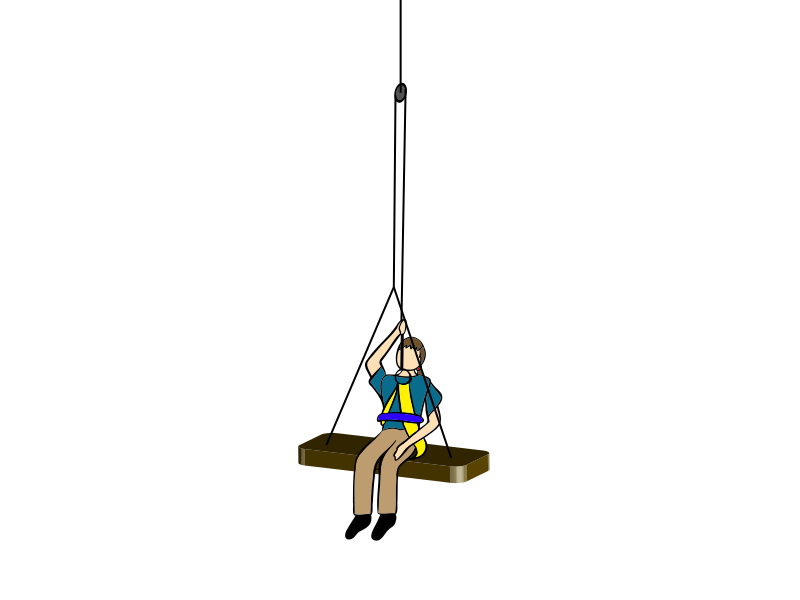
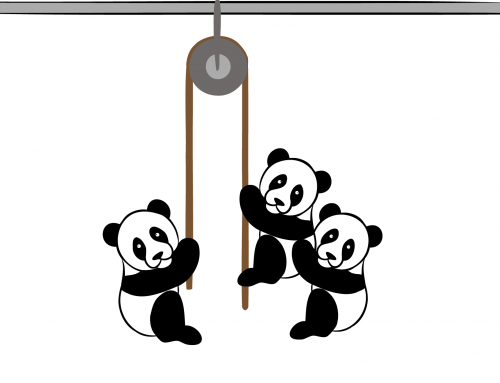
Commercial window cleaners utilize pulley systems to reach windows on tall multi-story buildings. Imagine a woman is attached to a safety harness and seated on a wooden platform, also called a \({Bosun’s Chair}\), and she is cleaning the windows of a skyscraper. If her mass is 80 kg, and the harness and wooden beam have a combined mass of 10 kg, calculate
(1) the force she exerts on the chair, and
(2) the tension on the rope
for each of the following scenarios:
a) She pulls the rope down and accelerates upwards at \(0.2 \, \text{m}/\text{s}^2\).
b) She lets the rope slide slightly from her hands and accelerates downwards at \(1 \, \text{m}/\text{s}^2\).
c) She pulls the rope and goes upward at a constant speed.
a) Draw a free body diagram for the chair and another free body diagram for the person. Write Newton’s second law for both scenarios, and use these two equations to solve for the two unknown variables.
b) Use the previously obtained formulae for \(T\) and \(N\) to evaluate at the mentioned acceleration.
c) Same hint as part (b).
a) Newton’s Second Law in the \({y-}\)direction for the person is:
\begin{equation*}
T+N_m-m_m g=m_ma,
\end{equation*}
and
\begin{equation*}
T-N_m-m_c g=m_ca.
\end{equation*}
The two unknown variables are \(T\) and \(N_m\).
You can sum both equations and do some algebra to solve for \(T\):
\begin{equation*}
T=\frac{(m_m+m_c)a+W_m+W_c}{2},
\end{equation*}
You can also subtract the equations to get:
\begin{equation*}
N_m=\frac{(m_m-m_c)(a+g)}{2}.
\end{equation*}
The numerical solutions are therefore:
\begin{equation*}
T=450\,\text{N},
\end{equation*}
and
\begin{equation*}
N_m=350\,\text{N}.
\end{equation*}
b) For the specific case, \(a=-1 \, \text{m/s}^2\):
\begin{equation*}
T=396\,\text{N},
\end{equation*}
and
\begin{equation*}
N_m=308\,\text{N}.
\end{equation*}
c) For the specific case, \(a= 0\), then:
\begin{equation*}
T=441\,\text{N},
\end{equation*}
and
\begin{equation*}
N_m=343\,\text{N}.
\end{equation*}
For a more detailed explanation of any of these steps, click on “Detailed Solution”.
a) In the first part of the problem, we need to find the tension on the rope when the window cleaner pulls it down and accelerates upwards. To approach this problem, we’ll make a free-body diagram for her and for the Bosun’s chair separately. For the woman, we identify three forces: the weight \(\vec{W}_m\) pointing downwards, the contact force exerted by the chair \(\vec{N}_m\) pointing upwards, and the tension \(\vec{T}\) exerted by the rope on her hands, which also points upwards (this tension is the reaction to her pulling the rope). Hence, the force diagram is shown in figure 1.
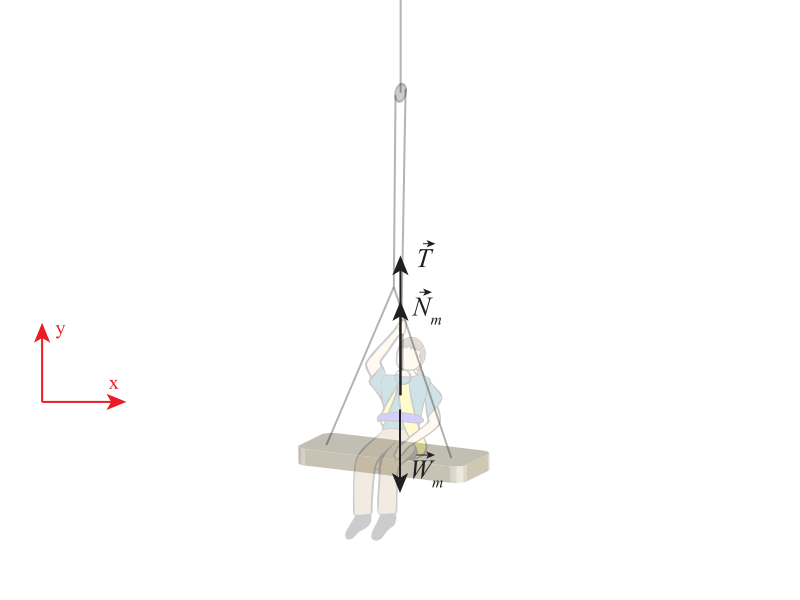
Figure 1: Force diagram for the woman. The forces shown are: the tension exerted by the rope \(\vec{T}\), the contact force \(\vec{N}_m\), and the weight \(\vec{W}_m\).
For the chair, there are also three forces: its own weight \(\vec{W}_c\) pointing downwards, the contact force exerted by the sitting woman \(\vec{N}_c\), and the tension \(\vec{T}\) exerted by the rope. Notice that the tension exerted on both the woman and on the chair is of the same magnitude because it’s the same rope, which we consider to be ideal. Also, in this case both tensions point in the same direction (upwards). Because of Newton’s third law, the contact force produced by the chair on the woman is of the same magnitude but in the opposite direction to the force produced by her on the chair. That is, \(\vec{N}_c=-\vec{N}_m \). So, the force diagram for the chair is
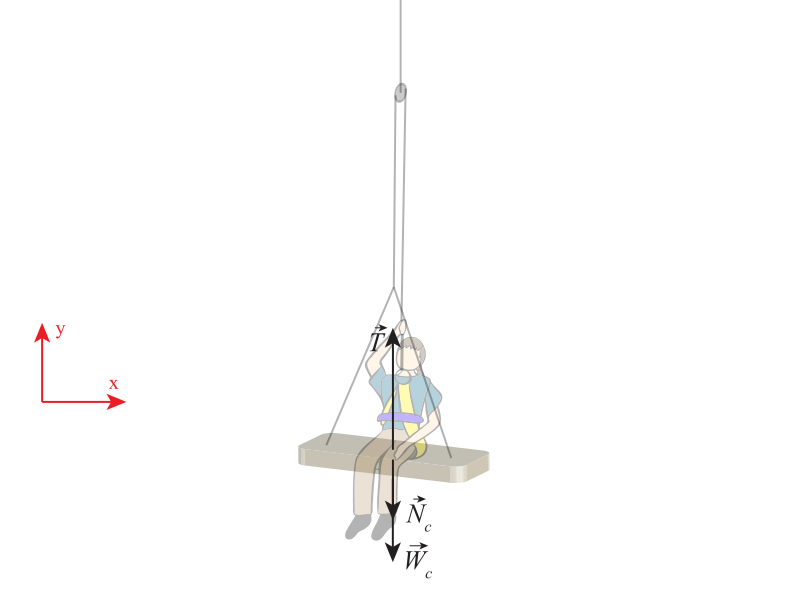
Figure 2: Force diagram for the chair. The forces shown are: the tension exerted by the rope \(\vec{T}\), the contact force \(\vec{N}_m\), and the weight \(\vec{W}_m\).
We can then write Newton’s second law along the Y axis for the woman as
\begin{equation}
\label{newtonman}
T\,\hat{\textbf{j}}+N_m\,\hat{\textbf{j}}-W_m\,\hat{\textbf{j}}=m_m a \,\hat{\textbf{j}},
\end{equation}
where \(a\) is the acceleration of the woman and \(m_m\) her mass. We can do the same for the chair and write Newton’s second law along the Y axis to obtain
\begin{equation}
\label{newtonchair0}
T\,\hat{\textbf{j}}-N_c\,\hat{\textbf{j}}-W_c\,\hat{\textbf{j}}=m_ca_c\,\hat{\textbf{j}},
\end{equation}
where \(m_c\) is the mass of the chair, \(a_c\) its acceleration. Let’s now use the fact that the contact forces are of the same magnitude:
\begin{equation}
\label{newtonchair00}
T\,\hat{\textbf{j}}-N_m\,\hat{\textbf{j}}-W_c\,\hat{\textbf{j}}=m_ca_c\,\hat{\textbf{j}}.
\end{equation}
Notice also that the acceleration of the woman and the chair are the same since they move together and are in contact at all times. Hence, we can write the previous equation as
\begin{equation}
\label{newtonchair}
T\,\hat{\textbf{j}}-N_m\,\hat{\textbf{j}}-W_c\,\hat{\textbf{j}}=m_c a\,\hat{\textbf{j}},
\end{equation}
We can now drop vector notation on equations \eqref{newtonman} and \eqref{newtonchair} (since everything is happening along the same axis) to get the following system of equations:
\begin{equation}
\label{nman}
T+N_m-W_m=m_ma,
\end{equation}
and
\begin{equation}
\label{nchair}
T-N_m-W_c=m_ca.
\end{equation}
Because we want to find the tension \(T\) and the normal \(N_m\), let’s solve for these variables using the equations above. Let’s add up equation \eqref{nman} and \eqref{nchair} to get
\begin{equation}
(T+N_m-W_m)+(T-N_m-W_c)=(m_m a)+(m_ca),
\end{equation}
which simplifies to
\begin{equation}
2T-W_m-W_c=(m_m+m_c)a.
\end{equation}
We can solve for \(T\) in the equation above by moving the other terms to the right hand side:
\begin{equation}
2T=(m_m+m_c)a+W_m+W_c.
\end{equation}
Dividing both sides by 2, we get
\begin{equation}
\label{tension1}
T=\frac{(m_m+m_c)a+W_m+W_c}{2}.
\end{equation}
To solve for the contact force \(N_m\), we subtract equation \eqref{nchair} from equation \eqref{nman} to get
\begin{equation}
(T+N_m-W_m)-(T-N_m-W_c)=(m_m a)-(m_ca).
\end{equation}
This can be simplified to
\begin{equation}
2N_m-W_m+W_c=(m_m-m_c)a.
\end{equation}
We can now solve for \(N_m\) in this equation by moving the other terms to the right hand side:
\begin{equation}
2N_m=(m_m-m_c)a+W_m-W_c.
\end{equation}
Let’s now divide by two on both sides, to get
\begin{equation}
\label{normal1}
N_m=\frac{(m_m-m_c)a+W_m-W_c}{2}.
\end{equation}
In our explicit expressions for the tension and the contact force given by equations \eqref{tension1} and \eqref{normal1}, we can use the explicit expressions for the weight of the woman and the chair, namely \(W_m=m_mg\) and \(W_c=m_cg\). Doing that, we obtain
\begin{equation}
T=\frac{(m_m+m_c)a+m_mg+m_cg}{2}.
\end{equation}
That is,
\begin{equation}
N_m=\frac{(m_m-m_c)a+m_mg-m_cg}{2}.
\end{equation}
Both expressions can be further simplified to
\begin{equation}
\label{tensiond}
T=\frac{(m_m+m_c)(a+g)}{2},
\end{equation}
and
\begin{equation}
\label{normald}
N_m=\frac{(m_m-m_c)(a+g)}{2}.
\end{equation}
For the first case, the acceleration is \(a=0.2\,\text{m/s}^2\) and is upwards, thus, it is positive. Using the rest of the numerical values on equations \eqref{tensiond} and \eqref{normald}, we obtain
\begin{equation}
T=\frac{(80\,\text{kg}+10\,\text{kg})(0.2\,\text{m/s}^2+9.8\,\text{m/s}^2)}{2},
\end{equation}
That is,
\begin{equation}
T=450\,\text{N}.
\end{equation}
For the contact force, we find
\begin{equation}
N_m=\frac{(80\,\text{kg}-10\,\text{kg})(0.2\,\text{m/s}^2+9.8\,\text{m/s}^2)}{2},
\end{equation}
that is,
\begin{equation}
N_m=350\,\text{N}.
\end{equation}
b) In this case the acceleration is downwards, which is negative according to our system. We can then use \(a=-1\,\text{m/s}^2\) in equations \eqref{tensiond} and \eqref{normald} to obtain
\begin{equation}
T=\frac{(80\,\text{kg}+10\,\text{kg})(-1\,\text{m/s}^2+9.8\,\text{m/s}^2)}{2}.
\end{equation}
This yields
\begin{equation}
T=396\,\text{N}.
\end{equation}
And for the contact force, we find
\begin{equation}
N_m=\frac{(80\,\text{kg}-10\,\text{kg})(1\,\text{m/s}^2+9.8\,\text{m/s}^2)}{2},
\end{equation}
that is,
\begin{equation}
N_m=308\,\text{N}.
\end{equation}
c) If the woman and chair move upwards at constant velocity, then the acceleration is zero, thus \(a=0\,\text{m/s}^2\). Using equations \eqref{tensiond} and \eqref{normald}, we obtain
\begin{equation}
T=\frac{(80\,\text{kg}+10\,\text{kg})(0\,\text{m/s}^2+9.8\,\text{m/s}^2)}{2},
\end{equation}
\begin{equation}
T=441\,\text{N}.
\end{equation}
And for the contact force, we find
\begin{equation}
N_m=\frac{(80\,\text{kg}-10\,\text{kg})(0\,\text{m/s}^2+9.8\,\text{m/s}^2)}{2},
\end{equation}
which results in
\begin{equation}
N=343\,\text{N}.
\end{equation}
Notice that as the woman and chair accelerate upwards, both the tension and contact force are greater than if the woman was moving at constant speed. Likewise, as the woman accelerates downwards, the tension and contact force are less than the ones calculated when the acceleration was zero.
Why do you plug in 0.1 m/s^2 instead of 1m/s^2 for equation 23?
Hi, thanks so much for the comment. It was an error that we have fixed now!