

A very large, open cylindrical tank has a side duct with two sections of different areas. Take \(r_{1} = \sqrt{2}\) cm, \(r_{2} = \sqrt{5}\) cm, \(d = 2.5\) m, \(x = 0.7\) m, and \(h = 70\) cm. Calculate:
a) The speed at which the water comes out of the smaller section.
b) The speed of the water in the largest section.
c) The height of the cylinder \(H\).
a) By using kinematic’s equations on both the X and Y-axis, find the time it takes to fall from the given height and then find the horizontal velocity with the given distance.
b) Use the rate of flux, or continuity equation, to get the speed.
c) Use Bernoulli’s equation and solve for the height \(H\).
a) By the vertical position of a fallen object, in this case the water, we get:
\begin{equation*}
y_f-y_0=v_{0y}t-\frac{1}{2}gt^2,
\end{equation*}
where solving for \(t\) we get:
\begin{equation*}
t = \sqrt{ \frac{2h}{g}}.
\end{equation*}
For the X displacement we have:
\begin{equation*}
x_f – x_i = v_{0x} t,
\end{equation*}
where using the time \(t\) found, and solving for \(v_{0x}\) we get:
\begin{equation*}
v_{0x}=\frac{d-x}{\sqrt{\frac{2h}{g}}},
\end{equation*}
or with numerical values:
\begin{equation*}
v_{0x} \approx 4.76 \, \text{m/s}.
\end{equation*}
b) By the continuity equation we have:
\begin{equation*}
v_B A_B = v_C A_C,
\end{equation*}
where solving for \(v_B\) and with numerical values we get:
\begin{equation*}
v_B \approx 1.90 \, \text{m/s}.
\end{equation*}
c) Bernoulli’s equation states:
\begin{equation*}
P_A+\rho g z_A+\frac{1}{2}\rho v_A^2=P_C+\rho g z_C+\frac{1}{2}\rho v_C^2,
\end{equation*}
where \(z_A = H\) and \(z_C = h\). Solving for \(H\) we get:
\begin{equation*}
H=h+\frac{v_C^2}{2g},
\end{equation*}
or with numerical values:
\begin{equation*}
H \approx 1.86 \, \text{m}.
\end{equation*}
For a more detailed explanation of any of these steps, click on “Detailed Solution”.
a) They’ve asked us to find the speed at which the water comes out of the smaller section. To solve this first part of the problem, we can use the kinematics of the parabolic trajectory of the water from the point it pours out to the ground, as seen in figure 1.
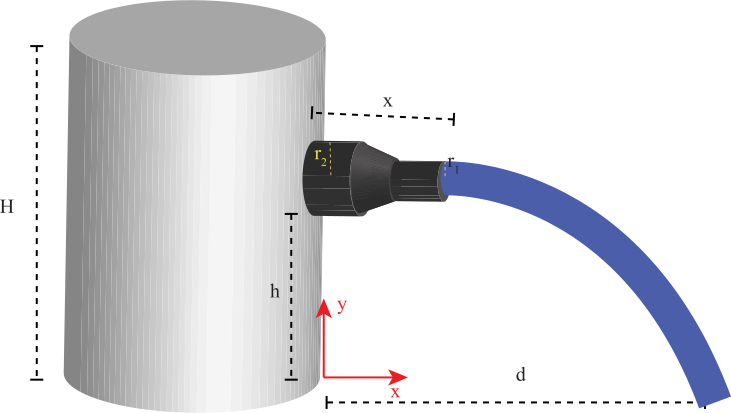
Figure 1: Tank filled with water with a hole where water pours out and describes a parabolic motion. The relevant dimensions for the problem are shown. We place the coordinate system on the ground just below the orifice in the tank that leads to the black section from which water pours out.
Taking the coordinate system, as shown in figure 1, we can write the equations of parabolic motion as
\begin{equation}
\label{kinemx}
x_f\,\hat{\textbf{i}}-x_i\,\hat{\textbf{i}}=v_{0x} t \,\hat{\textbf{i}},
\end{equation}
and
\begin{equation}
\label{kinemy}
y_f\,\hat{\textbf{j}}-y_i\,\hat{\textbf{j}}=v_{0y} t \,\hat{\textbf{j}}-\frac{1}{2}gt^2 \,\hat{\textbf{j}},
\end{equation}
where \(x_i,\, y_i\) are the initial coordinates, \(x_f,\,y_f\) are the final coordinates, and \(v_{0x},\,v_{0y}\) are the initial velocities in the X and Y axis respectively. As usual, \(g\) is the gravitational acceleration. Focusing on just the magnitudes of equations \eqref{kinemx} and \eqref{kinemy}, we obtain (respectively)
\begin{equation}
\label{kinemx2}
x_f-x_i=v_{0x}t,
\end{equation}
and
\begin{equation}
\label{kinemy2}
y_f-y_0=v_{0y}t-\frac{1}{2}gt^2.
\end{equation}
Noticing that when the water pours out, it is completely horizontal, there is no component of the velocity in the Y-axis. Thus \(v_y=0\), a result we can use in \eqref{kinemy2} to simplify it to
\begin{equation}
y_f-y_0=-\frac{1}{2}gt^2.
\end{equation}
From our placement of the reference frame, we can clearly see from the third figure that \(x_i=x\), \(x_f=d\), \(y_i=h\) and \(y_f=0\). Replacing in equations \eqref{kinemx2} and \eqref{kinemy2}, we get the following expressions:
\begin{equation}
\label{kinemx3}
d-x=v_{0x}t,
\end{equation}
and
\begin{equation}
\label{kinemy3}
0-h=-\frac{1}{2}gt^2.
\end{equation}
Solving for \(v_{0x}\) in equation \eqref{kinemx3}, we have
\begin{equation}
\label{kinemx4}
v_{0x}=\frac{d-x}{t},
\end{equation}
so, we need the time \(t\) to express \(v_{0x}\) only in terms of known variables. We can then solve for \(t\) from equation \eqref{kinemy3}, thus obtaining
\begin{equation}
t^2=\frac{2h}{g},
\end{equation}
or taking the square root on both sides
\begin{equation}
\label{kinemy4}
t=\sqrt{\frac{2h}{g}}.
\end{equation}
Using the expression for time found in equation \eqref{kinemy4} into equation \eqref{kinemx4}, we get
\begin{equation}
v_{0x}=\frac{d-x}{\sqrt{\frac{2h}{g}}}.
\end{equation}
Using the numerical values, we find that
\begin{equation}
\label{v0xvc}
v_{0x}=\frac{2.5\,\text{m}-0.7\,\text{m}}{\sqrt{\frac{2(0.7\,\text{m})}{9.8\,\text{m/s}^2}}}\approx4.76\,\text{m/s}.
\end{equation}
b) To calculate the velocity of water in the largest section, we must use the principle of mass conservation. The principle states that the rate at which a volume of water passes through the largest area must be the same as the rate at at which a volume of water passes through the smaller area. This rate or flux \(Q\) can be calculated as the product of velocity \(v\) and transverse area \(A\), explicitly:
\begin{equation}
\label{flux}
Q=vA.
\end{equation}
Then, the flux at point B must be the same as that of point C, namely
\begin{equation}
\label{caudal}
Q_B=Q_C.
\end{equation}
Using the definition of equation \eqref{flux} into equation \eqref{caudal}, we obtain
\begin{equation}
\label{caudal2}
v_BA_B=v_CA_C,
\end{equation}
where \(A_B\) and \(A_C\) are the transverse areas at points B and C respectively. Notice that the problem gives the radius of each section, then we can use the relation between the area and the radius that reads \(A=\pi r^2\) to express the terms \(A_B\) and \(A_C\) of equation \eqref{caudal2} as
\begin{equation}
v_B\pi r_B^2=v_C\pi r_C^2,
\end{equation}
where we can cancel the \(\pi\) to obtain a simpler expression in terms of the radius of the areas \(r_B\) and \(r_C\) and the velocities \(v_B\) and \(v_C\), namely
\begin{equation}
v_B r_B^2=v_C r_C^2.
\end{equation}
Solving for the only unknown \(v_B\) we have
\begin{equation}
v_B=v_C\frac{r_C^2}{r_B^2},
\end{equation}
where \(v_C\) is the velocity at point C, which is the result from (a) and is given by equation \eqref{v0xvc}. Using the numerical values we find
\begin{equation}
v_B=(4.76\,\text{m/s})\frac{(\sqrt{2}\,\text{cm})^2}{(\sqrt{5}\,\text{cm})^2}\approx 1.90\,\text{m/s}.
\end{equation}
c) For the last part of the problem, we need to calculate the height of the cylinder. To do this, we will use Bernoulli’s equation for the streamline depicted in figure 2. We can use this equation because we assume the flow is static, that is, none of the characteristics and variables of the fluid change with time.

Figure 2: The fluid streamline is pictured in red. The fluid parameters at points A,B and C, such as pressure and speed, don’t change in time
We can then write Bernoulli’s equation between points A and C as follows
\begin{equation}
\label{bernoulli}
P_A+\rho g z_A+\frac{1}{2}\rho v_A^2=P_C+\rho g z_C+\frac{1}{2}\rho v_C^2,
\end{equation}
where \(P\) is the pressure, \(z\) is the height, \(v\) is the velocity, and \(\rho\) is the density of the fluid. The subscript A or C indicates the point at which each variable is evaluated. Notice that since it is an open container, the pressure at A \(P_A\) is the atmospheric pressure \(P_0\). The same applies to point C, located just on the hole where the water pours out and the pressure \(P_C\) is the atmospheric pressure \(P_0\). Using this in equation \eqref{bernoulli}, we obtain
\begin{equation}
P_0+\rho g z_A+\frac{1}{2}\rho v_A^2=P_0+\rho g z_C+\frac{1}{2}\rho v_C^2,
\end{equation}
or canceling out \(P_0\)
\begin{equation}
\label{berni2}
\rho g z_A+\frac{1}{2}\rho v_A^2=\rho g z_C+\frac{1}{2}\rho v_C^2.
\end{equation}
From equation \eqref{berni2} notice that the term \(\rho\) is common to all the terms. Then we can divide equation \eqref{berni2} on both sides by \(\rho\) to cancel it out and get
\begin{equation}
\label{berni3}
g z_A+\frac{1}{2}v_A^2= g z_C+\frac{1}{2} v_C^2.
\end{equation}
Another assumption we will make is that \(H\), the level of water on the container, does not change with time. This implies that the velocity of water at point A is approximately zero, that is \(v_A\approx0\). Using this in equation \eqref{berni3}, it simplifies to
\begin{equation}
\label{berni4}
g z_A=g z_C+\frac{1}{2} v_C^2.
\end{equation}
Now, relative to the coordinate system, as shown in the previous figure, we can see that \(z_A=H\) and \(z_C=h\). Replacing these values into equation \eqref{berni4}, we get
\begin{equation}
\label{berni5}
gH=gh+\frac{1}{2}v_C^2,
\end{equation}
where we can solve for \(H\) by dividing both sides by \(g\), then
\begin{equation}
\label{berni6}
H=h+\frac{v_C^2}{2g}.
\end{equation}
Using the numerical values, we have that
\begin{equation}
H=0.7\,\text{m}+\frac{(4.76\,\text{m/s})^2}{2(9.8\,\text{m/s}^2)}\approx 1.86\,\text{m}.
\end{equation}


Leave A Comment