

A theatre tech is rummaging through some backdrop equipment behind a stage, and finds a heavy box attached to a strong rope that functions as an ideal pulley system. If the mass of the box is known to be a metric ton (1,000 kg), and the mass of the man is 80 kg, what would be the force that the floor exerts on the box in each of the following cases (assuming the system remains in equilibrium)?
a) The man pulls with a 100 N force.
b) The man pulls with a 300 N force.
c) The man hangs on the rope.
a) You are looking for the normal force the floor exerts on the box. If you make a free-body diagram, you will notice that the normal is less than if the box has no rope connected to it.
b) Same hint as part a)
c) Same hint as a), but consider that the tension is equal in magnitude to the man’s weight.
For the three cases, Newton’s Third Law is:
\begin{equation*}
N + T – mg = 0,
\end{equation*}
where \(T\) is the force exerted by the man through the rope, and \(N\) the force exerted by the floor, which is the unknown variable.
a) Solving for \(N\) and using that \(T = 100 \, \text{N}\), we get:
\begin{equation*}
N=9700\,\text{N}.
\end{equation*}
b) Solving for \(N\) and using that \(T = 300 \, \text{N}\), we get:
\begin{equation*}
N=9500\,\text{N}.
\end{equation*}
c) Again, solving for \(N\) and using that \(T = Mg\) where \(M\) is the man’s mass, we get:
\begin{equation*}
N=9016\,\text{N}.
\end{equation*}
For a more detailed explanation of any of these steps, click on “Detailed Solution”.
1. General Strategy for (a)
a) We need to find the force that the surface exerts on the box if the man pulls the rope with a force of 100 N. We’ll approach this problem by identifying all the forces exerted on the box and then use Newton’s Second Law to deduce the value of the contact force exerted by the floor on the box.
2. Identify the forces and make a free-body diagram
To create the free-body diagram, let’s choose a coordinate system on the ground, with \({y}\) pointing upwards. Given such system, we identify three forces along the \({y-}\)axis: the weight of the box \(\vec{W}\) pointing in the negative \({y-}\)direction, the tension \(\vec{T}\) exerted by the rope, pointing in the positive direction of \({y}\), and the contact force \(\vec{N}\) exerted by the floor, also pointing in the positive direction of \({y}\). Hence, the free-body diagram is shown in Figure 1.
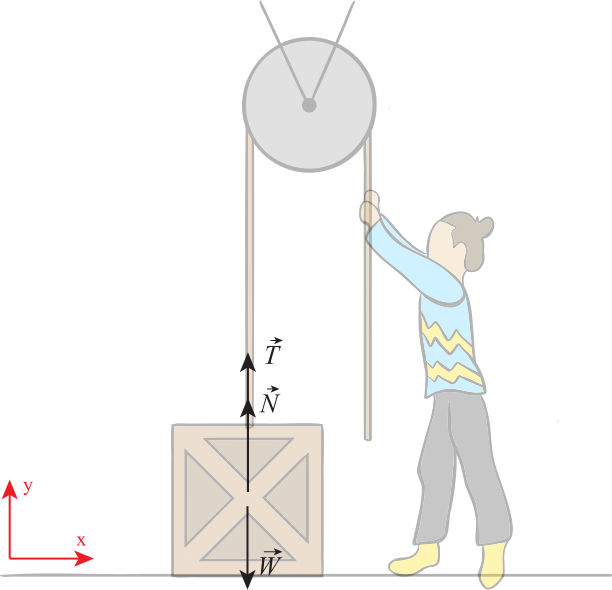
Figure 1: Force diagram for the box. The forces shown are: the contact force with the ground \(\vec{N}\), the tension \(\vec{T}\), and the weight \(\vec{W}\). The coordinate system is chosen with the Y axis pointing upwards.
3. Newton’s Second Law along the \({y-}\)axis
Because the system is in equilibrium, that is, its acceleration equals zero, we can write Newton’s Second Law along the \({y-}\)axis as
\begin{equation}
-W\,\hat{\textbf{j}}+N\,\hat{\textbf{j}}+T\,\hat{\textbf{j}}=0,
\end{equation}
where \(W=mg\) is the magnitude of the weight, \(m=1\,\text{Ton}=1000\,\text{kg}\) is the mass of the box, and \(g\) is the gravitational acceleration on Earth. Dropping the vector notation to focus on the magnitudes and using the explicit expression for the weight of the box, we get
\begin{equation}
-mg+N+T=0.
\end{equation}
4. Manipulate equations to solve for the unknown variables
We can solve for \(N\) to get
\begin{equation}
\label{normal}
N=mg-T.
\end{equation}
5. Insert the numerical values
Because the rope and the pulley are ideal, the tension exerted by the man on the right end is the same magnitude as the tension applied to the box. For the case in which the man pulls with a 100 N force, \(T=100\,\text{N}\). We can use all the numerical values in SI units in equation \eqref{normal} to obtain
\begin{equation}
N=(1000\,\text{kg})(9.8\,\text{m/s}^2)-100\,\text{N},
\end{equation}
which is the same as
\begin{equation}
N=9700\,\text{N}.
\end{equation}
6. General Strategy for (b)
(b) For the case in which the man pulls with a 300 N force, \(T=300\,\text{N}\), we can use equation \eqref{normal} again but with the new numerical values.
7. Insert numerical values
If we insert the numerical values in SI units in equation \eqref{normal}, we obtain
\begin{equation}
N=(1000\,\text{kg})(9.8\,\text{m/s}^2)-300\,\text{N},\end{equation}
which yields
\begin{equation}
N=9500\,\text{N}.
\end{equation}
8. General Strategy for (b)
(c) Finally, in the case in which the man hangs on the rope, the tension on the rope must be equal in magnitude to the weight of the man, \(Mg\), since these forces must be equal so that the man hangs without acceleration.
9. Insert numerical values
We know that \(M=80\,\text{kg}\). Then, since \(T=Mg\), we get that \(T=(80\,\text{kg})(9.8\,\text{m/s}^2)=784\,\text{N}\). Using this result for the tension in equation \eqref{normal}, we obtain
\begin{equation}
N=(1000\,\text{kg})(9.8\,\text{m/s}^2)-784\,\text{N},
\end{equation}
which gives us
\begin{equation}
N=9016\,\text{N}.
\end{equation}

Leave A Comment