

An amateur archer wants to hit an apple and naively points directly at it, as shown in the picture. A stroke of luck benefits them because a gust of wind fortuitously knocks the apple off the tree branch just after the arrow is released.
(a) Show that the arrow will always puncture the apple while the wind blows, as long as the archer aims exactly at it while releasing the arrow.
(b) Why are they an amateur archer? In what direction should they point the bow and arrow, assuming there is less wind in the future?
a) Consider that the vertical positions will be the same. Then find each vertical position with the equation of motion for an object moving with constant acceleration.
b) The archer is missing an important variable that affects the motion of any falling object.
a) Using the equation of motion for an object moving with constant speed, we have:
\begin{equation*}
x= v_x t,
\end{equation*}
where \(v_x = v_i \cos \theta\) and \(x = L\). Solving for \(t\), we get:
\begin{equation*}
t=\frac{L}{v_i\cos(\theta)}.
\end{equation*}
For a falling object, the equation of motion is:
\begin{equation*}
y_f = y_i + v_{i} t – \frac{1}{2} gt^2.
\end{equation*}
If the arrow hits the apple, their final positions must be the same ( \( y_a = y_f\) ). Then, by the given conditions we obtain
\begin{equation*}
v_i\sin(\theta) t-\frac{1}{2}gt^2=H-\frac{1}{2}gt^2.
\end{equation*}
Using the time \(t\) found before, and after using some algebra, we get the condition for the arrow to hit the apple:
\begin{equation*}
\tan(\theta)=\frac{H}{L}.
\end{equation*}
b) The archer is an amateur because they are not taking into account the effects of gravity on the shot. If strong winds hadn’t knocked off the apple, they would have never been able to puncture it by aiming directly at it. A more experienced archer would take gravity into account and aim a little higher.
For a more detailed explanation of any of these steps, click on “Detailed Solution”.
(a) They’ve asked us to demonstrate that as long as the archer aims directly at the apple, the arrow will always puncture it if it starts to fall at the same time the arrow is released. Let’s start by making a sketch of the situation (see figure 1).
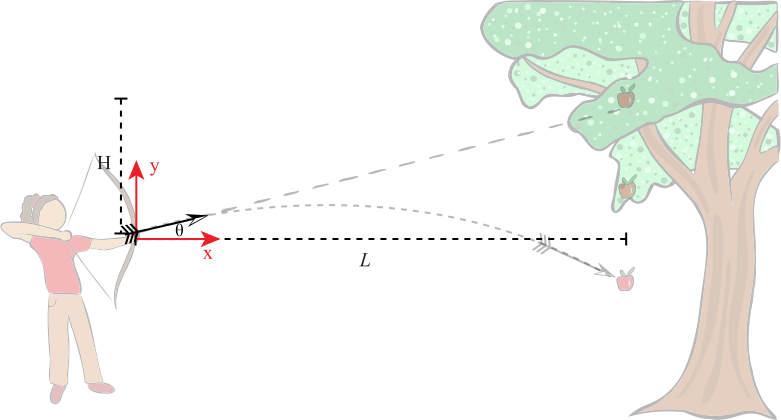
Figure 1: We place the coordinate system at the initial position of the arrow. The vertical distance from the arrow to the fruit is initially \(H\), while the horizontal distance between the arrow and the fruit is \(L\). The angle \(\theta\) is also shown.
We see that the arrow is initially a distance along the X axis of \(L\), and the vertical distance between the initial position of the apple and the initial position of the arrow is \(H\). Then, let’s write the equations of motion along the X and Y axes for the arrow and for the apple and find a condition in order for the arrow to puncture the fruit.
First, notice that the arrow follows a projectile motion. Thus, along the X axis, the velocity is positive and constant, and so the equation of motion is
\begin{equation}
\label{xa0}
x_a\,\hat{\textbf{i}}=x_{i,a}\,\hat{\textbf{i}}+v_{xi} t\,\hat{\textbf{i}},
\end{equation}
where \(x_{i,a}=0\) is the initial position of the arrow, \(v_{xi}\) is the initial speed along X, and \(x_a\) is the final position on X. Now, notice that \(v_{xi}=v_i\cos(\theta) \) is the initial velocity along the X axis, where \(\theta\) is the angle with respect to the horizontal line at which the archer aims. This is illustrated in figure 2.

Figure 2: The initial velocity of the arrow \(\vec{v}_i\) has components along the X and Y axis, as shown here. Its direction is given by the angle \(\theta\).
Hence, \eqref{xa0} becomes
\begin{equation}
\label{xa}
x_a\,\hat{\textbf{i}}=x_{i,a}\,\hat{\textbf{i}}+v_i\cos(\theta) t\,\hat{\textbf{i}}.
\end{equation}
We can drop the vector notation and focus on the magnitudes to obtain
\begin{equation}
x_a=v_i\cos(\theta) t,
\end{equation}
where we have already used the fact that \(x_{i,a}=0\). Since the apple falls and doesn’t change its position on the X axis, the only point along this axis where the arrow and the apple can meet is at \(x=L\). Thus, we set \(x_a=L\) in the equation above and solve for the time \(t\), which is the time that it takes for the arrow to travel from the archer to the point on the X axis where the apple is falling. Explicitly,
\begin{equation}
L=v_i\cos(\theta)t,
\end{equation}
and solving for the time, we get
\begin{equation}
\label{time}
t=\frac{L}{v_i\cos(\theta)}.
\end{equation}
We have found an expression for the time in terms of the angle and the initial speed (that we do not know). At the end of the day, we actually need to find this angle (so we show that the direction is the one they told us about in the prompt). So we need more equations.
Let’s focus on the motion along the Y axis. On the Y axis, the arrow falls with negative constant gravitational acceleration, and so the equation of motion along Y reads,
\begin{equation}
y_a\,\hat{\textbf{j}}=y_{i,a}\,\hat{\textbf{j}}+v_{yi}\,\hat{\textbf{j}}-\frac{1}{2}gt^2\,\hat{\textbf{j}},
\end{equation}
where \(y_{i,a}=0\) is the initial position of the arrow and \(v_{yi}\) is the initial vertical speed. Now, from figure 2, we see that \(v_{yi}=v_i\sin(\theta)\) is the initial velocity along the Y axis, where the angle \(\theta\) is defined as before and \(g=9.8\,\text{m/s}^2\) is the gravitational acceleration of Earth. Hence, we get
\begin{equation}
y_a\,\hat{\textbf{j}}=y_{i,a}\,\hat{\textbf{j}}+v_i\sin(\theta)\,\hat{\textbf{j}}-\frac{1}{2}gt^2\,\hat{\textbf{j}}.
\end{equation}
Focusing on the magnitudes (dropping the vector notation), we obtain
\begin{equation}
\label{ya}
y_a=v_{i}\sin(\theta)-\frac{1}{2}gt^2,
\end{equation}
where we used the fact that, according to the coordinate system, \(y_{i,a}=0\). Again, we have an equation involving three unknown variables: the initial angle, the time, and the initial speed. So, to find the angle, we need at least one more equation.
For the arrow to hit the apple, their Y positions need to be the same at the exact same time. So, consider the equation of motion of the apple. The fruit falls with constant gravitational acceleration, and so the equation of motion is
\begin{equation}
y_f\,\hat{\textbf{j}}=y_{i,f}\,\hat{\textbf{j}}+v_{i,f}\,\hat{\textbf{j}}-\frac{1}{2}gt^2\,\hat{\textbf{j}},
\end{equation}
where \(y_{i,f}=H\) is the initial position of the fruit and \(v_{i,f}=0\) is the initial velocity along the Y axis, which is zero. We can then write the equation of motion for the apple as
\begin{equation}
y_f\,\hat{\textbf{j}}=H\,\hat{\textbf{j}}-\frac{1}{2}gt^2\,\hat{\textbf{j}},
\end{equation}
or, after dropping the vector notation, as
\begin{equation}
\label{yf}
y_f=H-\frac{1}{2}gt^2.
\end{equation}
Notice that the time \(t=0\) here is taken to be the time at which the arrow leaves the bow and the apple starts to fall due to the strong wind.
As we explained earlier, if the arrow hits the apple, their final positions must be the same. We’ve already said that the position of the arrow along the X axis is the same as the fruit’s, namely, \(x_a=L\). And for the Y axis, we say that
\begin{equation}
y_a=y_f.
\end{equation}
Using the explicit expressions given by equations \eqref{ya} and \eqref{yf} in this equation, we obtain
\begin{equation}
v_i\sin(\theta) t-\frac{1}{2}gt^2=H-\frac{1}{2}gt^2,
\end{equation}
where we can cancel out the term \(\frac{1}{2}gt^2\) and get
\begin{equation}
v_i\sin(\theta) t=H.
\end{equation}
Using the expression for the time that it takes the arrow to travel to the point \(x_a=L\), given by equation \eqref{time}, we can write this expression as
\begin{equation}
v_i\sin(\theta)\left(\frac{L}{v_i \cos(\theta)}\right)=H.
\end{equation}
This simplifies to
\begin{equation}
L\tan(\theta)=H.
\end{equation}
Thus, the condition for the arrow to hit the fruit is that the angle \(\theta\), at which the archer aims is such that
\begin{equation}
\tan(\theta)=\frac{H}{L}.
\end{equation}
A drawing illustrating this might be helpful. See figure 3.

Figure 3: The angle \(\theta\) forms in the triangle defined by \(H\) and \(L\).
As we see in the drawing, this condition is achieved if the archer aims directly at the apple, just as the prompt asked us to show. From this drawing and basic trigonometry, we find that if the archer aims directly at the apple, then
\begin{equation}
\tan(\theta)=\frac{H}{L}.
\end{equation}
This is true as long as the initial velocity is enough for the arrow to travel the distance \(L\) horizontally.
(b) She is an amateur archer because is not taking into account the effects of gravity on her shot. If the strong winds hadn’t knocked off the apple, she would have never been able to puncture it by aiming directly at it.
A more experienced archer would take gravity into account and aim a little higher. See figure 4.
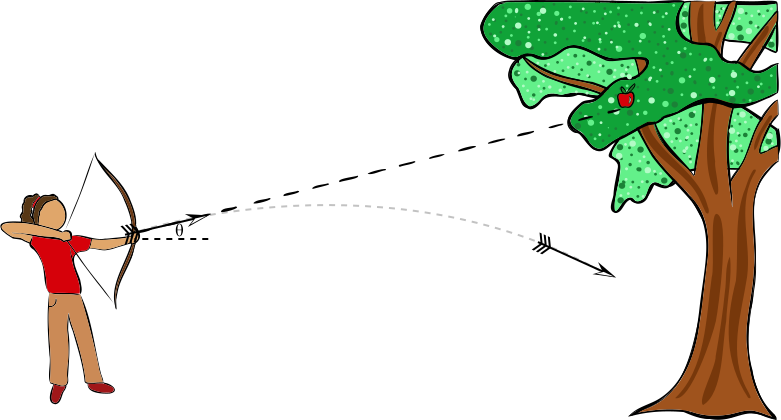
Figure 4: If the fruit does not fall at the same time that the arrow leaves the bow, then the archer misses the fruit if she points directly at it.



I love how explicative the drawings are. Plus, they are cute.