
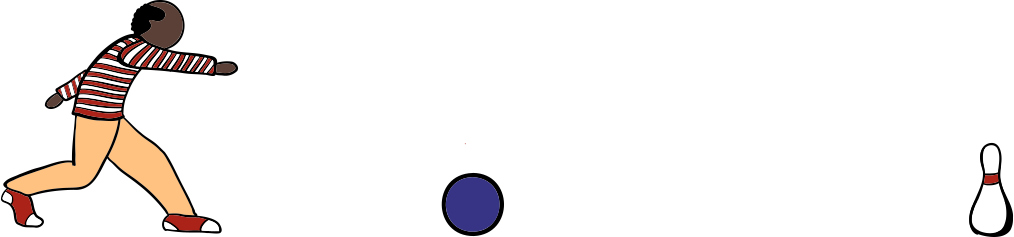
Enrique is bowling with his buddies at the local bowling league, and he rolls a 5 kg ball down the lane with an initial speed of 2 m/s. After the ball collides with the first pin (which weighs 1 kg), the bowling ball slows down to 1.5 m/s. Assuming friction is negligible, calculate the speed of the pin after being hit by the bowling ball.
Apply Conservation of Momentum, and consider the velocity of each object.
The equation for conservation of linear momentum in the horizontal direction can be written as:
\begin{equation*}
\vec{P}_{i}=\vec{P}_{f}.
\end{equation*}
Applying the given conditions, we have:
\begin{equation*}
m_b v_{ib} = m_b v_{fb} + m_p v_{fp}.
\end{equation*}
Solving for \(v_{fb}\):
\begin{equation*}
\frac{m_b }{m_p} (v_{ib}- v_{fb}) = v_{fp},
\end{equation*}
which, with numerical values, yields:
\begin{equation}
v_{fp}=2.5 \, \text{m/s}.
\end{equation}
For a more detailed explanation of any of these steps, click on “Detailed Solution”.
In order to find the final speed of the pin, we must relate that final speed to the known variables, which are: the initial and final speed of the ball and the masses of both the ball and the pin. As we’ll show below, we can easily find an equation relating these variables if we use the conservation of linear momentum.
The linear momentum of a system is conserved if the external force over the system is zero. If we focus on a particular axis or direction of motion, the linear momentum of the system along that direction is conserved if the external force along it is zero. In this case, this is true of the system conformed by the ball and the pin along the direction in which the ball moves. Notice that in such direction, there are no external forces because there is no friction and because the forces during the collision between the pin and the bowl are internal to the system (these forces are only manifesting between objects within the system). So, to continue, and to use the conservation of linear momentum, let’s focus on the system conformed by the ball and the pin.
Given that the linear momentum of the system conformed by the ball and the pin is conserved in the horizontal direction, we have
\begin{equation}
\label{first}
\vec{P}_{i}=\vec{P}_{f},
\end{equation}
where \(\vec{P}_{i}\) is the initial momentum of the system and \(\vec{P}_{f}\) is the final one. Using the definition of linear momentum for the ball and the pin, we have
\begin{equation}
\label{Basketball_conservMomentum}
m_b\vec{v}_{ib}+m_p\vec{v}_{ip}= m_b\vec{v}_{fb}+m_p\vec{v}_{fp},
\end{equation}
where we have used the subscript ‘b’ for the mass, initial velocity, and final velocity of the bowling ball, and ‘p’ for the mass, initial velocity, and final velocity of the pin.
Suppose that we take the direction of motion to be the positive X-axis, as illustrated in figure 1.

Figure 1: We place the coordinate system in such a way that the X axis points in the direction of motion for the ball.
In this case, we can rewrite equation \eqref{Basketball_conservMomentum} as
\begin{equation}
\label{Basketball_conservMomentumMagnitudes}
m_b v_{ib} \, \hat{\textbf{i}} + m_p v_{ip} \, \hat{\textbf{i}} = m_b v_{fb} \, \hat{\textbf{i}} + m_p v_{fp} \, \hat{\textbf{i}},
\end{equation}
where we used that, according to our system, the initial velocity of the ball is positive, the final velocity of the pin is also positive, and we assumed that the final velocity of the ball is positive as well (if this is not true, at some point we will get a negative sign that will let us know).
Initially, we know that the pin is at rest and so has no initial velocity. If we use this and focus on the magnitudes in equation \eqref{Basketball_conservMomentumMagnitudes}, we get
\begin{equation}
m_b v_{ib} = m_b v_{fb} + m_p v_{fp}.
\end{equation}
Now, notice that we know the mass of the pin, the mass of the ball, and the initial and final speeds of the ball. So we have enough information in this equation to find the final speed of the pin. First, move the \(m_b v_{fb}\) term to the left side, to get
\begin{equation}
m_b v_{ib} – m_b v_{fb} = m_p v_{fp}.
\end{equation}
And now simply divide by \(m_p\):
\begin{equation}
\frac{m_b v_{ib} – m_b v_{fb}}{m_p} = v_{fp}.
\end{equation}
If we take common factor for \(m_b\), we can write this as
\begin{equation}
\frac{m_b }{m_p} (v_{ib}- v_{fb}) = v_{fp}.
\end{equation}
Finally, we just need to insert the numerical values here:
\begin{equation}
\frac{(5 \, \text{kg})}{(1 \, \text{kg})} (2 \, \text{m/s}-1.5 \, \text{m/s}) = v_{fp},
\end{equation}
to get
\begin{equation}
v_{fp} = 2.5 \, \text{m/s}.
\end{equation}

Which final speed is given in the question, the pin or ball? you asked for the final speed of the pin but you calculated for the ball. I’m confused!
Hi ssuboh, you are right to be confused because we had a typo where “b” was changed for “p” and then the final answer was wrong! Thanks for reading carefully 🙂