

Carlos is setting up a gaming station for his grandchildren, and is trying to align the TV with the couch. Carlos wants to push the stand toward the right, but he is worried that if he pushes too hard, the TV might fall off the stand. If the mass of the TV stand is 1.0 kg, the mass of the TV is 4.0 kg, the coefficient of static friction between the TV and the stand is 0.8, and the coefficient of kinetic friction between the stand and the floor is 0.2, what is the maximum force Carlos can exert on the stand before the TV begins to slide off the stand?
Think about the possible movement of the TV; the force due to friction will be in the opposite direction. Draw a free body diagram for the TV stand, and include both the force due to friction between the TV and the TV stand, as well as the force due to friction between the TV stand and the floor. Note that both forces due to friction will point in the same direction.
Newton’s Second Law along the \({y-}\)axis for the TV is:
\begin{equation*}
N-mg=0,
\end{equation*}
and for the TV stand:
\begin{equation*}
N_f-mg-Mg=0.
\end{equation*}
Newton’s Second Law in the \({x-}\)direction for the TV gives:
\begin{equation*}
f_{r_{TS}} = ma,
\end{equation*}
where \(f_{r_{TS}} = \mu_s N\), so:
\begin{equation*}
\mu_s g = a.
\end{equation*}
Newton’s Second Law in the \({x-}\)direction for the TV stand gives:
\begin{equation*}
F_C – f_{r_{TS}} – f_r = Ma,
\end{equation*}
where \(f_r = \mu_k N_f\) is the force due to kinetic friction. Solving for \(F_C\), by substituting the other variables previously found with some algebra, we get:
\begin{equation*}
F_C = (\mu_s + \mu_f)(mg + Mg),
\end{equation*}
and plugging in numerical values:
\begin{equation*}
F_C = 49 \, \text{N}.
\end{equation*}
For a more detailed explanation of any of these steps, click on “Detailed Solution”.
As Carlos pushes the stand, the static friction between the stand and the TV allows the TV to move together with the stand. This means that the static friction between the stand and the TV allows the TV to move with the same acceleration as the stand itself. However, if Carlos pushes the stand very strongly, it might make it so that the static friction between the TV and the stand is no longer capable of giving the TV the same acceleration as the stand. In that case, the TV will still move in the same direction as the stand but with less acceleration, and so the TV will start sliding on the stand.
So, to find the maximum force Carlos can exert on the stand such that the TV does not slide, we have to figure out what the maximum acceleration the static friction produced by the stand over the TV can be. That maximum acceleration will then be the maximum acceleration that Carlos can give to the stand so that the TV and the stand move together (with the same acceleration).
As with all force problems, let’s start by making a force diagram. Here, it is convenient to use a system of coordinates where the direction of motion of the stand is the positive X axis. Over the stand there are three forces in the X-axis. One is Carlos’ force, which is positive. The other force is the kinetic friction between the floor and the stand, which is negative since it resists the direction of motion of the stand with respect to the floor. But the TV also exerts a force of friction over the stand (which is a static one), which opposes the motion of the stand with respect to the TV and so points in the negative X-direction. Along Y, there are three forces over the stand; its weight, which is negative in Y, the normal exerted by the floor, which is positive in Y, and the normal exerted by the TV, which is negative in Y. See figure 1.
Figure 1: Force diagram for the TV stand, the forces shown are: the weight of the stand \(W_S\), the friction exerted by the floor \(f_r\), the friction exerted by the TV \(f_{rST}\), the contact force with the floor \(N_f\), the contact force exerted by the TV \(N_{TS}\), and the force exerted by Carlos \(F_C\). The coordinate axis are chosen with X along the horizontal and Y along the vertical.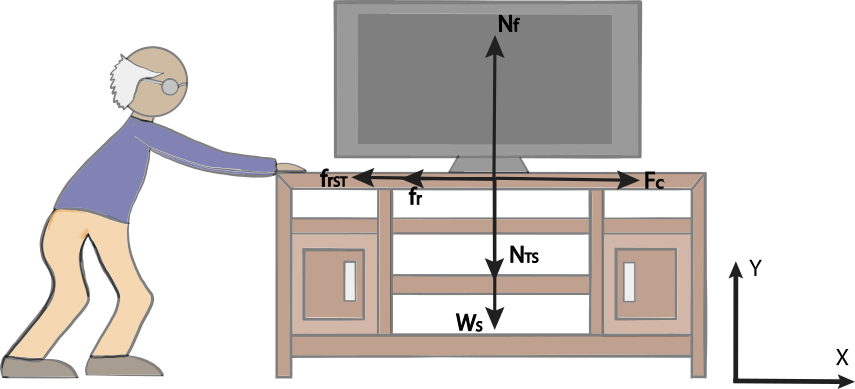
Over the TV, there are two forces in Y, the normal exerted by the stand, which is positive in Y, and the weight, which is negative in Y. And there is one force along X, which is the static friction that the stand exerts on the TV. This force points in the positive X direction because it is the force that allows the TV to move together with the stand as is shown in figure 2. Another way of seeing this is that since the TV exerts a force of friction on the stand in the negative X direction, the stand must exert a force of friction over the TV in the positive direction, because of Newton’s third law.
Figure 2: Force diagram for the TV with the following forces: the contact force exerted by the TV stand \(N\), the weight \(W\), and the friction exerted by the TV stand \(f_{rST}\).
We can now write Newton’s Second Law along X for the TV. It is:
\begin{equation}
f_{r_{TS}} \, \hat{\textbf{i}} = m a \, \hat{\textbf{i}}.
\end{equation}
As we explained before, we are interested in finding the maximum acceleration that the static friction can give to the TV. Thus, we are interested in the maximum static friction, which is always given by \( \mu_s N\), where \(\mu_s\) is the coefficient of static friction and \(N \) is the normal force. Thus, the equation reads
\begin{equation}
{\mu_s N} \, \hat{\textbf{i}} = m a \, \hat{\textbf{i}}.
\label{CarlosTV_fuerzas}
\end{equation}
Now, to find the normal force, we can use Newton’s second law along Y. Since the TV does not move in the Y direction, the acceleration in Y is zero, and we get
\begin{equation}
N \, \hat{\textbf{j}} -W \, \hat{\textbf{j}} = 0 \, \hat{\textbf{j}}.
\end{equation}
Thus,
\begin{equation}
N = mg,
\label{CarlosTV_normalTV}
\end{equation}
where we use that \(W=mg\) and we focused only on the magnitudes. We can then use this in equation \eqref{CarlosTV_fuerzas}. This, finally, give us the maximum acceleration the TV can have due to the static friction in terms of known variables.
\begin{equation}
\mu_s mg = ma.
\label{CarlosTV_aceleracionTV1}
\end{equation}
After cancelling the mass, we get
\begin{equation}
\mu_s g = a.
\label{CarlosTV_aceleracionTV}
\end{equation}
Now, as we explained earlier, this acceleration of the TV is the maximum that that stand can also have (if the stand has a greater acceleration, then the TV will slide). Let’s write Newton’s second law for the stand in the X direction. It is
\begin{equation}
F_C \, \hat{\textbf{i}} – f_{{ST}} \, \hat{\textbf{i}} – f_r \, \hat{\textbf{i}} = M a \, \hat{\textbf{i}},
\end{equation}
where \(F_{ST}\) is the force of static friction that the TV exerts on the stand, \(f_r\) is the force of kinetic friction that the floor exerts on the stand, \(M\) is the mass of the stand and \(F_C\) is the force that Carlos uses to push the stand (this is the one we are looking for). By Newton’s third law, \(F_{ST}\) must be of the same magnitude as the force that the stand exerts on the TV, namely, \(\mu_s N\). Thus, we get
\begin{equation}
F_C \, \hat{\textbf{i}} – {\mu_s N} \, \hat{\textbf{i}} – f_r \, \hat{\textbf{i}} = M a \, \hat{\textbf{i}}.
\end{equation}
Also, \(F_r\) is the kinetic force of friction that the floor exerts on the stand, which is given by \(\mu_f N_f\) (here \(N_f\) is the normal exerted by the floor on the stand). Thus, we get
\begin{equation}
F_C \, \hat{\textbf{i}} – \mu_s N \, \hat{\textbf{i}} – {\mu_f N_f} \, \hat{\textbf{i}} = M a \, \hat{\textbf{i}}.
\end{equation}
Finally, the acceleration of the stand is the same as the acceleration of the TV, which is given by equation \eqref{CarlosTV_aceleracionTV} above. Therefore, we finally obtain the following equation
\begin{equation}
F_C \, \hat{\textbf{i}} – \mu_s N \, \hat{\textbf{i}} – \mu_f N_f \, \hat{\textbf{i}} = M \mu_s g \, \hat{\textbf{i}}.
\label{CarlosTV_fuerzasXStand}
\end{equation}
Besides the force by Carlos, the only other variable we do not know here is \(N_f\), but we can obtain it from the force equations in Y:
\begin{equation}
N_f \, \hat{\textbf{j}} – N_{TV} \, \hat{\textbf{j}} – W_s \, \hat{\textbf{j}} = 0,
\end{equation}
since the acceleration is zero in the Y direction. Here, \(N_{TV}\) is the normal force by the TV, which by Newton’s third law is equal in magnitude to the normal force the stand exerts on the TV, and which we found to be \(mg\) earlier (equation \eqref{CarlosTV_normalTV}), and \(W_s\) is the weight of the stand which is \(Mg\). Thus, we get, after focusing on the magnitudes,
\begin{equation}
N_f = mg + Mg
\label{CarlosTV_normalStand}
\end{equation}
Using this in equation \eqref{CarlosTV_fuerzasXStand}, and focusing on the magnitudes, we get
\begin{equation}
F_C – \mu_s {(mg)} – \mu_f {(mg + Mg)} = M \mu_s g.
\end{equation}
Finally, let’s move all the terms to the right except for the force by Carlos:
\begin{equation}
F_C = mg( \mu_s + \mu_f) + Mg \mu_s + Mg\mu_f
\end{equation}
Take common factor of \(Mg\):
\begin{equation}
F_C = mg( \mu_s + \mu_f) + Mg (\mu_s + \mu_f),
\end{equation}
which is the same as
\begin{equation}
F_C = ( \mu_s + \mu_f)(mg + Mg).
\end{equation}
We can then replace the numerical values of the different quantities:
\begin{equation}
F_C = \bigg( {(0.8)} + {(0.2)}\bigg)\bigg({(4\; \text{kg})} {(9.8\; \text{m/s}^2)} + {(1\; \text{kg})} {(9.8\; \text{m/s}^2)}\bigg).
\end{equation}
The result is
\begin{equation}
F_C = 49 \, \text{N}.
\end{equation}

Leave A Comment