
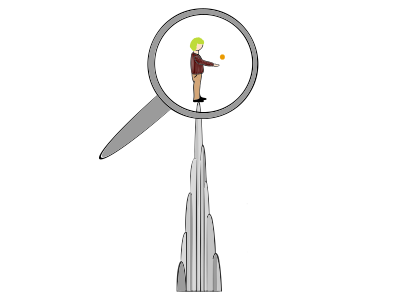
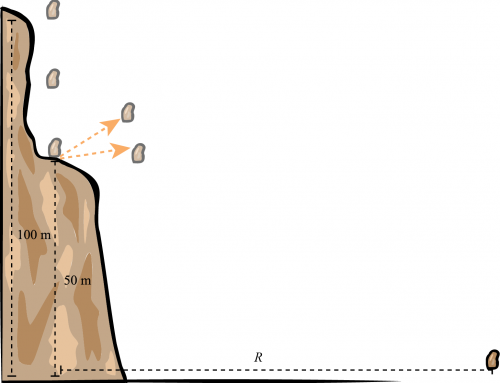
The Burj Khalifa is a \(828\) meters tall tower. A boy named Gabriel throws a coin from the top of the tower with an initial speed of \(15 \, \text{m/s}\) and at a 30-degree angle with respect to the ground.
a) Calcule la velocidad de la moneda justo antes de que toque el suelo. Suponga que la resistencia del aire es insignificante.
b) Encuentre el desplazamiento horizontal total.
c) Calcule la velocidad de la moneda, cuando haya transcurrido exactamente la mitad del tiempo que tarda la moneda en llegar al suelo.
(a) Trate de encontrar el tiempo que tarda un objeto en caer desde una altura determinada. Luego utilícelo para encontrar la velocidad final.
(b) Con la ecuación de movimiento para X y el tiempo encontrado en (a) puede encontrar la solución.
(c) El mismo procedimiento que en (a) es el camino a seguir.
(a) Usemos la ecuación de movimiento para Y, que es la ecuación de un objeto bajo aceleración constante. La ecuación es:
\begin{equation*}
\vec{y}_f = \frac{1}{2} \vec{a} t^2 + \vec{v}_i t + \vec{y}_i.
\end{equation*}
Despejando \(t\), obtenemos:
\begin{equation*}
t_1 = 13.78 \, \text{s},
\end{equation*}
y
\begin{equation*}
t_2 = -12.25 \, \text{s}.
\end{equation*}
Con la ecuación para la velocidad en Y tenemos:
\begin{equation*}
\vec{v_{fy}} = \vec{a_{y}} t + \vec{v_{iy}},
\end{equation*}
donde \(v_{iy} = v_i \sin \theta\) es conocido. Usando valores numéricos:
\begin{equation*}
v_{fy} = -127.54 \, \text{m/s}.
\end{equation*}
Para X:
\begin{equation*}
v_x = v_i \cos \theta \approx 13 \, \text{m/s}.
\end{equation*}
La magnitud de la velocidad final es:
\begin{equation*}
\|v_f\| = \sqrt{(v_x)^2 + (v_{fy})^2 } = 128.20 \, \text{m/s}.
\end{equation*}
Y el ángulo es:
\begin{equation*}
\tan \theta = \frac{v_{fy}}{v_x} \implies \theta = -84.18^\circ.
\end{equation*}
(b) El desplazamiento horizontal total es:
\begin{equation}
d = v_x t = 173.94 \, \text{m}.
\end{equation}
(c) Seguimos el mismo procedimiento que (a) para resolver este problema. La velocidad final en \(t/2\) es:
\begin{equation*}
v_y(t/2) = -60.02 \, \text{m/s}.
\end{equation*}
La rapidez horizontal es la misma que en (a), ya que es constante. Por tanto, la magnitud de la velocidad final en \(t/2\) es:
\begin{equation*}
\|v (t/2)\| = 61.41 \, \text{m/s}.
\end{equation*}
Y el ángulo es:
\begin{equation*}
\theta = -77.78 ^\circ.
\end{equation*}
Para obtener una explicación más detallada de cualquiera de estos pasos, haga clic en “Solución detallada”.
(a) Para calcular la velocidad de la moneda justo antes de tocar el suelo, debemos tener en cuenta que esta velocidad tiene, como cualquier vector, una magnitud y una dirección. Si usamos un sistema de coordenadas con Y vertical y la dirección X positiva apuntando hacia la derecha, entonces podemos dibujar la velocidad final en términos de su componente X y Y, de la siguiente manera:
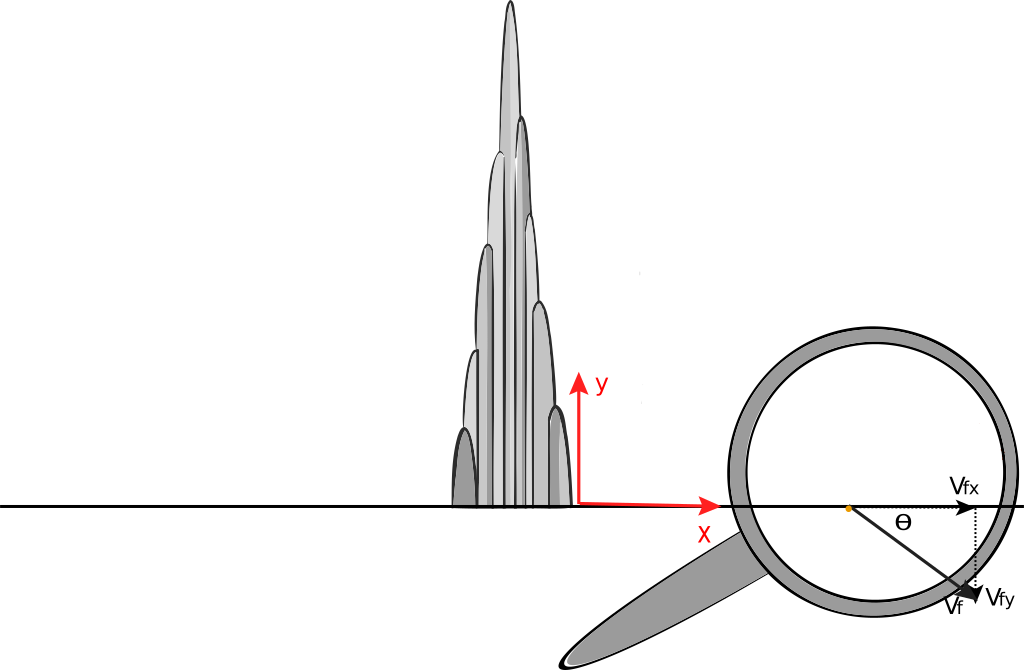
Figura 1: Colocamos el sistema de coordenadas en la base del edificio. En la figura ampliada, podemos ver las componentes de la velocidad final de la moneda \(\vec{v} _f \) cuando golpea el suelo. El ángulo \(\theta \) es el ángulo entre el vector de velocidad horizontal y final.
Observe que hemos usado \( \theta \) para indicar la dirección de la velocidad, y también observe que la magnitud de esta velocidad está dada por
\begin{equation}
\label{ParBuilding_magnitudVel}
\|v_f\| = \sqrt{v_{fx}^2 + v_{fy}^2 }.
\end{equation}
Además, del dibujo, está claro que
\begin{equation}
\label{ParBuilding_angulo}
\tan \theta = \frac{v_{fy}}{v_{fx}}.
\end{equation}
Entonces, tanto para encontrar la dirección como la magnitud de la velocidad final, necesitamos encontrar primero las componentes X y Y de esa velocidad.
Como es habitual en los problemas de movimiento parabólico, tenemos que analizar por separado el movimiento vertical y el horizontal. Empecemos por el horizontal.
Horizontalmente, la moneda sigue un movimiento muy simple, es decir, un movimiento de velocidad constante. Por lo tanto, la rapidez final en X que necesitamos encontrar es la misma que la rapidez inicial en X.
\begin{equation}
v_{fx} = v_{ix}.
\end{equation}
Y la velocidad inicial en X se puede encontrar fácilmente a partir de la velocidad inicial y el ángulo, como se ilustra en la figura 2.

Figura 2: Hacemos zoom en el momento en que se lanza la moneda con una velocidad inicial \(\vec{v} _i \) en un ángulo \(\alpha \) con respecto a una línea horizontal. El sistema de coordenadas se encuentra en la base del edificio.
En el diagrama, vemos que
\begin{equation}
v_x = v_i \cos \theta.
\end{equation}
Como conocemos tanto la rapidez inicial como el ángulo, podemos encontrar \(v_x\) y luego usarlo en las ecuaciones \eqref{ParBuilding_magnitudVel} y \eqref{ParBuilding_angulo} . Como lo necesitaremos más adelante, calculemos \(v_x\) ahora:
\begin{equation}
v_x = (15 \, \text{m/s}) \cos (30^\circ),
\end{equation}
para obtener
\begin{equation}
\label{ParBuilding_velXResultado}
v_x = 12.99 \, \text{m/s}\approx 13 \, \text{m/s}.
\end{equation}
Consideremos ahora el movimiento vertical de la moneda, ya que necesitamos encontrar la rapidez final en Y. En Y, la moneda tiene una aceleración constante (debido a la gravedad), por lo que su velocidad está dada por
\begin{equation}
\label{ParBuilding_velocidadYVector}
\vec{v_{fy}} = \vec{a_{y}} t + \vec{v_{iy}},
\end{equation}
donde \(\vec{v_{fy}}\) es la velocidad Y final, \(\vec{v_{iy} }\) es la velocidad Y inicial, \(\vec{a_{y}}\) la aceleración en Y y \(t\) el tiempo. Para el sistema de coordenadas que estamos usando, podemos ver que la velocidad inicial en Y es positiva, la gravedad es negativa y la velocidad final Y también es negativa (la moneda esta cayendo al tocar el suelo). Por lo tanto, la ecuación \eqref{ParBuilding_velocidadYVector} se convierte en
\begin{equation}
v_{fy} \, \hat{\textbf{j}} = – g t \, \hat{\textbf{j}} + v_{iy} \, \hat{\textbf{j}}.
\end{equation}
O, si nos enfocamos en las magnitudes, obtenemos
\begin{equation}
\label{ParBuilding_velocidadYMagnitud}
v_{fy} = – g t + v_{iy} .
\end{equation}
Ahora, como hicimos para \(v_x\), podemos encontrar \(v_{iy}\) usando la rapidez inicial y el ángulo. En particular, de la misma figura utilizada antes para \(v_x\), vemos que
\begin{equation}
v_{iy} = v_i \sin \theta.
\end{equation}
Si insertamos este resultado en la ecuación \eqref{ParBuilding_velocidadYMagnitud}, obtenemos
\begin{equation}
\label{ParBuilding_velYParaReemplazar}
v_{fy} = – g t + v_{i} \sin \theta.
\end{equation}
Ahora necesitamos encontrar el tiempo \(t\) en el que la moneda toca el suelo, y luego usar ese tiempo en la última ecuación para encontrar \(v_{fy}\).
Para encontrar el tiempo, necesitamos más información. Usemos la ecuación de movimiento para Y, que es la ecuación de un objeto bajo aceleración constante. La ecuación es
\begin{equation}
\vec{y}_f = \frac{1}{2} \vec{a} t^2 + \vec{v}_i t + \vec{y}_i,
\end{equation}
donde \(\vec{y}_f\) es la posición final en Y, \(\vec{y}_i\) es la posición inicial, \(\vec{a}\) es la aceleración (que es negativa según nuestro sistema de coordenadas), \(\vec{v}_i\) es la velocidad inicial en Y y \(t\) es el momento en que la moneda toca el suelo. Para el sistema de coordenadas que estamos usando, esa ecuación de movimiento se convierte en
\begin{equation}
y_f \, \hat{\textbf{j}} = -\frac{1}{2} g t^2 \, \hat{\textbf{j}} + v_{iy} t \, \hat{\textbf{j}} + y_i \, \hat{\textbf{j}},
\end{equation}
donde \(y_f\) es la posición final (que en realidad es cero en el momento en que la moneda toca el suelo), \(y_i\) la posición inicial y \(v_{iy}\) la rapidez Y inicial. Usemos aquí que \(y_f\) es cero, y que \(v_{iy}\) viene dado por \(v_{iy}=v_i \sin \theta \), como se explicó anteriormente. Obtenemos que
\begin{equation}
0 \, \hat{\textbf{j}} = -\frac{1}{2} g t^2 \, \hat{\textbf{j}} + v_i \sin \theta t \, \hat{\textbf{j}} + y_i \, \hat{\textbf{j}}.
\end{equation}
Centrémonos solo en las magnitudes:
\begin{equation}
0 = -\frac{1}{2} g t^2 + v_i \sin \theta t + y_i.
\end{equation}
Ahora, sabemos \(y_i\) (es \(828\) metros), sabemos \(v_i\) y conocemos el ángulo, por lo que podemos usar esta ecuación para encontrar \(t\). Si insertamos los valores numéricos, obtenemos
\begin{equation}
0 = -\frac{1}{2} (9,8 \, \text{m/s}^2) t^2 + (15 \, \text{m/s}) \sin (30^\circ) t + (828 \, \text{m}).
\end{equation}
Observe que esta es una ecuación cuadrática en el tiempo de la forma \(ax^2 + bx + c\), donde \(a\) es \(-\frac{1}{2} (9,8 \, \text{m/s}^2)\), \(b\) is \((15 \, \text{m/s}) \sin (30^\circ)\) and \(c\) is \((828 \, \text{m})\). El resultado es
\begin{equation}
\label{ParBuilding_tiempo}
t_1 = 13.78 \, \text{s},
\end{equation}
y
\begin{equation}
t_2 = -12.25 \, \text{s}.
\end{equation}
Claramente, solo nos preocupa la solución positiva (la negativa correspondería a momentos antes de que se lanzara la moneda). Ahora que tenemos el tiempo, podemos volver a la ecuación \eqref{ParBuilding_velYParaReemplazar} para obtener \(v_{fy}\). Usemos este tiempo y los valores de las otras variables en esa ecuación para obtener
\begin{equation}
v_{fy} = – (9,8 \, \text{m/s}^2) (13.78 \, \text{s}) + (15 \, \text{m/s}) \sin (30^\circ),
\end{equation}
que es igual a
\begin{equation}
v_{fy} = -127.54 \, \text{m/s}.
\end{equation}
Entonces usa este resultado y el de \(v_x\) dado en la ecuación \eqref{ParBuilding_velXResultado} para encontrar \(v_f\) de la ecuación \eqref{ParBuilding_magnitudVel} . Haciéndolo nos da
\begin{equation}
\|v_f\| = \sqrt{(12.99 \, \text{m/s})^2 + (-127.54 \, \text{m/s})^2 },
\end{equation}
para obtener
\begin{equation}
\| v_f \| = 128.20 \, \text{m/s}.
\end{equation}
Y ahora usaremos \(v_x\) y \(v_{fy}\) en la ecuación \eqref{ParBuilding_angulo} para obtener el ángulo:
\begin{equation}
\tan \theta = \frac{(-127.54 \, \text{m/s})}{(12.99 \, \text{m/s})}.
\end{equation}
Por eso,
\begin{equation}
\theta = \arctan(-9.81)
\end{equation}
para obtener
\begin{equation}
\theta = -84.18 ^\circ,
\end{equation}
donde el signo negativo indica que el ángulo se mide por debajo del plano horizontal.
(b) El desplazamiento horizontal total es fácil de encontrar una vez que conocemos el tiempo y \(v_x\). Simplemente usamos que en X la moneda tiene rapidez constante, por lo que la distancia horizontal está dada por
\begin{equation}
d_x = v_x t.
\end{equation}
Utilizamos aquí los valores numéricos para \(v_x\) (de la ecuación \eqref{ParBuilding_velXResultado} ) y \(t\) (de la ecuación \eqref{ParBuilding_tiempo}). El resultado es
\begin{equation}
d_x = 173.94 \, \text{m}.
\end{equation}
(c) Para encontrar la velocidad a la mitad del tiempo del movimiento total, seguimos un procedimiento muy similar al de (a). De hecho, el razonamiento es exactamente el mismo, excepto que el tiempo que necesitamos usar ahora es la mitad del tiempo que usamos en (a).
Encontremos la rapidez vertical en \(t/2\), que es el tiempo que nos importa. Usemos la ecuación \eqref{ParBuilding_velYParaReemplazar} pero con \(t/2\) en lugar de \(t\):
\begin{equation}
v_y(t/2) = – (9,8 \, \text{m/s}^2) \frac{(13.78 \, \text{s})}{2} + (15 \, \text{m/s}) \sin (30^\circ)
\end{equation}
para obtener:
\begin{equation}
\label{ParBuilding_velYParteC}
v_y(t/2) = -60.02 \, \text{m/s}.
\end{equation}
La rapidez horizontal es la misma que en (a), ya que es constante. Por lo tanto, podemos usar \(v_{fy}=v_y(t/2)\) y \(v_x\) de la ecuación \eqref{ParBuilding_velXResultado} en la ecuación \eqref{ParBuilding_magnitudVel} :
\begin{equation}
\|v (t/2)\| = \sqrt{(12.99 \, \text{m/s})^2 + (-60.02 \, \text{m/s})^2 },
\end{equation}
para obtener
\begin{equation}
\|v (t/2)\| = 61.41 \, \text{m/s}.
\end{equation}
Y para encontrar la dirección, usemos la ecuación \eqref{ParBuilding_angulo} de nuevo:
\begin{equation}
\tan \theta = \frac{(-60.02 \, \text{m/s})}{(12.99 \, \text{m/s})}
\end{equation}
Por eso,
\begin{equation}
\theta = \arctan(-4.62)
\end{equation}
para obtener
\begin{equation}
\theta = -77.78 ^\circ.
\end{equation}
Sin embargo, debemos tener cuidado con la dirección de la velocidad vertical en el tiempo \(t/2\). Para (a), sabíamos que la velocidad vertical era negativa para el momento en que la moneda tocó el suelo, pero para (c) ya no sabemos si la moneda está subiendo o bajando en el momento dado. Esto es importante porque si está subiendo, entonces no deberíamos usar \(\theta\) como hicimos en la primera figura para encontrar la dirección de la velocidad. Más bien, si está subiendo, deberíamos usar un triángulo como el de la velocidad inicial.
Entonces, averigüemos si la velocidad vertical es positiva o negativa en \(t/2\). Esto es fácil de hacer mirando la ecuación \eqref{ParBuilding_velYParaReemplazar} donde en realidad obtuvimos \((- 60.06 \, \text{m/s})\) como podemos ver en la ecuación \eqref{ParBuilding_velYParteC} . Entonces, la velocidad es negativa, por lo que el ángulo que estamos usando tiene sentido.


Leave A Comment