
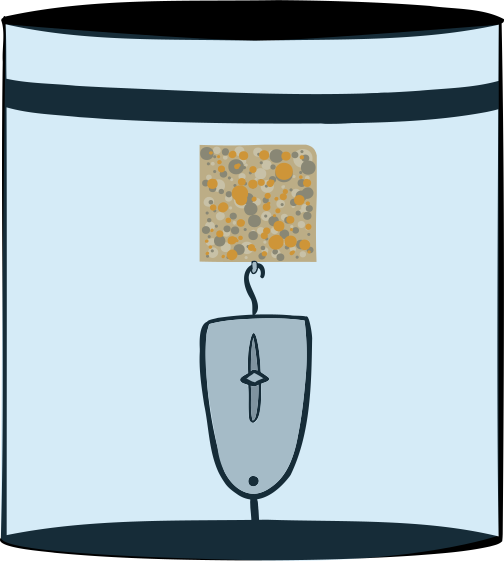
A cork with a mass of 35 g is submerged in water and held by a spring scale at the bottom of the container, as shown in the figure. If the scale reads 110 g, what is the density of the cork?
Use Newton’s Second Law, and consider the reading on the scale for the mass is just a “normal force”.
By Newton’s second law in equilibrium, we have:
\begin{equation*}
\sum F = 0,
\end{equation*}
which in this case we get:
\begin{equation*}
F_B – N – mg = 0,
\end{equation*}
where \(N = m_s g\) and \(F_B = \rho_f V g\). In this case, the submerged volume can be written as:
\begin{equation*}
V = \frac{m}{\rho_c}.
\end{equation*}
Replacing those variables and solving for \(\rho_c\) after some algebra, we get:
\begin{equation*}
\rho_c=\rho_f \frac{m}{m+m_s},
\end{equation*}
or with numerical values:
\begin{equation*}
\rho_c \approx 241.4 \, \text{kg/m}^3.
\end{equation*}
For a more detailed explanation of any of these steps, click on “Detailed Solution”.
We need to find the density of the cork. We notice this is a problem of equilibrium of forces, so we will identify all the forces present on the cork and then use Newton’s second law, along with Archimedes’ principle, to solve for the cork’s density.
First, let’s draw the free-body diagram for the cork, as seen in figure 1. The three forces exerted on the cork are the weight \(\vec{W}\), the buoyant force \(\vec{F}_B\), and the contact force of the cork with the spring scale \(\vec{N}\).

Figure 1: Free-body diagram of the cork. The coordinate system is oriented such that the Y-axis points upwards. Three forces exerted on the cork are shown: the buoyant force \(\vec{F}_B\), the weight \(\vec{W}=-mg\,\hat{\textbf{j}}\), and the contact force exerted by the submerged balance \(\vec{N}\).
The direction of the weight and the buoyant force is evident from their nature. The direction of the contact force \(\vec{N}\) is such that it keeps the cork from going up.
For the static case, the acceleration of the cork is zero, \(\vec{a}=\vec{0}\), so we can write Newton’s second law as
\begin{equation}
\sum \vec{F}=m\vec{a},
\end{equation}
\begin{equation}
\label{newton}
\sum \vec{F}=\vec{0},
\end{equation}
where \(m\) is the mass of the cork and \(\sum \vec{F}\) is the sum of all forces exerted on the cork. In terms of the forces shown in figure 1, we can then write equation \eqref{newton} as
\begin{equation}
\label{newton2}
\vec{F}_B+\vec{W}+\vec{N}=\vec{0}.
\end{equation}
From the established coordinate system in figure 1, the weight is directed in the negative Y direction, its magnitude is \(mg\), where \(g\) is the gravitational acceleration, hence
\begin{equation}
\label{w}
\vec{W}=-mg\,\hat{\textbf{j}}.
\end{equation}
The buoyant force is directed upwards, towards the positive Y axis, and with magnitude, according to Archimedes principle \(\rho_f V_{\text{sub}}g\). Thus:
\begin{equation}
\label{fb}
\vec{F}_B=\rho_f V_{\text{sub}}g\,\hat{\textbf{j}},
\end{equation}
where \(\rho_f\) is the density of the fluid in which the cork is submerged and \(V_{\text{sub}}\) is the volume of the cork submerged. In our case, the submerged volume is the whole volume of the cork, an unknown variable. However, we can relate the total volume to the mass, a known variable, through the cork’s density \(\rho_c\) as follows
\begin{equation}
\rho_c=\frac{m}{V},
\end{equation}
which solving for \(V\), the total volume, becomes
\begin{equation}
\label{volu}
V=\frac{m}{\rho_c}.
\end{equation}
Using the expression for \(V\) of equation \eqref{volu} into equation \eqref{fb}, we get
\begin{equation}
\label{fb2}
\vec{F}_B=\rho_f\frac{m}{\rho_c}g\,\hat{\textbf{j}}.
\end{equation}
The contact force \(\vec{N}\) has a magnitude denoted by \(N\), and its direction is downwards, thus we can write
\begin{equation}
\label{ene}
\vec{N}=-N\,\hat{\textbf{j}}.
\end{equation}
The magnitude \(N\) is equal to the value of mass reported by the spring \(m_{s}\) scale multiplied by the gravitational acceleration \(g\). Remember that all balances measure force, not mass. The equivalence constant always being the acceleration of gravity in the static case. Hence, we can write equation \eqref{ene} as
\begin{equation}
\label{ene2}
\vec{N}=-m_sg\,\hat{\textbf{j}}.
\end{equation}
Using the explicit expressions for the three forces given in equations \eqref{w}, \eqref{fb2} and \eqref{ene2} into equation \eqref{newton2} we obtain,
\begin{equation}
\rho_f\frac{m}{\rho_c}g\,\hat{\textbf{j}}-mg\,\hat{\textbf{j}}-m_sg\,\hat{\textbf{j}}=\vec{0}.
\end{equation}
Since all forces are along the Y axis, we can omit the unitary vector \(\hat{\textbf{j}}\) and write
\begin{equation}
\rho_f\frac{m}{\rho_c}g-mg-m_sg=0,
\end{equation}
where we can cancel out the factor \(g\) to get
\begin{equation}
\rho_f\frac{m}{\rho_c}-m-m_s=0.
\end{equation}
Solving for the term containing \(\rho_c\), we have
\begin{equation}
\rho_f\frac{m}{\rho_c}=m+m_s,
\end{equation}
where we can exchange the place of \(\rho_c\) and \(m+m_s\) to finally obtain
\begin{equation}
\rho_c=\rho_f \frac{m}{m+m_s}.
\end{equation}
We can use the numerical given values to get
\begin{equation}
\rho_c=(1000\,\text{kg/m}^3)\frac{35\,\text{g}}{35\,\text{g}+110\,\text{g}},
\end{equation}
\begin{equation}
\rho_c\approx 241.4\,\text{kg/m}^3.
\end{equation}


Leave A Comment