
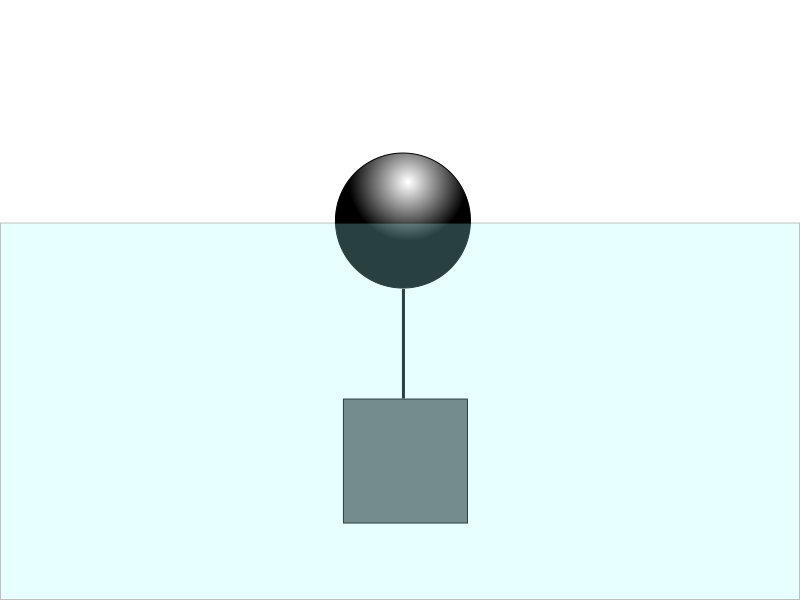
A block of unknown mass and volume \(V\) is attached by a rope to a sphere of mass \(m\) and the same volume \(V\). Both objects are immersed in water. The sphere is floating with half its volume over the surface while the block sinks completely, leaving both balanced in a vertical configuration. Find the mass of the block.
By Newton’s second law for each object write the equations to relate the forces (there will be two equations with two unknown variables). For the buoyant force, be careful with the submerged volume for each object.
For equilibrium, Newton’s second law states:
\begin{equation*}
\sum F = 0,
\end{equation*}
where for the fully submerged block we have:
\begin{equation*}
F_{b,b} + T – Mg = 0,
\end{equation*}
which in this case, the buoyant force for this object is:
\begin{equation*}
F_{b,b} = \rho_w V g.
\end{equation*}
Newton’s second law for the sphere is:
\begin{equation*}
F_{b,s} – T – mg = 0,
\end{equation*}
where in this case, the buoyant force for the sphere is:
\begin{equation*}
F_{b,s} = \rho_w \frac{V}{2} g.
\end{equation*}
Solving for \(T\) in the previous Newton’s second law equation we get:
\begin{equation*}
T =\rho_w \frac{V}{2} g\, – mg,
\end{equation*}
and replacing in the other equation, and solving for \(M\) we have:
\begin{equation*}
M = \frac{3}{2} \rho_w V – m,
\end{equation*}
For a more detailed explanation of any of these steps, click on “Detailed Solution”.
Let us define \(M\) as the mass of the block that we should find in terms of the other known variables. We can apply Newton’s second law to the sphere and the block in order to relate these variables to the mass \(M\) and finally solve for it.
In order to use Newton’s second law, we must first define a reference frame and draw the force diagram for each body. Figure 1 shows the force diagram for the block and our choice of reference frame.
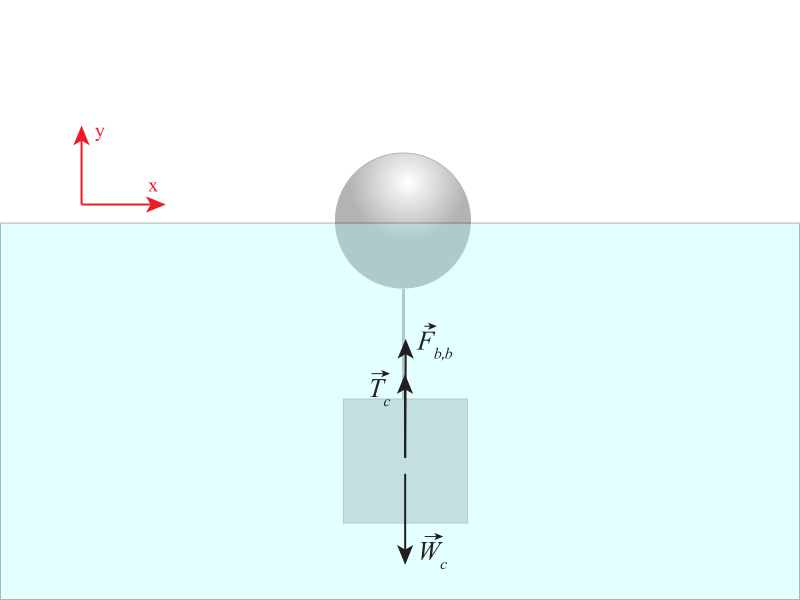
Figure 1: Free-body diagram for the fully submerged block showing the three forces exerted on it: the buoyant force \(\vec{F}_{b,b}\) , the tension exerted by the rope \(\vec{T}_c\) and the weight \(\vec{W}_c = -Mg \hat{\textbf{j}}\).
Let us note that since there is a single rope connecting the two objects, the magnitude of any tension on the rope will be the same. Explicitly,
\begin{equation}
\vec{T}_c=T \hat{\textbf{j}},
\end{equation}
where we have purposely dropped the subscript since there is only one rope. According to figure 1, we can write Newton’s second law for the block as
\begin{equation}
F_{b,b} \hat{\textbf{j}} + T \hat{\textbf{j}} – Mg \hat{\textbf{j}} = M a_b \hat{\textbf{j}},
\end{equation}
where \(T\) is the magnitude of the tension exerted by the rope on the block, \(F_{b,b}\) is the magnitude of the buoyant force exerted by the water, and \(a_b\) is the magnitude of its acceleration. Since all the forces act along the \(\hat{\textbf{j}}\) direction, we can only consider their magnitudes. This gives
\begin{equation}
F_{b,b} + T – Mg = Ma_b.
\end{equation}
Now, the block is stationary and thus \(a_b = 0 \), yielding
\begin{equation}
F_{b,b} + T – Mg = 0.
\end{equation}
If we add \(Mg\) on both sides of the equation, we obtain
\begin{equation}
\label{EQ:n2l_b}
Mg = F_{b,b} + T.
\end{equation}
Ultimately, we want to solve this equation for M. However, we still need to find expressions for the buoyant force \(F_{b,b}\) and for the tension T in terms of known variables.
Let us find the buoyant force first. According to Archimedes’ principle, the magnitude of the buoyant force exerted by a fluid on an object equals the weight of fluid displaced by that object \(w_{d,b}\) (i.e. the weight of the amount of fluid equivalent to the volume of the object). We can write this as
\begin{equation}
F_{b,b} = w_{d,b},
\end{equation}
which by definition of weight, we can rewrite as
\begin{equation}
\label{EQ:fbb}
F_{b,b} = m_{d,b} g.
\end{equation}
Here, \(m_{d,b}\) is the mass of water displaced by the block. From the definition of density, we can rewrite this mass as
\begin{equation}
m_{d,b} = \rho_w V,
\end{equation}
where \(\rho_w\) is the density of water, and \(V\) is the volume of the block, which is equal to the volume of water being displaced by it. Inserting this in eq. \eqref{EQ:fbb} gives
\begin{equation}
F_{b,b} = \rho_w V g,
\end{equation}
and substituting this equation in eq. \eqref{EQ:n2l_b} yields
\begin{equation}
\label{EQ:block}
Mg = \rho_w V g + T.
\end{equation}
Now, in order to find an expression for \(T\), we should apply Newton’s second law on the sphere. Figure 2 shows the force diagram for the sphere
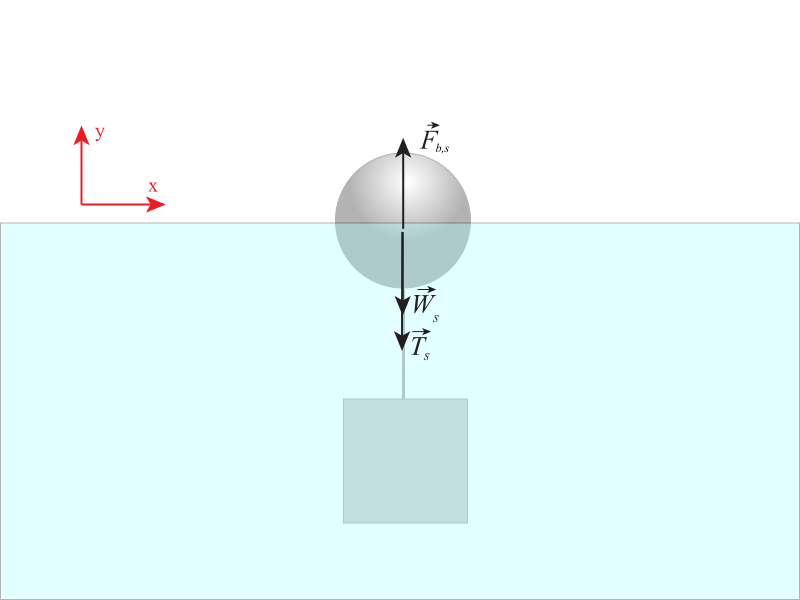
Figure 2: Free-body diagram for the sphere showing the three forces exerted on it: the buoyant force \(\vec{F}_{b,s}\) , the Tension of the rope \(\vec{T}_s = -T \hat{\textbf{j}}\) and the weight \(\vec{W}_s = -mg \hat{\textbf{j}}\).
According to the force diagram shown in figure 2, we can write Newton’s second law as
\begin{equation}
F_{b,s}\hat{\textbf{j}} – T \hat{\textbf{j}} – mg \hat{\textbf{j}} = m a_s \hat{\textbf{j}},
\end{equation}
where \(T\) is the magnitude of the tension exerted by the rope on the sphere (which is the same as the magnitude of the tension exerted on the block), \(F_{b,s}\) is the magnitude of the buoyant force exerted by the water, and \(a_s\) is the magnitude of its acceleration.
As it was the case for the block, all the forces act along the \(\hat{\textbf{j}}\) direction, and the sphere is stationary. Hence, we can consider the magnitudes of the force vectors only, and set \(a_s = 0\). This gives
\begin{equation}
\label{EQ:n2l_s}
F_{b,s} – T – mg = 0.
\end{equation}
Now, we need to find the buoyant force on the sphere \(F_{b,s}\). As explained above for the block, \(F_{b,s}\) is equal to the magnitude of the weight of water displaced by the sphere. We can write this as
\begin{equation}
F_{b,s} = m_{d,s} g,
\end{equation}
where \(m_{d,s}\) is the mass of water displaced by the sphere. We can rewrite the mass in terms of the volume \(V_{d,s}\) of water displaced by the sphere as
\begin{equation}
F_{b,s} = \rho_w V_{d,s} g.
\end{equation}
The volume of water displaced by the sphere is equal to the volume of the sphere that is submerged. Since half of its volume is submerged, we have \(V_{d,s} = V/2\). Inserting this in the previous equation gives
\begin{equation}
F_{b,s} = \rho_w \frac{V}{2} g.
\end{equation}
Now, substituting this in eq. \eqref{EQ:n2l_s} yields
\begin{equation}
\rho_w \frac{V}{2} g\, – T – mg = 0,
\end{equation}
and after solving for \(T\), we get
\begin{equation}
T =\rho_w \frac{V}{2} g\, – mg.
\end{equation}
Finally, substituting this in eq. \eqref{EQ:block} gives
\begin{equation}
Mg = \rho_w V g + \rho_w \frac{V}{2} g \, – mg.
\end{equation}
Notice that all terms have \(g\) as a factors. Hence, if we divide by \(g\) on both sides of the equation, it cancels out, yielding
\begin{equation}
M = \rho_w V + \rho_w \frac{V}{2} – m.
\end{equation}
If we factor out \(\rho_w V\) from the first two terms at the right-hand side we get
\begin{equation}
\label{EQ:M}
M = \rho_w V \left(1 + \frac{1}{2}\right) – m
= \frac{3}{2} \rho_w V – m,
\end{equation}
where \(\rho_w, V\) and \(m\) are all known variables.
Notice that \(\frac{3}{2}\) \(V\) is the total submerged volume from the two bodies (a volume \(V\) from the block, and a volume \(V/2\) from the sphere are submerged). Therefore, \(\frac{3}{2} \rho_w V g\) is the total buoyant force on both blocks. Let’s now consider the two objects as conforming a single system. Let’s apply Newton’s second law, taking into account the forces acting on this system. We obtain
\begin{equation}
\frac{3}{2} \rho_w V g \, – (M+m)g = 0,
\end{equation}
where the first term represents the buoyant force acting on both objects, and the second term represents the total weight. If we divide by g we get
\begin{equation}
\frac{3}{2} \rho_w V – (M+m) = 0,
\end{equation}
and solving for M gives
\begin{equation}
M = \frac{3}{2} \rho_w V – m,
\end{equation}
which is the same as eq. \eqref{EQ:M}. We obtained the same result in a much simpler way by considering both objects as a single system when applying Newton’s second law.


Leave A Comment