
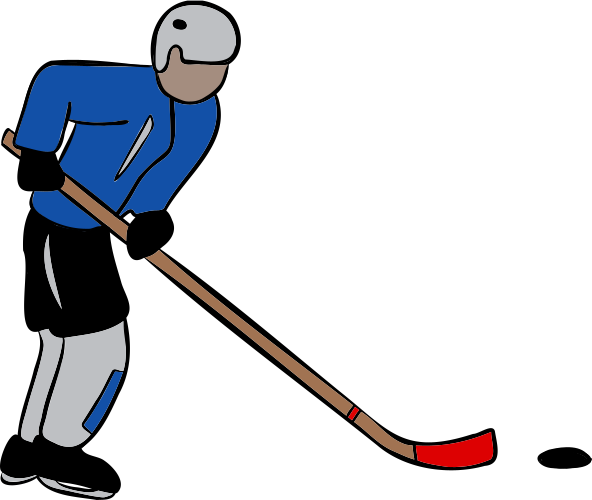
It’s the Stanley Cup Final, and the crowds are cheering from the stands surrounding the ice rink that is 60 meters in length. The \(150 \, \text{g}\) hockey puck slides across the ice at constant speed, and travels half the rink in \(6 \, \text{s}\). A hockey player, wanting to score a goal, uses their hockey stick to apply constant force on the moving puck for half a second, causing the puck to attain a speed of \(35 \,\text{m}/\text{s}\) and move in the opposite direction. Calculate the force that the player must exert on the hockey puck to score the goal.
To find the change of momentum, you will need the speed, the distance travelled, and time elapsed. You can also solve for the applied force because you know the time it takes for the puck to move from one side to the other.
Suppose the puck moves at constant speed. Traveling a distance \(L=30\,\text{m}\) in a time period of \(T=6\,\text{s}\), the puck’s speed \(v_i\) is:
\begin{equation*}
v_i=\frac{L}{T}.
\end{equation*}
The problem asks us to find the force that the hockey player exerts on the puck. We must relate the force exerted on the puck with the change of momentum per time interval. For finite changes, the force applied can be approximated to:
\begin{equation*}
\vec{F}\approx \frac{\vec{p}_f-\vec{p}_i}{\Delta t},
\end{equation*}
where the velocity \(v_i\) was recently found.
Plugging in numerical values yields:
\begin{equation*}
\vec{F}\approx 12 \, \text{N} \hat{\textbf{i}}.
\end{equation*}
For a more detailed explanation of any of these steps, click on “Detailed Solution”.
The problem asks us to find the force that the hockey player exerts on the puck. To approach this problem, we must relate the force exerted on the puck with the change of linear momentum in a time interval. For really small time intervals, \(\Delta t\) the force \(\vec{F}\) applied can be approximated to
\begin{equation}
\label{force}
\vec{F}\approx \frac{\vec{p}_f-\vec{p}_i}{\Delta t},
\end{equation}
where \(\vec{p}_i\) and \(\vec{p}_f\) are the linear momentum of the puck before the hockey player hits it and after the hockey player hits it, respectively. The time interval between these events is \(\Delta t=0.5\,\text{s}\).
We can calculate the linear momentum using the following equation
\begin{equation}
\label{momentum}
\vec{p}=m\vec{v},
\end{equation}
where \(m=150\,\text{g}=0.150\,\text{kg}\) is the mass of the puck and \(\vec{v}\) its velocity.
Suppose the puck moves with constant speed \(v_i\) along the X axis in the negative direction before the player hits it. Knowing that it travels a distance of \(L=30\,\text{m}\) in a time of \(T=6\,\text{s}\), the puck’s speed \(v_i\) can be calculated. The speed is
\begin{equation}
v_i=\frac{L}{T},
\end{equation}
and numerically
\begin{equation}
v_i=\frac{30\,\text{m}}{6\,\text{s}}=5\,\text{m/s}.
\end{equation}

Figure 1: We place the coordinate system on the ground where the hockey player is. The puck travels a distance \(L\) at a constant velocity \(\vec{v}_i\) along the negative X axis before encountering the hockey player.
Because we must include the velocity vector \(\vec{v}_i\) in the equation for the momentum, direction will be important. We can thus write
\begin{equation}
\vec{v}_i=-v_i\,\hat{\textbf{i}},
\end{equation}
where \(\hat{\textbf{i}}\) is the unitary vector along the X axis. Thus, the linear momentum before the collision, following equation \eqref{momentum} is
\begin{equation}
\label{pi}
\vec{p}_i=-mv_i\,\hat{\textbf{i}}.
\end{equation}
After the player hits the puck, it moves towards the right with speed \(v_f=35\,\text{m/s}\) as illustrated in figure 2.
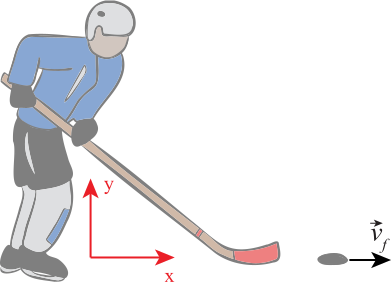
Figure 2: After the hockey player hits puck, it starts going along the positive X axis with a velocity \(\vec{v}_f\).
We can then write an expression for the velocity \(\vec{v}_f\) as
\begin{equation}
\vec{v}_f=v_f\,\hat{\textbf{i}}.
\end{equation}
The linear momentum of the puck after the player hits it is then, using equation \eqref{momentum},
\begin{equation}
\label{pf}
\vec{p}_f=mv_f\,\hat{\textbf{i}}.
\end{equation}
Using the expressions for the linear momentum before and after the hockey player hits the puck into equation \eqref{force}, we obtain
\begin{equation}
\vec{F}\approx \frac{mv_f\,\hat{\textbf{i}}-(-mv_i\,\hat{\textbf{i}})}{\Delta t},
\end{equation}
which simplifies to
\begin{equation}
\vec{F}\approx \frac{mv_f+mv_i}{\Delta t}\,\hat{\textbf{i}}.
\end{equation}
Using the numerical values, we obtain
\begin{equation}
\vec{F}\approx \frac{(0.15\,\text{kg})(35\,\text{m/s})+(0.15\,\text{kg})(5\,\text{m/s})}{0.5\,\text{s}}\,\hat{\textbf{i}},
\end{equation}
\begin{equation}
\vec{F}\approx 12\,\text{N}\,\hat{\textbf{i}}.
\end{equation}


It goes half of the length of the rink in 6 seconds. So it actually travels a distance L=30 m in 6s.