
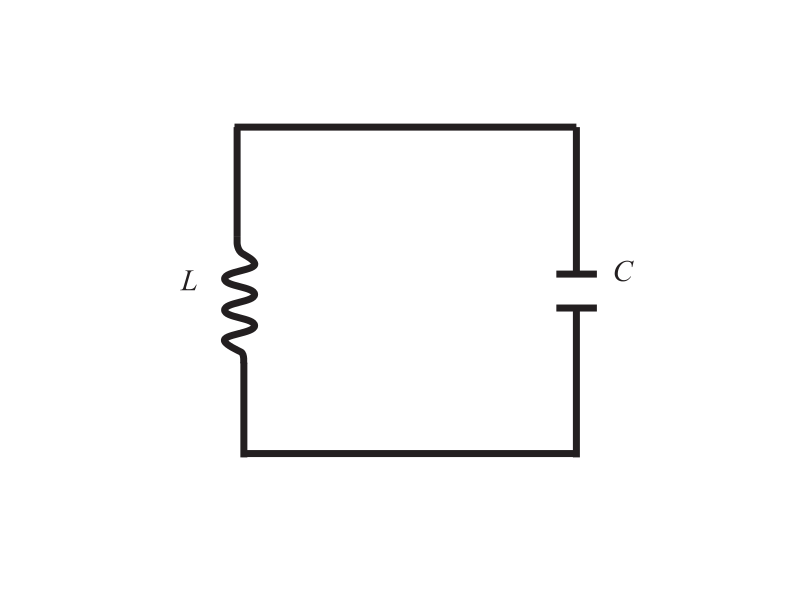
Suppose there is an electric circuit with a capacitor \(C\) connected in parallel to an inductor \(L\). Show that the amount of charge stored in the capacitor oscillates in a simple harmonic manner, and find the period of this oscillation.
Sum the voltages for each element, and write each voltage in terms of the charge. Write a second-order differential equation which, compared to a harmonic oscillator, is easy to solve for the frequency and the period.
For the closed path, the sum of the voltages must be zero. Then:
\begin{equation*}
V_C+V_L=0.
\end{equation*}
The voltage for the capacitor is \(V=Q/C\), and for the inductor \(V_L = L \frac{dI}{dt}\). Then:
\begin{equation*}
\frac{Q}{C}+L\frac{dI}{dt}=0.
\end{equation*}
Since the current is the derivative of the charge over time, the derivative of the current will be the second derivative over time. Using some algebra, we get:
\begin{equation*}
\frac{d^2Q}{dt^2}+\frac{1}{LC}Q=0.
\end{equation*}
Now compare this with the harmonic oscillator differential equation, which reads:
\begin{equation*}
\frac{d^2x}{dt^2}+\omega^2x=0.
\end{equation*}
Then:
\begin{equation*}
\omega=\sqrt{\frac{1}{LC}}.
\end{equation*}
The period \(T\) can be related with the frequency as \( \frac{2\pi}{\omega}\). Then:
\begin{equation*}
T=2\pi\sqrt{LC}.
\end{equation*}
For a more detailed explanation of any of these steps, click on “Detailed Solution”.
In this problem, we will use Kirchhoff’s voltage law to show that the amount of charge satisfies an expression analogous to that of a harmonic oscillator such as a pendulum or a spring-mass system. Kirchhoff’s voltage law indicates that the sum of voltages across a closed path in a circuit must be zero, which is actually equivalent to the conservation of energy principle.
In our case, we only have one closed path. Thus, the current flows either clockwise or anti-clockwise. In both cases, the sum of the voltages over the capacitor \(V_C\) and over the inductor \(V_L\) must add up to zero. Explicitly:
\begin{equation}
\label{kirch}
V_C+V_L=0.
\end{equation}
The voltage over a capacitor depends on the charge \(Q\) stored in their conducting surfaces, and on its capacitance \(C\), which is a quantity that depends on the geometry of the capacitor. Hence, the expression for the voltage over the capacitor is
\begin{equation}
V_C=\frac{Q}{C}.
\end{equation}
The voltage over an inductor depends on the rate of change of the current \(dI/dt\), and on the inductance \(L\), which depends solely on the geometry of the inductor. So for the inductor, we can write the following expression for the voltage:
\begin{equation}
V_L=L\frac{dI}{dt}.
\end{equation}
Thus, Kirchhoff voltage law given in equation \eqref{kirch} becomes
\begin{equation}
\label{kirch2}
\frac{Q}{C}+L\frac{dI}{dt}=0.
\end{equation}
Because the current \(I\) is defined as the rate of change of the charge, then we can write it as
\begin{equation}
I=\frac{dQ}{dt}.
\end{equation}
Using this expression in Kirchhoff’s law given in equation \eqref{kirch2}, we get
\begin{equation}
\frac{Q}{C}+L\frac{d^2Q}{dt^2}=0,
\end{equation}
which is a second order differential equation for \(Q\). Dividing all the terms in the expression by \(L\), we end up with
\begin{equation}
\frac{d^2Q}{dt^2}+\frac{1}{LC}Q=0.
\end{equation}
Now compare this with the harmonic oscillator differential equation, which reads
\begin{equation}
\frac{d^2x}{dt^2}+\omega^2x=0.
\end{equation}
If we compare both equations, we identify \(Q=x\) to be the quantity that oscillates, which is precisely the charge. Hence, we have shown that the amount of charge oscillates in a simple harmonic manner, as we wanted to show.
To find the period, we first identify \(\omega^2=1/LC\), which is the angular frequency of the oscillatory motion. We then have that
\begin{equation}
\label{omega}
\omega=\sqrt{\frac{1}{LC}}.
\end{equation}
The period \(T\) of the oscillatory motion is expressed in terms of the angular frequency as
\begin{equation}
T=\frac{2\pi}{\omega}.
\end{equation}
Using the explicit expression for \(\omega\) given by equation \eqref{omega}, we finally get
\begin{equation}
T=2\pi\sqrt{LC}.
\end{equation}


Leave A Comment