

Two French bulldogs named Yuyi and Luna are laying down in the grass, when suddenly Yuyi decides to start a game of tag! Yuyi jumps up and accelerates at \(0.5 \,\text{m}/\text{s}^2\). It takes Luna \(3\) seconds to react and get up, but when she does manage, she runs after Yuyi with an acceleration of \(1 \,\text{m}/\text{s}^2\)! (Assume Luna runs after Yuyi in a straight line.)
(a) How long does it take Luna to reach Yuyi?
(b) Once Luna starts running and is 1 meter behind Yuyi, what is Yuyi’s speed? And Luna’s speed?
(c) Make a graph of velocity vs. time for both Luna and Yuyi during the first 5 seconds. Plot both Luna and Yuyi’s motion on the same graph. Describe the graph and how it relates to the dogs’ motion.
(a) Notice that there is a delay between the time used for Luna and the time used for Yuyi. When Luna reaches Yuyi, their final positions must be the same. Notice also that both dogs move with constant acceleration.
(b) Set the difference between their final positions to one meter and try to find the time for this to happen. Then, find the velocity at that time taking into account that the velocity is proportional to the time and the acceleration.
(c) Consider the velocity as a function of time for both Luna and Yuyi. Notice that the y−intersect for one of the dogs is not zero.
(a) When they meet, their final positions (given by their equations of motion) must be the same. That is,
\begin{equation*}
\vec{x}_{fy}= \vec{x}_{fl}.
\end{equation*}
The equation of motion that we need to use is the following one:
\begin{equation*}
\vec{x}_f = \frac{1}{2} \vec{a} t^2 + \vec{v}_i t + \vec{x}_i.
\end{equation*}
The relation for the time is simple: Luna starts running three seconds after Yuyi starts. This means that
\begin{equation*}
t_l = t_y – t_d = t_y – 3 \, \text{s}.
\end{equation*}
Using this in equation the previous equation, considering they were at rest, we get:
\begin{equation*}
\frac{1}{2} a_y (t_l + t_d)^2 \, \hat{\textbf{i}} = \frac{1}{2} a_l t_l^2 \, \hat{\textbf{i}}.
\end{equation*}
Now, solving for \(t_l\) as a quadratic equation the solutions are:
\begin{equation*}
t_{l1} = 7.24 \, \text{s},
\end{equation*}
and
\begin{equation*}
t_{l2} = -1.24 \, \text{s}.
\end{equation*}
Clearly, the answer is the one corresponding to the positive value (negative times are about things that occurred before Luna started running).
(b) Now, let’s find the time when the distance between Yuyi and Luna is the given in the problem. Defining \(d\) as:
\begin{equation*}
d = \| \vec{x}_y – \vec{x}_l \|,
\end{equation*}
where using the equation of motion as previously used, and the time delay, we get:
\begin{equation*}
d = \frac{1}{2} a_y (t_l + t_d)^2 – \frac{1}{2} a_l t_l^2.
\end{equation*}
This, again, is a quadratic equation for the time. The solutions are:
\begin{equation*}
t_{l1} = 6.74 \, \text{s},
\end{equation*}
and
\begin{equation*}
t_{l2} = -0.74 \, \text{s}.
\end{equation*}
As before, the positive solution is the relevant one.
Now, let’s find Luna’s speed when she is two meters away from Yuyi. For a case of constant acceleration, the velocity is given by:
\begin{equation*}
\vec{v}_f = \vec{v}_i + \vec{a} t,
\end{equation*}
where using numerical values we get:
\begin{equation*}
v_{fy} = 4.87 \, \text{m/s}.
\end{equation*}
(c) To make a graph of velocity vs time for Luna and Yuyi, we can use their velocities equations. For Luna, we have
\begin{equation*}
v_{fl} = a_l t_l,
\end{equation*}
For Yuyi, recall that \(t_y=t_l+t_d\), where \(t_d\) is 3 seconds. So, the line we need to plot is this one
\begin{equation*}
v_{fy} = a_{y} (t_l + t_d).
\end{equation*}
If we plot both of these lines, we get:

Plot of the velocity vs time for Luna and Yuyi. The intersection point between the lines is around \(t=3.1\,\text{s}\).
The lines intersect at around 3.1 s, which is the time when their speeds are the same (careful, this is not the point where they meet each other, since this is not a plot of position vs time).
For a more detailed explanation of any of these steps, click on “Detailed Solution”.
\begin{equation}
\label{YuyiLuna_igualdadPosicionesVectores}
\vec{x}_{fy}= \vec{x}_{fl},
\end{equation}
where \(\vec{x}_{fy}\) is the final position of Yuyi and \(\vec{x}_{fl}\) the final position of Luna. To obtain \(\vec{x}_{fy}\) and \(\vec{x}_{fl}\), we need to use their equations of motion. Both Yuyi and Luna follow a motion with constant acceleration, and so the general equation describing their movement is
\begin{equation}
\vec{x}_f = \frac{1}{2} \vec{a} t^2 + \vec{v}_i t + \vec{x}_i,
\end{equation}
where \(\vec{x}_f\) is the final position, \(\vec{x}_i\) the initial position, \(\vec{v}_i\) the initial velocity, \(a\) the acceleration and \(t\) the time.
Now, in order to apply this equation to the present problem, we need to choose a coordinate system. Let’s place a system whose origin is the initial position of the dogs and whose X axis points in the direction of motion of the two dogs (see figure 1).
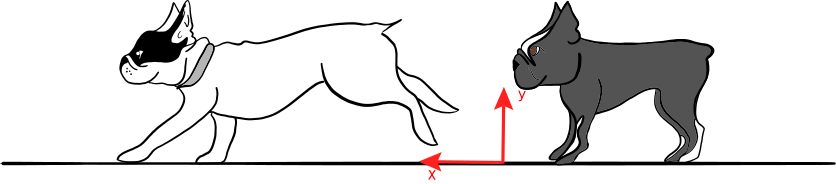
Figure 1: We place the coordinate system at Luna’s initial position. The positive X axis goes along the straight line in which both dogs run.
According to this coordinate system, the initial position of Yuyi is zero, her acceleration is positive, the final position is positive, and the initial velocity is zero because she was initially lying on the grass. Hence, Yuyi’s equation of motion is
\begin{equation}
\label{YuyiLuna_Yuyi}
x_{fy} \, \hat{\textbf{i}} = \frac{1}{2} a_y t_y^2 \, \hat{\textbf{i}} + (0) t_y \, \hat{\textbf{i}} + 0 \, \hat{\textbf{i}},
\end{equation}
where \(t_y\) is the time variable for Yuyi and \(a_y\) her acceleration.
We can then use this result in equation \eqref{YuyiLuna_igualdadPosicionesVectores} to get
\begin{equation}
\label{YuyiLuna_PosicionesConYuyi}
\frac{1}{2} a_y t_y^2 \, \hat{\textbf{i}} = \vec{x}_{fl}.
\end{equation}
The next step is to find an expression for Luna’s final position.
Now, we do exactly the same thing for Luna that we did for Yuyi; the initial position is zero, the initial velocity is zero, the final position is positive and the acceleration is positive. Hence, we get
\begin{equation}
\label{YuyiLuna_Luna}
x_{fl} \, \hat{\textbf{i}} = \frac{1}{2} a_l t_l^2 \, \hat{\textbf{i}} + (0) t_l\, \hat{\textbf{i}} + 0 \, \hat{\textbf{i}},
\end{equation}
where \(t_l\) is the time for Luna and \(a_l\) the magnitude of her acceleration. Now, we can insert this result in equation \eqref{YuyiLuna_PosicionesConYuyi}.
\begin{equation}
\label{YuyiLuna_PosicionesParaReemplazar}
\frac{1}{2} a_y t_y^2 \, \hat{\textbf{i}} = \frac{1}{2} a_l t_l^2 \, \hat{\textbf{i}}.
\end{equation}
Notice that we have two different time variables now, one for Yuyi and the other one for Luna. In order to continue, we should use the same time variable, and so we need to relate \(t_y\) and \(t_l\). The relation is simple: Luna starts running three seconds after Yuyi starts. This means that
\begin{equation}
t_l = t_y – 3 \, \text{s}.
\end{equation}
Since we want to find the time it takes Luna to reach Yuyi, we should then write \(t_y\) in terms of \(t_l\):
\begin{equation}
\label{YuyiLuna_TiemposCon2}
t_y = t_l + 3 \, \text{s}.
\end{equation}
Since we want to replace the numerical values at the end, let’s just call \(t_d\) the delay time (the 3 seconds of delay), so that equation \eqref{YuyiLuna_TiemposCon2} becomes
\begin{equation}
\label{YuyiLuna_TiemposConDelay}
t_y = t_l + t_d.
\end{equation}
Using this in equation \eqref{YuyiLuna_PosicionesParaReemplazar}, we get
\begin{equation}
\frac{1}{2} a_y (t_l + t_d)^2 \, \hat{\textbf{i}} = \frac{1}{2} a_l t_l^2 \, \hat{\textbf{i}}.
\end{equation}
Let’s focus on the magnitudes: multiply by 2 on both sides and operate the squared parenthesis
\begin{equation}
a_y (t_l^2 + 2 t_l t_d + t_d^2 ) = a_l t_l^2,
\end{equation}
which can be write as
\begin{equation}
a_y t_l^2 + 2 a_y t_l t_d + a_y t_d^2 = a_l t_l^2.
\end{equation}
Let’s move all the terms to the left side and factorize \(t_l^2\)
\begin{equation}
\label{YuyiLuna_Cuadratica}
(a_y – a_l) t_l^2 + 2 a_y t_d t_l + a_y t_d^2 = 0
\end{equation}
If we insert the numerical values here, we get
\begin{equation}
((0.5\, \text{m/s}^2) – (1\, \text{m/s}^2)) t_l^2 + 2(0.5\, \text{m/s}^2) (3 \, \text{s}) t_l + (0.5\, \text{m/s}^2) (3 \, \text{s})^2 = 0.
\end{equation}
Notice that this is a quadratic equation for the time. Recall that a quadratic equation is of the form \( ax^2 + bx + c \). In this case, \(a\) corresponds to \(-0.5\), \(b\) to \(3\) and \(c\) to \(4.5\).
The solutions are
\begin{equation}
t_{l1} = 7.24 \, \text{s},
\end{equation}
and
\begin{equation}
t_{l2} = -1.24 \, \text{s}.
\end{equation}
Clearly, the answer is the one corresponding to the positive value (negative times are about things that occurred before Luna started running).
(b) Now, let’s find Luna’s speed when she is two meters away from Yuyi. For a case of constant acceleration, the velocity is given by
\begin{equation}
\vec{v}_f = \vec{v}_i + \vec{a} t,
\end{equation}
where \(\vec{v}_f\) is the final velocity, \(\vec{v}_i\) is the initial velocity, \(a\) the acceleration, and \(t\) the time. In the case of Luna (and also Yuyi), the initial velocity is zero, the acceleration is positive and the final velocity is also positive (if we did not know the final velocity, then we could just assume that it is positive and then, if we get a negative sign, then we’ll learn that we were wrong). So we get
\begin{equation}
v_f \, \hat{\textbf{i}} = 0 \, \hat{\textbf{i}} + a_l t_2 \, \hat{\textbf{i}},
\end{equation}
where \(t_2\) is the time at which Luna is two meters away from Yuyi (which we do not know).
Or, if we focus on the magnitudes, we get
\begin{equation}
\label{YuyiLuna_velLuna}
v_f = a_l t_2.
\end{equation}
Now, in order to find the speed from this equation, we need to find \(t_2\). The distance between two objects in one dimension is generally given by
\begin{equation}
d = \| \vec{x}_1 – \vec{x}_2 \|,
\end{equation}
where \(\vec{x}_1\) and \(\vec{x}_2\) are the position between the objects and d the distance (we need the absolute value because the distance must be positive). In our case, the positions we need to use are Yuyi’s and Luna’s positions:
\begin{equation}
d = \| \vec{x}_y – \vec{x}_l \|,
\end{equation}
Now, clearly, \(\vec{x}_y – \vec{x}_l\) will be positive because Luna is two meters behind Yuyi at the time in question. So, we can just ignore the absolute value (the absolute value of a positive number is just the number).
\begin{equation}
d = x_y – x_l.
\end{equation}
Next, in this equation, let’s insert the equations of motion for Yuyi and Luna found earlier, but only their magnitudes (equations \eqref{YuyiLuna_Yuyi} and \eqref{YuyiLuna_Luna} respectively):
\begin{equation}
d = \frac{1}{2} a_y t_y^2 – \frac{1}{2} a_l t_l^2.
\end{equation}
Again, let’s make sure that we use the same time variable, so equation \eqref{YuyiLuna_TiemposConDelay} is also valid here, but remember that \(t_l\) and \(t_y\) are not going to be the same as in (a):
\begin{equation}
d = \frac{1}{2} a_y (t_l + t_d)^2 – \frac{1}{2} a_l t_l^2.
\end{equation}
Let’s multiply everything by 2 and solve the square
\begin{equation}
2d = a_y (t_l^2 + 2 t_l t_d + t_d^2 ) – a_l t_l^2.
\end{equation}
If we move all the terms to the right side, and organize as we did previously
\begin{equation}
0 = (a_y – a_l) t_l^2 + 2 a_y t_d t_l + a_y t_d^2 – 2d = 0.
\end{equation}
Notice that this equation is very similar to equation \eqref{YuyiLuna_Cuadratica}, but the differences will give us different solutions. With numerical values we get
\begin{equation}
0 = ((0.5\, \text{m/s}^2) – (1\, \text{m/s}^2)) t_l^2 + 2(0.5\, \text{m/s}^2) (3 \, \text{s}) t_l + (0.5\, \text{m/s}^2) (3 \, \text{s})^2 – 2 (1 \, \text{m}).
\end{equation}
This, again, is a quadratic equation for the time, where the only difference with the previous equation is that the constant term \(c\) is \((2.5) \). The solutions are
The solutions are
\begin{equation}
t_{l1} = 6.74 \, \text{s},
\end{equation}
and
\begin{equation}
t_{l2} = -0.74 \, \text{s}.
\end{equation}
As before, the positive solution is the relevant one. So now that we have \(t_l = t_2 = 6.74 \, \text{s}\) (the time it takes Luna) we can use it in equation \eqref{YuyiLuna_velLuna} with Luna’s acceleration. The result is
\begin{equation}
v_{fl} = 6.74 \, \text{m/s}.
\end{equation}
For Yuyi, the equation for the speed is exactly the same, except that we have to use her time (not Luna’s time \(t_2\)), because we want Yuyi’s speed (she has been accelerating for longer that Luna has). So we need to use
\begin{equation}
\label{YuyiLuna_velYuyi}
v_{fy} = a_y t_{2y},
\end{equation}
where \(t_y\) is the time when Yuyi is two meters ahead, and \(a_y\) is her acceleration. Recall from equation \eqref{YuyiLuna_TiemposConDelay} that \(t_y=t_l+t_d\) (this is true for any time, so for \(t_l=t_2\) in particular):
\begin{equation}
v_{fy} = a_y (t_2 + t_d).
\end{equation}
Finally, let’s insert the numerical values here
\begin{equation}
v_{fy} = (0.5\, \text{m/s}^2) ((6.74 \, \text{s}) +(3 \, \text{s})).
\end{equation}
We get
\begin{equation}
v_{fy} = 4.87 \, \text{m/s}.
\end{equation}
(c) To make a graph of velocity vs time for Luna and Yuyi, we can use their velocities equations (\eqref{YuyiLuna_velLuna} and \eqref{YuyiLuna_velYuyi}, respectively). For Luna, we have
\begin{equation}
v_{fl} = a_l t_l,
\end{equation}
which is the equation of a straight line that goes through the origin (because \(v_{fl}=0\) when \(t = 0\)), and where the slope is the acceleration \(a_l\). With numbers, we get
\begin{equation}
v_{fl} = (1\,{\text{m}/\text{s}^2})t_l.
\end{equation}
For Yuyi, we also get the equation of a straight line given by
\begin{equation}
v_{fy} = a_y t_y.
\end{equation}
However, if we are using the same graph, we need to use the same time variable. Recall that \(t_y=t_l+t_d\), where \(t_d\) is 3 seconds. So, the line we need to plot is this one
\begin{equation}
v_{fy} = a_{y} (t_l + t_d).
\end{equation}
With numbers, we get
\begin{equation}
v_{fy} = (0.5\, {\text{m}/\text{s}^2})(t_l+3\, \text{s}).
\end{equation}
This is at line that when \(t_l=0\), it cuts the Y axis at 1.5 \({\text{m}/\text{s}}\). If we plot both of these lines, we get the graph shown in figure 2.
Figure 2: Plot of the velocity vs time for Luna and Yuyi. The intersection point between the lines is around \(t=3.1\,\text{s}\).
Notice that when \(t_l=0\), Yuyi already has some speed (1.5 m/s to be exact). This makes sense, of course, since Luna starts to run when \(t_l\) is zero, while Yuyi has been running for three seconds already by that point! Also notice that the slope of Yuyi’s line is less than the slope of Luna because Luna’s acceleration is greater. And finally, the lines intersect at around 3.1 s, which is the time when their speeds are the same (careful, this is not the point where they meet each other, since this is not a plot of position vs time).



Leave A Comment