
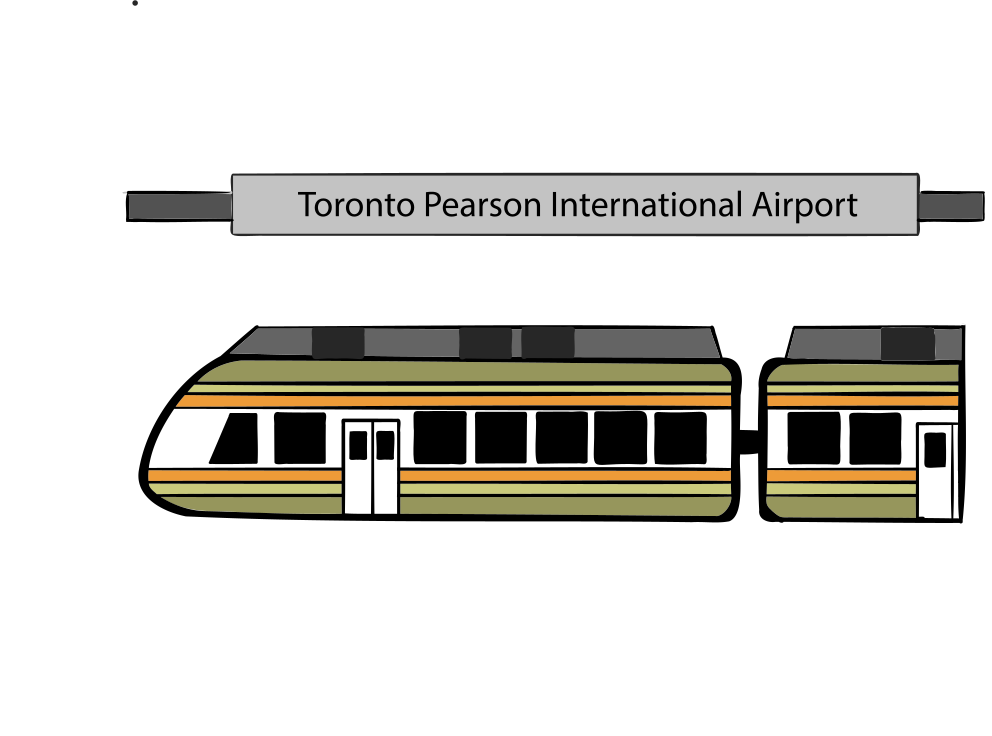
Landing in a new country is exciting, but landing in the middle of the countryside is not necessarily what every city slicker wants. The UP Express train at the Toronto Airport claims it can reach downtown in 30 minutes! If the distance from the airport to downtown is around 25 km, calculate:
(a) The average speed of the train in m/s.
(b) The minimum acceleration the train has to reach for the first 5 minutes in order to arrive on time (assuming the last 25 minutes of the trip are travelled at a constant speed.)
(c) Sketch a qualitative graph of distance vs time for the total trip found in part (b). (No numbers needed.)
(a) Use the equation that gives the position of an object moving with constant velocity. Also, make sure to use SI units.
(b) Divide the problem in two stages: first, a stage with constant acceleration and then a stage with constant velocity. Remember to use SI units.
(c) Consider your results as piecewise functions that depend on the time.
The average speed is easily found given the time and the distance. This average speed is given by
\begin{equation*}
v_{\text{aver}} = \frac{d}{t},
\end{equation*}
Remember to use SI units and replace the numerical values to get:
\begin{equation*}
v_{\text{aver}} = \frac{125}{9} \, \text{m/s}.
\end{equation*}
(b) Now, we have to study the motion of the train in two steps. First, the distance on the first five minutes (\(d_a\), with constant acceleration) and then the distance on the last 25 minutes (\(d_v\), with constant acceleration.
The total distance travelled by the train equals:
\begin{equation*}
d_T=d_a+ d_v,
\end{equation*}
By using kinematic equations and the initial conditions we get:
\begin{equation*}
d_a = \frac{1}{2} a t_a^2,
\end{equation*}
and
\begin{equation*}
d_v = vt_v,
\end{equation*}
where \(v = a t_a\), and where \(a\) and \(t_a\) is the acceleration and the time of the first step respectively. Then we can solve for \(a\) and replace the numerical values in the correct units to get:
\begin{equation*}
0.05 \, \text{m/s}^2 = a.
\end{equation*}
(c) By the equations of motions, the first one describes a parabolic function:
\begin{equation*}
d_a = \frac{1}{2} a t_a^2,
\end{equation*}
and the second one describes a line:
\begin{equation*}
d_v = vt_v.
\end{equation*}
The sketch of the graph is:
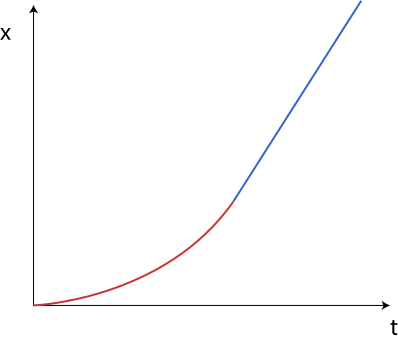
Qualitative sketch of position of the train as a function of time. The red line represents the first 5 minutes while the blue straight line is for times greater than 5 minutes, showing a constant slope.
For a more detailed explanation of any of these steps, click on “Detailed Solution”.
(a) The average speed is easily found given the time and the distance. This average speed is given by
\begin{equation}
\label{Train_velocidad}
v_{\text{aver}} = \frac{d}{t},
\end{equation}
where \(d\) is the distance and \(t\) the time. So, we just need to plug in the distance and the time in this equation, but we have to be careful about the units because the answer has to be given in meters per second.
On the one hand, since 1 minute has 60 seconds, then 30 minutes corresponds to
\begin{equation}
30 \, \text{min} \cdot \left( \frac{60 \, \text{s}}{1 \, \text{min}} \right) = 1800 \, \text{s}.
\end{equation}
On the other hand, 1 kilometer has 1000 meters, and so 25 kilometers correspond to
\begin{equation}
25 \, \text{km} \cdot \left( \frac{1000 \, \text{m}}{1 \, \text{km}} \right) = 25000 \, \text{m}.
\end{equation}
Then use \(1800 \, \text{s}\) and \(25000 \, \text{m}\) in equation \eqref{Train_velocidad} to get
\begin{equation}
v_{\text{aver}} = \frac{125}{9} \, \text{m/s}.
\end{equation}
(b) Now, we need to find the minimum acceleration for the train in the first five minutes so that it arrives on time. We have to study the motion of the train in two steps. First, we should focus on the first five minutes, where the train has constant acceleration. Second, we should focus on the last 25 minutes when the train has constant speed.
Clearly, the total distance travelled by the train equals
\begin{equation}
\label{Train_distancias}
d_T=d_a+ d_v,
\end{equation}
where \(d_T\) is the total distance (25000 meters), \(d_a\) the distance travelled during the first five minutes (with constant acceleration), and \(d_v\) the distance travelled during the last 25 minutes (with constant speed). By finding expressions for \(d_a\) and \(d_v\), and using this equation, we can then find the acceleration (because \(d_a\) will be given in terms of this acceleration).
When an object has constant (and positive) acceleration, the distance it travels is given by
\begin{equation}
d_a = \left\| \frac{1}{2} a t^2 + v_i t \right\|,
\end{equation}
where \(a\) is the magnitude of the acceleration and \(v_i\) the initial speed (the absolute value is required because the distance must be positive but sometimes, when the acceleration or the initial velocity are negative, we might get a negative number inside the parentheses). In this case the initial speed is zero and the acceleration is positive, thus we get
\begin{equation}
\label{Train_DistanciaA}
d_a = \frac{1}{2} a t_a^2,
\end{equation}
where \(t_a\) is the time during which the train accelerates (it is five minutes, but we will use the values at the end). Notice that the absolute value is no longer needed because the terms are already positive. If we use this result in \eqref{Train_distancias}, we get
\begin{equation}
\label{Train_distanciasYaConDa}
d_T = \frac{1}{2} a t_a^2 + d_v.
\end{equation}
We now need to find \(d_v\) in order to find \(a\) from this equation (we already know all the other variables). This is easy because the distance travelled by an object with constant speed is
\begin{equation}
d = vt,
\end{equation}
where \(v\) is the speed. In our case, we can write
\begin{equation}
\label{Train_distanciaV}
d_v = vt_v,
\end{equation}
where \(t_v\) is 25 minutes (but we will only replace the values at the end). Now, in order to find \(d_v\) from this equation, we have to find the speed \(v\). So the next step is to find that speed.
The speed the train has for the last 25 minutes corresponds to the final speed acquired at the end of the five minutes. The final speed during a motion with constant acceleration is given by
\begin{equation}
v_f = \| v_i + at \|,
\end{equation}
where \(v_i\) is the initial speed and \(a\) the magnitude of the acceleration (the absolute value is needed because the speed is always positive, but there might be cases where the acceleration or the initial velocity are negative and so the term \(v_i + at\) might be negative). In this case, there is no initial speed (the train starts accelerating from rest) and the acceleration is positive, so we can simply write
\begin{equation}
v_f = a t_a,
\end{equation}
where \(t_a\) is the time during which the train accelerates (five minutes). This final speed is precisely the speed \(v\) the train has during the last 25 minutes. So, let’s use it in equation \eqref{Train_distanciaV}
\begin{equation}
d_v = (a t_a) t_v.
\end{equation}
Since we know both of the times here (5 and 25 minutes, respectively), we can use this result in equation \eqref{Train_distanciasYaConDa}
\begin{equation}
d_T = \frac{1}{2} a t_a^2 + (a t_a) t_v.
\end{equation}
Now, let’s take \(a\) as common factor:
\begin{equation}
d_T = \left(\frac{1}{2} t_a^2 + t_a t_v \right) a.
\end{equation}
Now divide by \(\left(\frac{1}{2} t_a^2 + t_a t_v \right)\) to get
\begin{equation}
\frac{d_T}{\frac{1}{2} t_a^2 + t_a t_v} = a.
\end{equation}
Before we insert the numerical values, one might ask: How do we know if this is the minimum acceleration? At the moment we use the fact that \(d_T\) equals 25000 meters, then we will be implicitly assuming that this is the minimum acceleration because 25000 meters is the minimum distance we expect the train to travel. Of course, if we were to use another value for \(d_T\), for example, 5000000 meters, then the acceleration we would get would not be the minimum one but a much higher one.
Finally, we can just plug in the numerical values. But again, we should make sure to use meters and seconds. \(t_a = 5\) minutes are
\begin{equation}
5 \, \text{min} \cdot \left( \frac{60 \, \text{s}}{1 \, \text{min}} \right) = 300 \, \text{s}.
\end{equation}
and \(t_v = 25\) minutes are
\begin{equation}
25 \, \text{min} \cdot \left( \frac{60 \, \text{s}}{1 \, \text{min}} \right) = 1500 \, \text{s}.
\end{equation}
Using these times for \(t_a\) and \(t_v\) respectively, and that \(d_T\) is 25000 meters
\begin{equation}
\frac{(25000 \, \text{m})}{\frac{1}{2} (300 \, \text{s})^2 + (300 \, \text{s}) (1500 \, \text{s})} = a,
\end{equation}
we get
\begin{equation}
0.05 \, \text{m/s}^2 = a.
\end{equation}
(c) Finally, we need to do a qualitative plot of distance vs time for the train’s trip described in (b). This is easy to do since we already found the equations of motion. In particular, for the first 5 minutes we have (see equation \eqref{Train_DistanciaA}):
\begin{equation}
d_a = \frac{1}{2} a t_a^2.
\end{equation}
This is the equation of a parabola that opens upwards (because the \(t^2\) term is positive), and that starts at the origin because if \(t_a=0\) we get \(d_a=0\). So, for this first part we have something like figure 1:
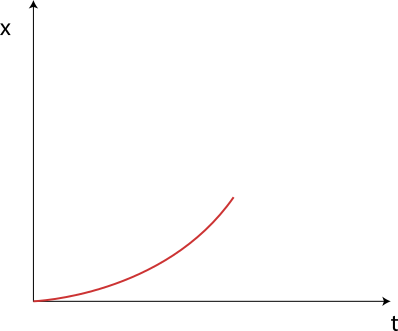
Figure 1: Qualitative sketch of the graph representing the position as a function of time for the first 5 minutes.
And for the last 25 minutes, the equation of motion is that of an object with constant speed, which is given by (see equation \eqref{Train_distanciaV}):
\begin{equation}
d_v = vt_v
\end{equation}
This is the equation of a straight line, where the slope is given by \(v\). Of course, this straight line should start where the previous plot ended and should have the slope that the last bit of the previous curve had (because the train moves with the same speed as the very last speed it gained during the acceleration, and the slope represents the speed). So, if we trace this line on the same plot we had earlier, we get figure 2.
Figure 2: Qualitative sketch of position of the train as a function of time. The red line represents the first 5 minutes while the blue straight line is for times greater than 5 minutes, showing a constant slope.



Leave A Comment