
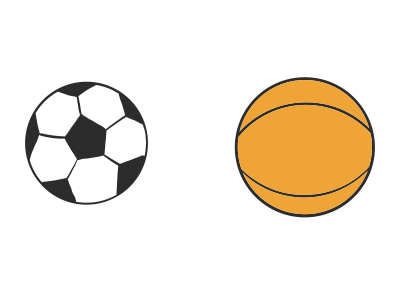
A \(0.3 \, \text{kg}\) soccer ball rolls toward a basketball that is at rest on the ground. After the elastic collision, the basketball moves with a speed of \(0.4 \, \text{m/s}\).
a) If the basketball has four times the mass of the soccer ball, what was the speed of the soccer ball an instant before the impact?
b) What is the speed and direction of the soccer ball after the impact?
a) Apply both Conservation of Momentum and Conservation of Energy to relate the final speed of basketball ball to the initial speed of the soccer ball.
b) Use either equation to get the speed of the other sports ball.
a) Conservation of Momentum (\(\vec{p}_i = \vec{p}_f\)) can be written as:
\begin{equation*}
m_s v_{is} = m_s v_{fs} + m_b v_{fb},
\end{equation*}
where \(m_b = 4m_s\). The mass cancels, so we get:
\begin{equation*}
v_{is} = v_{fs} + 4v_{fb}.
\end{equation*}
Conservation of energy gives us:
\begin{equation}
\frac{1}{2} m_s v_{is}^2 = \frac{1}{2} m_s v_{fs}^2 + \frac{1}{2} m_b v_{fb}^2.
\end{equation}
Combining both equations leads us to:
\begin{equation*}
v_{fs} = – \frac{3}{2} v_{fb},
\end{equation*}
and
\begin{equation*}
v_{is} = \frac{5}{2} v_{fb}.
\end{equation*}
Plugging in numerical values, we get:
\begin{equation*}
v_{is} = 1 \, \text{m/s}.
\end{equation*}
b) Relating the velocities, we get:
\begin{equation*}
v_{fs} = -0.6 \, \text{m/s}.
\end{equation*}
a) In order to find the speed of the soccer ball after the impact, we must relate that speed to the masses of the balls and to the final speed of the basketball. We also must take into account that the collision is elastic, meaning that the kinetic energy of the objects is conserved. Notice that all the variables in question (the different speeds and masses) are related to one another by both the kinetic energy of the different objects and their linear momentum. So the key to solving this problem will consists of using these two conservation principles (for momentum and energy).
The linear momentum of a system is always conserved if the total external force over the system is zero. Because of this, the linear momentum of a system is conserved along a certain direction of motion (for example, along X) if the total external force in that direction is zero. In this case, it is convenient to take the system to be conformed by the two balls. This way, there are no external forces over the system in the horizontal direction. Notice that if we were to take the system to consist only of one ball, say the basketball, then there would be external forces acting on the basketball (the soccer ball will exert a force when they collide). Hence, the linear momentum of the basketball would not be conserved. However, if we take the two balls to conform a single system, then the forces between the two balls when they collide are not external but only internal, and so we can say that the linear momentum of the system is conserved.
Given that the linear momentum of the system conformed by the two balls is conserved in the horizontal direction, we have
\begin{equation}
\label{first}
\vec{P}_{i}=\vec{P}_{f},
\end{equation}
where \(\vec{P}_{i}\) is the initial momentum of the system and \(\vec{P}_{f}\) is the final one. Using the definition of linear momentum, we have
\begin{equation}
\label{Basketball_conservMomentum}
m_s\vec{v}_{is}+m_b\vec{v}_{ib}= m_s\vec{v}_{fs}+m_b\vec{v}_{fb},
\end{equation}
where we have used the subscript s for the mass, initial velocity and final velocity of the soccer ball, and b for the mass, initial velocity and final velocity of the basketball.
Suppose that we take the direction of motion to be the positive X-axis, as illustrated in figure 1.

Figure 1: We place the coordinate system with the X axis along the direction of the movement of both balls.
In this case, we can rewrite equation \eqref{Basketball_conservMomentum} as
\begin{equation}
\label{Basketball_conservMomentumMagnitudes}
m_s v_{is} \, \hat{\textbf{i}} + m_b v_{ib} \, \hat{\textbf{i}} = m_s v_{fs} \, \hat{\textbf{i}} + m_b v_{fb} \, \hat{\textbf{i}},
\end{equation}
where we used that, according to our system, the initial velocity of the soccer ball is positive, the final velocity of the basketball is also positive, and we assumed that the final velocity of the soccer ball is positive as well (if this is not true, at some point we will get a negative sign that will let us know that we were wrong).
Initially, we know that the basketball is at rest, therefore it has no initial velocity. If we use this and focus on the magnitudes in equation \eqref{Basketball_conservMomentumMagnitudes}, we get
\begin{equation}
m_s v_{is} = m_s v_{fs} + m_b v_{fb}.
\end{equation}
We can simplify the equation a bit further if we know that the mass of the basketball is four times the one of the soccer ball. If we use that information, we get
\begin{equation}
m_s v_{is} = m_s v_{fs} + (4m_s) v_{fb}.
\end{equation}
Notice that we can now cancel \(m_s\) everywhere, to get
\begin{equation}
\label{Basketball_velocidadesMomentum}
v_{is} = v_{fs} + 4 v_{fb}.
\end{equation}
Now, we know the final speed of the basketball; however, we do not know the final speed of the soccer ball, and we do not know its initial speed (which is what we want to find). So to continue, we need to use more equations.
Let’s then use the fact that the collision is elastic, meaning that the kinetic energy of the system is conserved (no energy is lost during the collision). That is,
\begin{equation}
\label{Basketball_cineticas}
K_i = K_f.
\end{equation}
The kinetic energy of the system is the sum of the kinetic energy of the balls, and so equation \eqref{Basketball_cineticas} becomes
\begin{equation}
K_{si} + K_{bi} = K_{sf} + K_{bf}.
\end{equation}
Let’s now use the explicit equation of the kinetic energy for the different objects:
\begin{equation}
\frac{1}{2} m_s v_{is}^2 + \frac{1}{2} m_b v_{ib}^2 = \frac{1}{2} m_s v_{fs}^2 + \frac{1}{2} m_b v_{fb}^2.
\end{equation}
If we use the fact that the initial speed of the basketball is zero and that the mass of the basketball is four times the mass of the soccer ball, we get
\begin{equation}
\frac{1}{2} m_s v_{is}^2 = \frac{1}{2} m_s v_{fs}^2 + \frac{1}{2} (4 m_s) v_{fb}^2.
\end{equation}
If we multiply by 2 and cancel \(m_s\) everywhere, we get
\begin{equation}
\label{Basketball_velocidadesEnergia}
v_{is}^2 = v_{fs}^2 + 4 v_{fb}^2.
\end{equation}
So, we have a new equation relating the initial speed of the soccer ball to the final speeds. The reader can notice that this equation is very similar to \eqref{Basketball_velocidadesMomentum}, except that here we have \(v_{is}^2\) and there we had only \(v_{is}\). One strategy for proceeding is to square equation \eqref{Basketball_velocidadesMomentum} to get
\begin{equation}
v_{is}^2 = (v_{fs} + 4 v_{fb})^2.
\end{equation}
If we open the parenthesis on the right side, we get
\begin{equation}
v_{is}^2 = v_{fs}^2 + 8 v_{fs} v_{fb} + 16 v_{fb}^2.
\end{equation}
Now let’s use this result for \(v_{is}^2\) on equation \eqref{Basketball_velocidadesEnergia} to get
\begin{equation}
v_{fs}^2 + 4 v_{fb}^2 = v_{fs}^2 + 8 v_{fs} v_{fb} + 16 v_{fb}^2.
\end{equation}
Notice that the \(v_{fs}^2\) term cancels, and we get
\begin{equation}
4 v_{fb}^2 = 8 v_{fs} v_{fb} + 16 v_{fb}^2.
\end{equation}
We can now add the \(v_{fb}^2\) terms to get
\begin{equation}
0 = 8 v_{fs} v_{fb} + 12 v_{fb}^2.
\end{equation}
Let’s now divide by \(v_{fb}\) (we can do this because \(v_{fb}\) is not zero, since the basketball will move due to the collision with the soccer ball):
\begin{equation}
0 = 8 v_{fs} + 12 v_{fb}.
\end{equation}
Then divide by 4 to get
\begin{equation}
0 = 2 v_{fs} + 3 v_{fb},
\end{equation}
to obtain
\begin{equation}
\label{Basketball_velocidadfs}
v_{fs} = – \frac{3}{2} v_{fb}.
\end{equation}
Since we have the final speed of the basketball, we can use this equation to find the final speed of the soccer ball; however, we want the initial speed of the soccer ball! This is easy to get now that we have its final speed, since we can use equation \eqref{Basketball_velocidadfs} in equation \eqref{Basketball_velocidadesMomentum}. The result is
\begin{equation}
v_{is} = – \frac{3}{2} v_{fb} + 4 v_{fb}.
\end{equation}
Let’s add \(v_{fb}\), to get
\begin{equation}
v_{is} = \frac{5}{2} v_{fb}.
\end{equation}
We can finally insert the numerical values here:
\begin{equation}
v_{is} = \frac{5}{2} (0.4 \, \text{m/s}),
\end{equation}
to get
\begin{equation}
v_{is} = 1 \, \text{m/s}.
\end{equation}
b) We already found the speed of the soccer ball after the impact, it is given by equation \eqref{Basketball_velocidadfs}. So, if we use the numerical values, we get
\begin{equation}
v_{fs} = – 0.6 \, \text{m/s}.
\end{equation}
Regarding the direction, notice that the negative sign indicates that the final velocity of the soccer ball has the opposite direction to the final velocity of the basketball. So, the soccer ball moves in the negative direction of the X axis.


I’m confused, why twice mass converted into 4 times
Hi ssuboh, thanks for your question. It was a typo, it has been corrected now!