
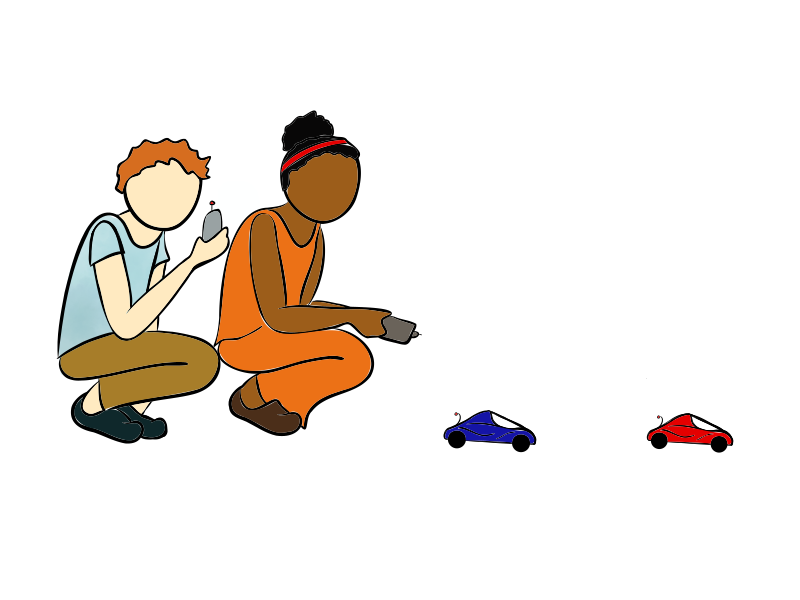
David and Amy are racing their remote control cars. They use a timer that beeps to signal when to start the race. The timer beeps, but David is distracted and so he starts the race one second after Amy’s car. After 4 seconds, Amy’s car has a speed of \(10 \,\text{m}/\text{s}\). Suppose that the magnitude of the acceleration of David’s car is two times the magnitude of the acceleration of Amy’s car. And assume the cars are always moving on a straight line with uniform acceleration.
(a) After 3 seconds, what car is ahead and by how much?
(b) If the length of the circuit is 40 meters, what will the time difference be between the winning car and the losing one?
(a) Use the equation that gives the position of an object moving with constant acceleration. Also, note that their accelerations are related. Finally, compare their final positions at 3 seconds for Amy’s car and at 2 seconds for David’s car.
(b) Find the time it takes for each car to travel 40 m using the equations of motion.
(a) For both cars, we can write the position using the equation for a constant acceleration motion:
\begin{equation*}
\vec{x}_f=\vec{x}_i+\vec{v}_i t+\frac{1}{2}\vec{a}t^2,
\end{equation*}
[mepr-show rules=”4409″ unauth=”both”]
which also for both becomes:
\begin{equation*}
\vec{x}_f=\frac{1}{2}\vec{a}t^2.
\end{equation*}
For Amy’s car, the given values allows us to get the acceleration by means of the following equation:
\begin{equation*}
a_A=\frac{\Delta v}{\Delta t},
\end{equation*}
which lead us:
\begin{equation*}
a_A=2.5\,\text{m/s}^2.
\end{equation*}
And the acceleration for David’s car is twice Amy’s car acceleration.
Then, using \(3 \, \text{s}\) as time for Amy’s car in the equation of motion we get:
\begin{equation}
x_A=11.25\,\text{m}.
\end{equation}
And using \(2 \, \text{s}\) for David’s car we get:
\begin{equation}
x_D=10\,\text{m}.
\end{equation}
Thus, Amy’s car is ahead by \(1.25\,\text{m}\).
(b) Then, solving for the time \(t\) in equation of motion:
\begin{equation*}
t^2=\frac{2x}{a}.
\end{equation*}
For Amy’s car we get:
\begin{equation*}
t_A \approx5.66\,\text{s}.
\end{equation*}
For David’s car, where we need to add \(1 \, \text{s} \) to the result, we get:
\begin{equation*}
t_D= 5 \,\text{s}.
\end{equation*}
Then, David’s car arrives first and Amy’s car arrives \(t_A-t_D=5.66\,\text{s}-5\,\text{s}=0.66\,\text{s}\) later.
For a more detailed explanation of any of these steps, click on “Detailed Solution”.
[/mepr-show]
(a) We need to find out which car is ahead and by how much 3 seconds into the race. To approach the problem we will write the position for David’s car and Amy’s car as a function of time \(t\).
For Amy’s car, we can write the position \(\vec{x}_A\) using the equation for a constant acceleration motion:
\begin{equation}
\vec{x}_A=\vec{x}_i+\vec{v}_i t+\frac{1}{2}\vec{a}_At^2.
\end{equation}
[mepr-show rules=”4409″ unauth=”both”]
To continue, let’s place a coordinate system at the origin of the motion for both cars, and with the X-axis pointing in the direction of motion, as shown in figure 1:
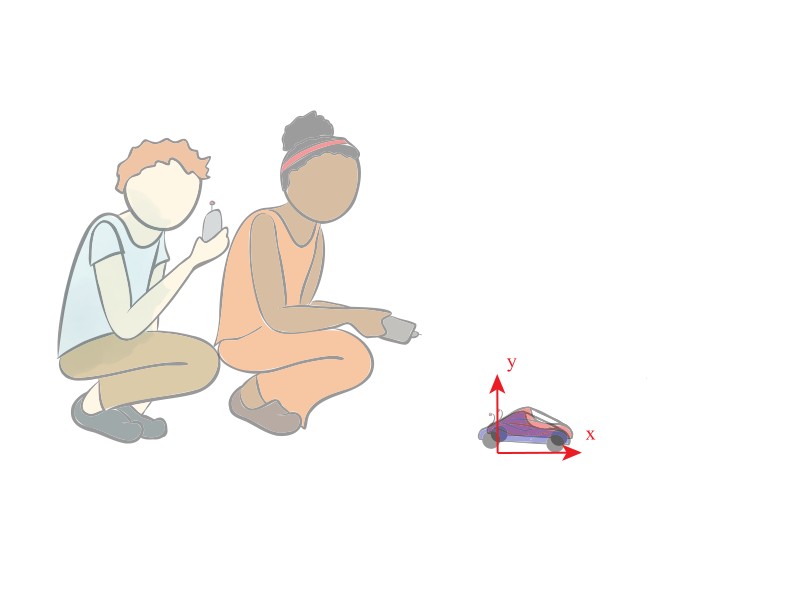
Figure 1: We place the coordinate system at the origin for both cars
Given this choice of coordinate system, the equation of motion becomes
\begin{equation}
\label{xa}
x_A\,\hat{\textbf{i}}=x_i\,\hat{\textbf{i}}+v_it\,\hat{\textbf{i}}+\frac{1}{2}at^2\,\hat{\textbf{i}},
\end{equation}
where \(x_i=0\) is the initial position of Amy’s car, \(v_i=0\) is the initial velocity and \(a_A\) is the magnitude of the acceleration. Dropping the vector notation and focusing on the magnitudes in equation \eqref{xa}, we get
\begin{equation}
\label{xap}
x_A=\frac{1}{2}a_At^2,
\end{equation}
where we have used the fact that \(x_i=0\) and \(v_i=0\).
Now we need to consider the equation of motion for David’s car, which also has constant acceleration. However, because his car starts a time \(t_D=1\,\text{s}\) after the timer starts, we will write \(t-t_D\) instead of just \(t\) in all the equations for this car (in other words, David’s car runs for one second less than Amy’s). Hence, the equation of motion can be written as
\begin{equation}
\vec{x}_D=\vec{x}_i+\vec{v}_i(t-t_D)+\frac{1}{2}a_D(t-t_D)^2.
\end{equation}
But according to the coordinate system we chose, this becomes
\begin{equation}
\label{xd}
x_D\,\hat{\textbf{i}}=x_i\,\hat{\textbf{i}}+v_i(t-t_D)\,\hat{\textbf{i}}+\frac{1}{2}a_D(t-t_D)^2\,\hat{\textbf{i}}.
\end{equation}
For David’s car, the initial position \(x_i\) and the initial velocity \(v_i\) are the same as Amy’s, namely, zero. According to the problem, the acceleration of David’s car is twice as much as Amy’s. Thus,
\begin{equation}
\label{acels}
a_D=2a_A.
\end{equation}
Dropping the vector notation from equation \eqref{xd} (which we can do because everything is on the same line of motion) and using the fact the initial position and initial velocity are zero, we get
\begin{equation}
x_D=\frac{1}{2}a_D(t-t_D)^2.
\end{equation}
Replacing the acceleration of David’s car and using equation \eqref{acels} in the last equation above we get
\begin{equation}
\label{xdp}
x_D=a_A(t-t_D)^2.
\end{equation}
Notice that both Amy’s car position \(x_A\) and David’s car position \(x_D\) depend on the value of \(a_A\), which is unknown. Therefore, to determine which car is ahead, we must find the value of \(a_A\) using more information from the prompt. Let’s write the definition of \(a_A\) in terms of velocity and time:
\begin{equation}
a_A=\frac{\Delta v}{\Delta t},
\end{equation}
We known that in a time interval of 4 seconds, Amy’s car goes from 0 to \(10\,\text{m/s}\). Thus,
\begin{equation}
a_A=\frac{10\,\text{m/s}}{4\,\text{s}}=2.5\,\text{m/s}^2.
\end{equation}
Now that we know the acceleration of Amy’s car, we can calculate the position of both cars when \(t=3\,\text{s}\). Explicitly, using equations \eqref{xap} and \eqref{xdp}
\begin{equation}
x_A=\frac{1}{2}(2.5\,\text{m/s}^2)(3\,\text{s})^2,
\end{equation}
which is the same as
\begin{equation}
x_A=11.25\,\text{m}.
\end{equation}
For David’s car
\begin{equation}
x_D=(2.5\,\text{m/s}^2)(3\,\text{s}-1\,\text{s})^2,
\end{equation}
which yields
\begin{equation}
x_D=10\,\text{m}.
\end{equation}
Thus, Amy’s car is ahead and the distance between the two cars at \(t=3\,\text{s}\) is \(x_A-x_D\), which numerically is
\begin{equation}
x_A-x_D=11.25\,\text{m}-10\,\text{m}=1.25\,\text{m}.
\end{equation}
(b) Now, let’s consider that the length of the circuit is \(40\) meters. The problem asks us to find out what the time difference will be between the winning and losing cars. To answer this question, we can use the equations for the positions of the cars in terms of the time given in equations \eqref{xap} and \eqref{xdp}. We will have to solve for the time \(t\) in which each cars travels a distance of 40 \(\,\text{m}\). Thus, we use \(x_A=40 \,\text{m} \) and solve for Amy’s time, and then we use \(x_D=40\,\text{m}\) and solve for David’s time.
Let’s then solve for the time \(t\) in equation \eqref{xap} by multiplying by \(2/a_A\):
\begin{equation}
t^2=\frac{2x_A}{a_A},
\end{equation}
Now take the square-root on both sides
\begin{equation}
t=\sqrt{\frac{2x_A}{a_A}}.
\end{equation}
Thus, the time that Amy’s car needed to finish the circuit is
\begin{equation}
t_A=\sqrt{\frac{2(40\,\text{m})}{2.5\,\text{m/s}^2}}\approx5.66\,\text{s}.
\end{equation}
Now, let’s solve for time \(t\) in equation \eqref{xdp}:
\begin{equation}
(t-t_D)^2=\frac{x_D}{a_A},
\end{equation}
which after taking the square-root on both sides yields
\begin{equation}
t-t_D=\sqrt{\frac{x_D}{a_A}}
\end{equation}
Finally,
\begin{equation}
t=t_D+\sqrt{\frac{x_D}{a_A}}.
\end{equation}
Using the numerical values, we obtain
\begin{equation}
t_D=1\,\text{s}+\sqrt{\frac{40\,\text{m}}{2.5\,\text{m/s}^2}}=5\,\text{s}.
\end{equation}
Contrasting both times, we can conclude that David’s car arrives first and Amy’s car arrives \(t_A-t_D=5.66\,\text{s}-5\,\text{s}=0.66\,\text{s}\) later.
[/mepr-show]



Leave A Comment