

A tank with a very large diameter has a water column of height H. At the bottom is a tube through which water escapes with an initial cross-sectional area of \(0.03 \, \text{m}^2\) that eventually is reduced to an area of \(0.01 \ \text{m}^2\). The water that runs from the tube comes out horizontally and describes a parabolic motion falling at a distance of 2 meters, as shown in the figure. What is the height \(H\) of the water column?
Use Bernoulli’s equation and continuity equation to get a relation between \(H\) and \(v_B\). Then, use kinematics equations to get the time, and the relation between \(v_B\) and \(H_0\), to finally relate \(H\) with \(H_0\).
Bernoulli’s equation states:
\begin{equation*}
P_A + \rho g h_A + \frac{1}{2} \rho v_A^2 = P_B + \rho g h_B + \frac{1}{2} \rho v_B^2,
\end{equation*}
[mepr-show rules=”4409″ unauth=”both”]
where by applying the given conditions we have:
\begin{equation*}
gH + \frac{1}{2} v_A^2 = \frac{1}{2} v_B^2.
\end{equation*}
By the continuity equation \(A_A v_A = A_B v_B\), the velocity \(v_A\) is proportional to \(A_B / A_A\). The result is approximately:
\begin{equation*}
v_A \approx 0.
\end{equation*}
Then, solving for \(H\) we have:
\begin{equation*}
H = \frac{v_B^2}{2g}.
\end{equation*}
The displacement \(L\) can be written as:
\begin{equation*}
v_B = \frac{L}{t_f}.
\end{equation*}
By the kinematic equation for position we have:
\begin{equation*}
\vec{y} = \vec{y}_i + \vec{v}_{y,i} t + \frac{1}{2} \vec{a} t^2,
\end{equation*}
where with the given conditions we have:
\begin{equation*}
t_f^2 = \frac{2H_0}{g}.
\end{equation*}
Combining the previous relations and solving for \(H\) as a function of \(H_0\) we get:
\begin{equation*}
H = \frac{L^2}{4 H_0},
\end{equation*}
or with numerical values:
\begin{equation}
H = 1 \, \text{m}.
\end{equation}
For a more detailed explanation of any of these steps, click on “Detailed Solution”.
[/mepr-show]
In order to find the height of the water column, we can use the Bernoulli equation to relate this height with the velocity of the water once it leaves the tank. We can then use kinematics equations to find this velocity in terms of the vertical and horizontal distances traveled by the water as it falls towards the ground.
Let’s consider points A and B, as shown in figure 1.
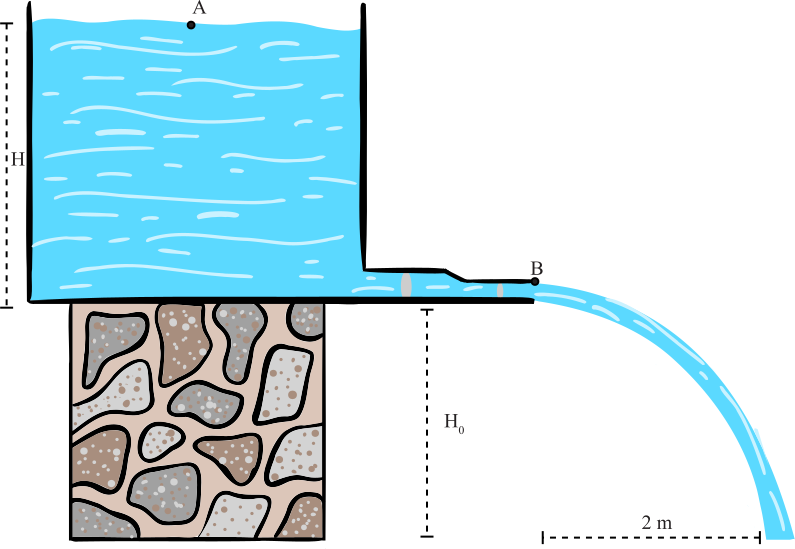
Figure 1: The tank with water of height \(H\) is shown. Point A, where the water is static, and point B, where the water is pouring out, are also given along with the height of the tank from the ground and the horizontal reach of the pouring water.
Point A is on the surface of the tank, and point B is right outside the small aperture. The Bernoulli equation for these two points is given by
\begin{equation}
\label{EQ:B}
P_A + \rho g h_A + \frac{1}{2} \rho v_A^2 = P_B + \rho g h_B + \frac{1}{2} \rho v_B^2,
\end{equation}
[mepr-show rules=”4409″ unauth=”both”]
where \(P_A\) is the pressure at point \(A\), \(\rho\) is the density of the fluid, \(h_A\) is the height of point \(A\) relative to the reference frame shown in the next figure, and \( v_A\) is the fluid speed at point \(A\). The variable names are analogous for point \(B\). Let’s rewrite these variables in terms of known ones.
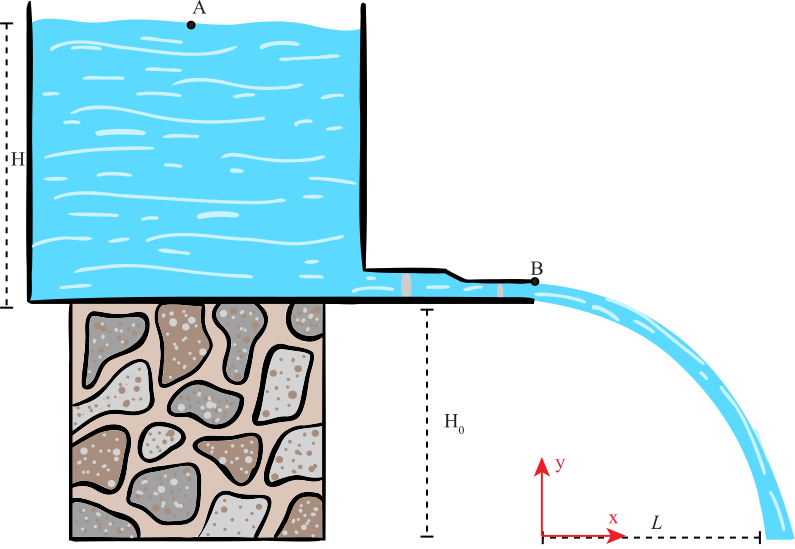
Figure 2: To examine the parabolic motion we place the coordinate system on the ground below the point at which water pours out.
First, notice that points \(A\) and \(B\) are both directly exposed to the atmosphere and there is no liquid above them. Hence, the pressure at these points is the atmospheric pressure i.e.
\begin{equation}
P_A = P_B = P_{\text{atm}}.
\end{equation}
Substituting this in eq. \eqref{EQ:B} gives
\begin{equation}
P_{\text{atm}} + \rho g h_A + \frac{1}{2} \rho v_A^2 = P_{\text{atm}} + \rho g h_B + \frac{1}{2} \rho v_B^2,
\end{equation}
and after subtracting \(P_{\text{atm}}\) on both sides, we obtain
\begin{equation}
\rho g h_A + \frac{1}{2} \rho v_A^2 = \rho g h_B + \frac{1}{2} \rho v_B^2.
\end{equation}
We can now divide by \(\rho\) on both sides. This yields
\begin{equation}
\label{EQ:B2}
g h_A + \frac{1}{2} v_A^2 = g h_B + \frac{1}{2} v_B^2.
\end{equation}
Second, from figure 2, we can notice that \(h_A = H_0 + H\), and \(h_B = H_0\). If we substitute this in eq. \eqref{EQ:B2}, we get
\begin{equation}
g (H_0 + H) + \frac{1}{2} v_A^2 = g H_0 + \frac{1}{2} v_B^2,
\end{equation}
or equivalently
\begin{equation}
g H_0 + gH + \frac{1}{2} v_A^2 = g H_0 + \frac{1}{2} v_B^2.
\end{equation}
If we subtract \(gH_0\) from both sides of the equation, we obtain
\begin{equation}
\label{EQ:VB3}
gH + \frac{1}{2} v_A^2 = \frac{1}{2} v_B^2.
\end{equation}
Third, we can relate \(v_A\) and \(v_B\) by using the continuity equation. The volume flow rate \(I\) of a fluid at a point \(P\) in a liquid flowing through a tube is given by
\begin{equation}
\label{EQ:I}
I_{V,P} = A_P v_P,
\end{equation}
where \(A_P\) is the cross-sectional area of the container and \(v_P\) is the speed of the fluid at point \(P\). Assuming that the motion of the fluid is constant at all points, the volume flow rate is constant. Therefore, for points A and B, we have
\begin{equation}
I_{V,A} = I_{V,B}.
\end{equation}
From eq. \eqref{EQ:I}, we can rewrite this equation as
\begin{equation}
\label{EQ:C}
A_A v_A = A_B v_B,
\end{equation}
where \(A_A\) is the cross-sectional area of the tube at point \(A\), \(v_A\) is the speed of the fluid at point \(A\), and analogously for \(A_B\) and \(v_B\) at point \(B\). Solving this eq. for \(v_A\) gives
\begin{equation}
v_A = \frac{A_B}{A_A v_B}.
\end{equation}
Now, since the cross-sectional area of the tank \(A_A\) is much larger than the cross sectional area of the opening \(A_B\). The fraction \(\frac{A_B}{A_A}\) will be a very small number. Hence, we can make the approximation that the speed with which the water moves at point \(A\) is zero, i.e.
\begin{equation}
v_A = 0,
\end{equation}
and substituting this in eq. \eqref{EQ:VB3} gives
\begin{equation}
gH + \frac{1}{2} 0^2 = \frac{1}{2} v_B^2.
\end{equation}
This can be rewritten as
\begin{equation}
gH = \frac{1}{2} v_B^2,
\end{equation}
and dividing by \(g\) on both sides gives
\begin{equation}
\label{EQ:H}
H = \frac{v_B^2}{2g}.
\end{equation}
We have an equation for H; however, we still need to write \(v_B\) in terms of other known variables. Let’s consider the motion of one molecule of water as it leaves the small hole at point \(B\). The only force acting on this molecule is its weight, which acts on the vertical direction. Therefore, the molecule will follow a motion with constant acceleration in the vertical direction and a motion with constant velocity in the horizontal direction. Let’s define a reference frame, as shown in the second figure. According to it, the equation describing the motion in the \(x\)-direction is
\begin{equation}
\label{EQ:X}
\vec{x}(t) = \vec{x}_i + \vec{v}_{x,i} t,
\end{equation}
where \(\vec{x}(t)\) is the \(x\)-position of the molecule at time \(t\), \(\vec{x}_i\) is its \(x\)-position at \(t=0\), and \(\vec{v}_{x,i}\) is the \(x\)-component of its velocity at \(t = 0\) (which will remain the same for \(t > 0\)).
Let \(t=0\) be the time at which the water molecule leaves the hole at point \(B\). According to this, we have that \(v_{x,i} = v_B\), and thus, according to the reference frame shown in the second figure, we can write \(\vec{v}_{x,i} = v_B \hat{i}\). If we substitute this in eq. \eqref{EQ:X}, we obtain
\begin{equation}
\label{EQ:X1}
\vec{x}(t) = \vec{x}_i + v_B t \hat{i}.
\end{equation}
Also, according to our reference frame we have \(\vec{x}_i = \vec{0}\), and we can write \(\vec{x}(t) = x(t) \hat{i}\). With this, eq. \eqref{EQ:X1} becomes
\begin{equation}
x(t) \hat{i} = v_B t \hat{i},
\end{equation}
and if we consider only the magnitudes, we get
\begin{equation}
\label{EQ:X2}
x(t) = v_B t.
\end{equation}
This equation is valid for all times \(t\) during the interval in which the water molecule falls from point \(B\) towards the ground. In particular, it is valid right before hitting the ground. Let \(t_f\) be the time at which this occurs. According to our reference frame, the position at this time will be
\begin{equation}
x(t = t_f) = L.
\end{equation}
Substituting this in eq. \eqref{EQ:X2} yields
\begin{equation}
\label{EQ:X3}
L = v_B t_f,
\end{equation}
and solving for \(v_B\) gives
\begin{equation}
\label{EQ:VB22}
v_B = \frac{L}{t_f}
\end{equation}
We have found an expression for \(v_b\) that includes the known variable L and the unknown variable \(t_f\). We now need to write \(t_f\) in terms of known variables. In order to do so, we can use the equation of motion in the \(y\)-direction, which is given by
\begin{equation}
\label{EQ:Y}
\vec{y}(t) = \vec{y}_i + \vec{v}_{y,i} t + \frac{1}{2} \vec{a} t^2,
\end{equation}
where \(\vec{y}(t)\) is the \(y\)-position of the molecule at time \(t\), \(\vec{y}_i\) is its \(y\)-position at \(t=0, \vec{v}_{y,i}\) is the \(y\)-component of its velocity at \(t = 0\), and \(\vec{a}\) is its acceleration.
At the time at which the water molecule leaves the hole at point \(B\), it is undergoing a horizontal motion. Hence \(\vec{y}_i = \vec{0}\). With this, eq. \eqref{EQ:Y} becomes
\begin{equation}
\label{EQ:Y2}
\vec{y}(t) = \vec{y}_i + \frac{1}{2} \vec{a} t^2.
\end{equation}
Now, from the second figure, we notice that in our reference frame we have that \(y_i = H_0\), and thus \(\vec{y}_i = H_0 \hat{j}\). Also, in this case \(\vec{a} = -g\hat{j}\), and we can write \(\vec{y}(t) = y(t) \hat{j}\). Substituting all this in eq. \eqref{EQ:Y2} gives
\begin{equation}
y(t) \hat{j} = H_0 \hat{j} -\frac{1}{2} g t^2 \hat{j},
\end{equation}
and if we consider only the magnitudes, we obtain
\begin{equation}
\label{EQ:Y3}
y(t) = H_0 – \frac{1}{2} g t^2.
\end{equation}
Furthermore, according to our reference frame (see the second figure), a water molecule will hit the ground at a time \(t = t_f\) such that \(y(t_f) = 0\). At this time, eq. \eqref{EQ:Y3} becomes
\begin{equation}
0 = H_0 – \frac{1}{2}gt_f^2,
\end{equation}
which we can rewrite as
\begin{equation}
\label{EQ:Y4}
\frac{1}{2} gt_f^2 = H_0.
\end{equation}
Solving for \(t_f^2\) gives
\begin{equation}
\label{EQ:TF}
t_f^2 = \frac{2H_0}{g}.
\end{equation}
This equation and eq. \eqref{EQ:VB} can be used to obtain an expression for \(v_B\) in terms of known variables. If we square eq. \eqref{EQ:VB22} on both sides, we get
\begin{equation}
v_B^2 = \frac{L^2}{ t_f^2},
\end{equation}
and substituting eq. \eqref{EQ:TF} gives
\begin{equation}
v_B^2 = \frac{L^2}{ \frac{2H_0}{g} }
= \frac{L^2 g }{ 2H_0}.
\end{equation}
Finally, after substituting this in eq. \eqref{EQ:H}, we find that the height of the water column in the tank is
\begin{equation}
H = \frac{1}{2g} \frac{L^2 g }{2H_0}
= \frac{L^2}{4 H_0},
\end{equation}
and inserting numerical values gives
\begin{equation}
H = \frac{(2 \ \text{m})^2}{4 \ \text{m}} = 1 \ \text{m}.
\end{equation}
[/mepr-show]


Leave A Comment