

A 2m-long steel beam with a cross-sectional area of 20 \(\text{cm}^2\) is placed tightly between two walls on a winter day with a temperature of -10 \(^{\circ}\)C. In the summer, the temperature reaches 45 \(^{\circ}\)C.
a) If the beam was not between the walls, how much would its length change on a summer day?
b) How much force must the walls exert to prevent the beam from expanding in the summer?
c) If the beam does not resist the force and breaks in half, find the height that the midpoint reaches after the beam brakes. For this part, assume the beam is very thin.
Use the following values:
– Steel linear expansion coefficient: \(12 \times10^{- 6} \,^{\circ}\text{C}^{-1}\)
– Steel Young’s Coefficient: 200 GPa
a) Apply linear thermal expansion’s formula to get the change in lenght.
b) Use Young’s module formula to get the force from the wall.
c) Pythagora’s theorem is useful to relate the given dimensions.
a) For a linear thermal expansion we get:
\begin{equation*}
\Delta L = L_i \alpha (T_f – T_i).
\end{equation*}
Replacing the numerical values we get:
\begin{equation*}
\Delta L = 1.32 \, \text{mm}.
\end{equation*}
b) By Young’s module formula we have:
\begin{equation*}
F_{\text{wall}} =\frac{Y A \Delta L}{L_i},
\end{equation*}
or with numerical values:
\begin{equation*}
F_{\text{wall}} = 2.6 \times 10^{5} \, \text{N}.
\end{equation*}
c) By Pythagora’s theorem, we have:
\begin{equation*}
h^2 + \left(\frac{L_i}{2}\right)^2 = \left(\frac{L_f}{2}\right)^2,
\end{equation*}
where \(L_f = L_i + \Delta L\). Solving for \(h\) is:
\begin{equation*}
h = \sqrt{\left(\frac{L_i + \Delta L}{2}\right)^2 – \left(\frac{L_i}{2}\right)^2},
\end{equation*}
and inserting numerical values yields
\begin{equation*}
h = 0.036 \, \text{m}.
\end{equation*}
For a more detailed explanation of any of these steps, click on “Detailed Solution”.
a) The first part of the problem asks us to calculate how much the beam’s length changes when the summer months come. We must use the coefficient of linear expansion of steel to relate the temperature change with the change in length of the beam.
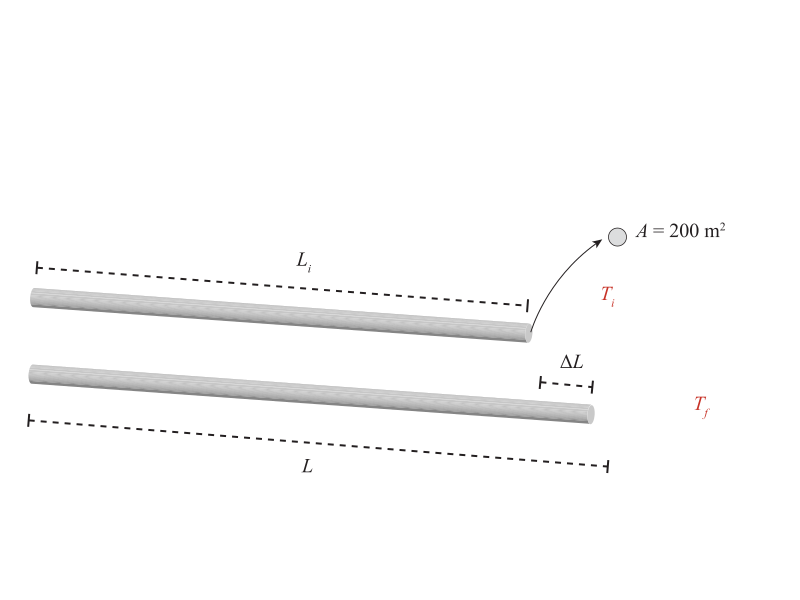
Figure 1: Length of the beam for two temperatures. In the beam above, the temperature is less than the one on the beam below. The circular transverse area \(A\) is also shown.
As the temperature of the beam increases, its length L will be increased. The fractional change in length \(\Delta\) \(L/L_i\) is directly proportional to the temperature change \(\Delta T\). We can write this as
\begin{equation}
\label{EQ:exp}
\frac{\Delta L}{L_i} = \alpha \Delta T,
\end{equation}
where the proportionality constant \(\alpha\) is the coefficient of linear expansion of steel, which describes how much length changes for a given temperature change. \(L_i\) is the initial length of the beam, and \(\Delta L\) is its change in length. If we write \(\Delta T = T_f – T_i\), where \(T_f\) and \(T_i\) are the final and initial temperatures of the beam, respectively, we get
\begin{equation}
\label{EQ:exp2}
\frac{\Delta L}{L}= \alpha (T_f – T_i),
\end{equation}
and multiplying eq. \eqref{EQ:exp} by \(L_i\) yields
\begin{equation}
\Delta L = L_i \alpha (T_f – T_i).
\end{equation}
Finally, after inserting numerical values, we get
\begin{equation}
\Delta L = (2 \, \text{m})(12 \times {10^{-6}} \, ^{\circ} \text{C}^{-1})( (45\, ^{\circ} \text{C}) – (-10\, ^{\circ} \text{C})) = 0.00132 \, \text{m} = 1.32 \, \text{mm}.
\end{equation}
b) The stress resulting from the length change can be found by using Young’s modulus, from which we can find the force exerted by the beam over the walls as it expands. We can then find the force exerted by the walls to prevent the beam from expanding by applying Newton’s third law.
As the beam expands, it exerts a force towards its ends, as shown in figure 2.

Figure 2: When the beam is constrained and, when heated, it tends to expand. This results in a contact force \(F\) exerted on the left and right walls, which is proportional to \(\Delta L\).
The fractional change in length \(\Delta L/L_i\) of the beam is related to the force \(F_{\text{beam}}\) it exerts by the following equation
\begin{equation}
\label{EQ:y}
\frac{F_{\text{beam}}}{A} = \frac{Y \Delta L}{L_i},
\end{equation}
where \(A\) is the cross-sectional area of the beam. This equation can be interpreted as follows: The force per unit area exerted by the beam along its length during the expansion is proportional to its fractional change in length. Young’s modulus is the proportionality constant in this relation.
Now, if we multiply eq. \eqref{EQ:y} by \(A\), we get
\begin{equation}
\label{EQ:fb}
F_{\text{beam}} = \frac{Y A \Delta L}{L_i}.
\end{equation}
\(F_{\text{beam}}\) is the magnitude of the force that the beam exerts as it expands. According to Newton’s third law, for the beam to remain at the same positions, the walls must exert a force of equal magnitude and opposite direction to the force exerted by the beam as it tries to expand i.e.
\begin{equation}
F_{\text{wall}} = F_{\text{beam}},
\end{equation}
where \(F_{\text{wall}}\) is the magnitude of the force that the walls must exert over the beam to prevent it from expanding. Substituting this in eq. \eqref{EQ:fb}, we get
\begin{equation}
F_{\text{wall}} =\frac{Y A \Delta L}{L_i} .
\end{equation}
Now, inserting eq. \eqref{EQ:exp2} gives
\begin{equation}
F_{\text{wall}} = Y A \alpha (T_f – T_i),
\end{equation}
and after substituting numerical values, we get
\begin{equation}
F_{\text{wall}} = \left(200 \times 10^9 \frac{\text{N}}{\text{m}^2}\right) \left(0.002 \, \text{m}^2\right) \left(12 \times 10^{-6} \,^{\circ}\text{C}^{-1}\right) \left( 45 \,^{\circ} \text{C} – \left(- 10\,^{\circ} \text{C}\right)\right),
\end{equation}
which is equivalent to
\begin{equation}
\label{force}
F_{\text{wall}} = 2.6 \times 10^{5} \, \text{N}.
\end{equation}
c) Let’s now assume that the beam breaks due to the force calculated previously in \eqref{force}. As shown in figure 3, the height that the midpoint reaches, the initial half-length, and the final half-length make a right triangle. Hence, we can find the height that the midpoint reaches after the beam breaks by using the Pythagorean theorem.
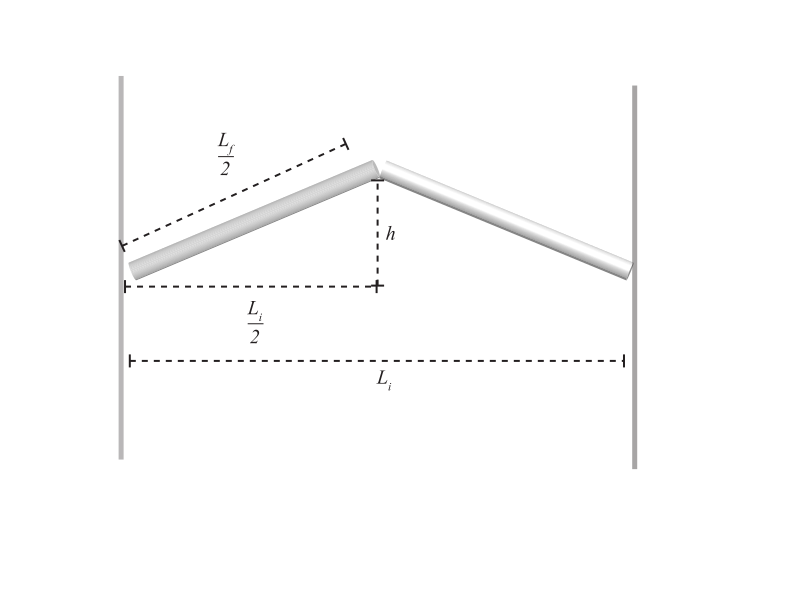
Figure 3: Broken beam with constrained ends. The initial and final length of the left half of the beam is shown along with the elevation \(h\) of the middle point.
According to figure 3, the Pythagorean theorem for the highlighted right triangle can be written as
\begin{equation}
h^2 + \left(\frac{L_i}{2}\right)^2 = \left(\frac{L_f}{2}\right)^2,
\end{equation}
subtracting \(\left(\frac{L_i}{2}\right)^2\) gives
\begin{equation}
h^2 = \left(\frac{L_f}{2}\right)^2 – \left(\frac{L_i}{2}\right)^2.
\end{equation}
Finally, if we take the square root, we obtain that the height that the midpoint reaches is given by
\begin{equation}
\label{EQ:h}
h = \sqrt{\left(\frac{L_f}{2}\right)^2 – \left(\frac{L_i}{2}\right)^2}.
\end{equation}
Now, we are given \(L_i\), and we found the increment in length \(\Delta L\) in part (a). In order to find \(L_f\), we can write \(\Delta L\) as
\begin{equation}
\Delta L = L_f – L_i,
\end{equation}
and thus, if we add \(L_i\) we get
\begin{equation}
L_f = L_i + \Delta L.
\end{equation}
Substituting this in eq. \eqref{EQ:h} gives
\begin{equation}
h = \sqrt{\left(\frac{L_i + \Delta L}{2}\right)^2 – \left(\frac{L_i}{2}\right)^2},
\end{equation}
and inserting numerical values yields
\begin{equation}
h = 0.036 \text{ m} = 3.6 \, \text{cm}.
\end{equation}


Leave A Comment