
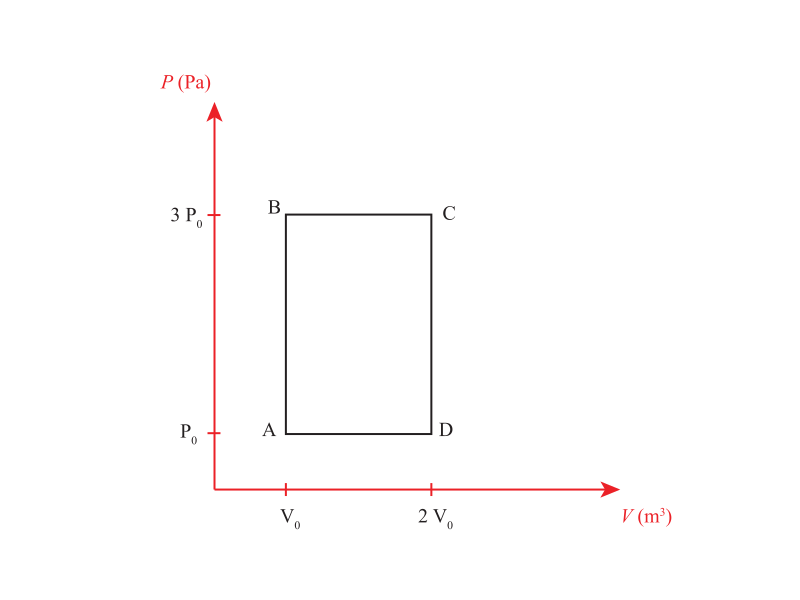
\(n\) moles of an ideal diatomic gas go through a cycle, as seen in the figure. In terms of \(P_{0}\) and \(V_{0}\), calculate:
a) Temperature for the four states A, B, C, and D.
b) The change in internal energy, heat, and work carried out by the four processes.
c) The total work done by the gas during a cycle.
d) The efficiency of this machine.
a) Use the ideal gas equation and solve for the temperature.
b) Use the definition of work, to find the work. Use directly the equation for the change of internal energy to get it. And use the first law of thermodynamics to get the heat.
c) Sum all the works found before.
d) Use the equation of efficiency with the values found in b).
a) The ideal gas equation states:
\begin{equation*}
PV = nRT,
\end{equation*}
where each pressure and volume can be expressed in terms of \(P_0\) and \(V_0\) respectively.
For state A:
\begin{equation*}
T_A = \frac{P_0 V_0 }{nR}.
\end{equation*}
For state B:
\begin{equation*}
T_B = \frac{3 P_0 V_0 }{nR}.
\end{equation*}
For state C:
\begin{equation*}
T_C = \frac{6 P_0 V_0 }{nR}.
\end{equation*}
For state D:
\begin{equation*}
T_D = \frac{2 P_0 V_0 }{nR}.
\end{equation*}
b) The work definition is:
\begin{equation*}
W = \int_{V_i}^{V_f} P dV.
\end{equation*}
The change of internal energy is:
\begin{equation*}
\Delta U = \frac{5}{2} nR \Delta T.
\end{equation*}
The first law of thermodynamics states:
\begin{equation*}
\Delta U = Q – W.
\end{equation*}
Using those equation for each process we get:
Process A \(\rightarrow\) B.
\begin{equation*}
\Delta U_{A \rightarrow B} = 5 P_0 V_0.
\end{equation*}
\begin{equation*}
W_{A \rightarrow B} = 0.
\end{equation*}
\begin{equation*}
Q_{A \rightarrow B} = 5 P_0 V_0.
\end{equation*}
Process B \(\rightarrow\) C.
\begin{equation*}
\Delta U_{B \rightarrow C} = \frac{15}{2} P_0 V_0.
\end{equation*}
\begin{equation*}
W_{B \rightarrow C} = 3 P_0 V_0.
\end{equation*}
\begin{equation*}
Q_{B \rightarrow C} = \frac{21}{2} P_0 V_0.
\end{equation*}
Process C \(\rightarrow\) D.
\begin{equation*}
\Delta U_{C \rightarrow D} = -10 P_0 V_0.
\end{equation*}
\begin{equation*}
W_{C \rightarrow D} = 0.
\end{equation*}
\begin{equation*}
Q_{C \rightarrow D} = -10 P_0 V_0.
\end{equation*}
Process D \(\rightarrow\) A.
\begin{equation*}
\Delta U_{D \rightarrow A} = -\frac{5}{2} P_0 V_0.
\end{equation*}
\begin{equation*}
W_{D \rightarrow A} = – P_0 V_0.
\end{equation*}
\begin{equation*}
Q_{D \rightarrow A} = -\frac{3}{2} P_0 V_0.
\end{equation*}
c) By the sum of the four works found in b) we get:
\begin{equation*}
W_{ \text{Total}} = 2 P_0 V_0.
\end{equation*}
d) The efficiency can be written as:
\begin{equation*}
\epsilon = \frac{W_{ \text{Total}}}{Q_{\text{abs}}}.
\end{equation*}
The total work was already found. The heat absorbed is \(Q_{A \rightarrow B} + Q_{B \rightarrow C} \). Then:
\begin{equation*}
\epsilon = 0.129.
\end{equation*}
For a more detailed explanation of any of these steps, click on “Detailed Solution”.
a) We can find the temperature by using the ideal gas law.
The ideal gas law states that for \(n\) moles of an ideal gas, its pressure \(P\), volume \(V\), and temperature \(T\) are related by the equation:
\begin{equation}
PV = nRT,
\end{equation}
where \(R\) is the ideal gas constant. If we divide on both sides of the equation by \(n\)R, we get
\begin{equation}
\label{EQ:T}
T = \frac{PV}{nR}.
\end{equation}
We can use this equation to find the temperature of the gas at all four states.
State A: In this state, according to the P-V diagram, the pressure of the gas is \(P_A = P_0\), and its volume is \(V_A = V_0\). Hence, substituting these values in eq. \eqref{EQ:T} gives
\begin{equation}
\label{EQ:TA}
T_A = \frac{P_A V_A }{nR} = \frac{P_0 V_0 }{nR},
\end{equation}
We should follow an identical procedure to find the temperature of the gas at the states B, C, and D.
State B: For state B, the pressure is \(P_B = 3P_0\), and the volume is \(V_0\), according to the problem’s figure. Hence,
\begin{equation}
\label{EQ:TB}
T_B = \frac{P_B V_B }{nR} = 3\frac{P_0 V_0 }{nR}.
\end{equation}
State C: For state C, the pressure is \(P_C = 3P_0\), and the volume is \(V_C = 2V_0\). Therefore,
\begin{equation}
\label{EQ:TC}
T_C = \frac{P_C V_C }{nR} = \frac{3P_0 \cdot 2V_0 }{nR} = \frac{6 P_0 V_0 }{nR}.
\end{equation}
State D: Finally, for state D, the pressure is \(P_D = P_0\), and the volume is \(V_D = 2V_0\). Therefore,
\begin{equation}
\label{EQ:TD}
T_D = \frac{P_D V_D}{nR} = \frac{ P_0 \cdot 2V_0 }{nR} = \frac{2 P_0V_0}{nR}.
\end{equation}
b) We can find the internal energy of each state directly from the temperatures found in part (a) by using the equipartition theorem. We can then use these internal energies to find the change in internal energy during each process. In order to find the work done by the gas during each process, we can use the area under the curve of the P-V diagram. Finally, we can use the first law of thermodynamics to find the heat transferred during each process.
Internal energy
The equipartition theorem states that for \(n\) moles of a gas in equilibrium, there is an average internal energy of \( \frac{1}{2} nRT\) for each degree of freedom. A diatomic gas has 5 degrees of freedom because for each molecule, there is translational kinetic energy in three dimensions and rotational kinetic energy over two rotation axes. Therefore, the internal energy \(U\) of \(n\) moles of a diatomic gas is given by
\begin{equation}
\label{EQ:U}
U = 5 \left(\frac{1}{2} nRT\right) = \frac{5}{2} nRT.
\end{equation}
We can substitute the temperatures found in part (a) in this equation to obtain expressions for the internal energy at all four states. Let’s consider each process separately:
Process A \(\rightarrow\) B: For this process, the change in internal energy \(U_{A \rightarrow B}\) is given by
\begin{equation}
\label{EQ:pre_DUAB}
U_{A \rightarrow B} = U_B – U_A,
\end{equation}
Now, according to eq. \eqref{EQ:U}, the internal energies \(U_B\) and \(U_A\) are given by
\begin{equation}
U_A = \frac{5}{2} nRT_A,
\end{equation}
and
\begin{equation}
U_B = \frac{5}{2} nRT_B.
\end{equation}
Substituting eqs. \eqref{EQ:TA} and \eqref{EQ:TB} yields
\begin{equation}
\label{EQ:UA}
U_A = \frac{5}{2} nR \left(\frac{P_0 V_0 }{nR}\right) = \frac{5}{2} P_0 V_0.
\end{equation}
and
\begin{equation}
\label{EQ:UB}
U_B = \frac{5}{2} nR \left(3\frac{P_0 V_0 }{nR}\right) = \frac{5}{2} \left(3 P_0 V_0\right) = \frac{15}{2} P_0 V_0,
\end{equation}
Therefore, inserting these equations in eq. \eqref{EQ:pre_DUAB} gives
\begin{equation}
\label{EQ:DUAB}
U_{A \rightarrow B} = \frac{15}{2} P_0 V_0 – \frac{5}{2} P_0 V_0 = \left(\frac{15}{2}-\frac{5}{2}\right) P_0 V_0 = \frac{10}{2} P_0 V_0 = 5 P_0 V_0.
\end{equation}
Process B \(\rightarrow\) C: In order to find the change in internal energy during process \(B \rightarrow C\), we should find the internal energy \(U_C\) at state C. According to eq. \eqref{EQ:U}, \(U_C\) is given by
\begin{equation}
U_C = \frac{5}{2} nRT_C,
\end{equation}
and after inserting eq. \eqref{EQ:TC}, we get
\begin{equation}
\label{EQ:UC}
U_C = \frac{5}{2} nR \left(6 P_0 \frac{V_0 }{nR}\right) = \frac{5}{2} \left(6 P_0 V_0\right) = 5\cdot 3 P_0 V_0 = 15 P_0 V_0.
\end{equation}
Therefore, from this equation and eq. \eqref{EQ:UB}, the change in internal energy \(U_{B\rightarrow C}\) is given by
\begin{equation}
\label{EQ:DUBC}
U_{B\rightarrow C} = U_C – U_B = 15 P_0 V_0 – \frac{15}{2} P_0 V_0 = 15 P_0 V_0 \left(1 – \frac{1}{2}\right) = \frac{15}{2} P_0 V_0.
\end{equation}
Process C \(\rightarrow\) D: We should first find \(U_D\), which according to eq. \eqref{EQ:UB} is given by
\begin{equation}
U_D = \frac{5}{2} nRT_D,
\end{equation}
and substituting eq. \eqref{EQ:TD} gives
\begin{equation}
\label{EQ:UD}
U_D = \frac{5}{2} nR \left(2 P_0 \frac{V_0 }{nR}\right) = \frac{5}{2} \left(2 P_0 V_0\right) = 5P_0 V_0.
\end{equation}
Hence, from the last equation and eq. \eqref{EQ:UC}, the change in internal energy during process \(C\rightarrow D\) is
\begin{equation}
\label{EQ:DUCD}
U_{C\rightarrow D} = U_D – U_C = 5P_0 V_0 – 15 P_0 V_0 = -10 P_0 V_0
\end{equation}
The negative sign indicates that the internal energy of the gas is reducing during the process.
Process D \(\rightarrow\) A: Finally, we can find \( U_{D\rightarrow A}\) from eqs. \eqref{EQ:UD} and \eqref{EQ:UA}, yielding
\begin{equation}
\label{EQ:DUDA}
U_{D\rightarrow A} = U_A – U_D = \frac{5}{2} P_0 V_0 – 5P_0 V_0 = 5 P_0 V_0 \left( \frac{1}{2} – 1\right) = 5 P_0 V_0 \left( -\frac{1}{2}\right) = -\frac{5}{2} P_0V_0.
\end{equation}
Work
The work performed by the gas \(W\) during a process can be shown to be equal to the area under the curve of the line describing the process in a P-V diagram. This can be formally written as
\begin{equation}
\label{EQ:W}
W = \int_{V_i}^{V_f} P dV.
\end{equation}
For processes \(A \rightarrow B\) and \(C \rightarrow D\), the volume does not change. Hence,
\begin{equation}
\label{EQ:WAB}
W_{A \rightarrow B} = 0,
\end{equation}
and
\begin{equation}
\label{EQ:WCD}
W_{C \rightarrow D} = 0.
\end{equation}
In other words, there is no work under the respective “curve” (line in this case), as illustrated in figure 1 and figure 2.

Figure 1: Thermodynamic process from point A to point B. Notice that since it is a vertical line (i.e. a process at constant volume) there is no area under the curve; hence, there is no work done between A and B.

Figure 2: Thermodynamic process from point C to point D. Notice that since it is a vertical line (i.e. a process at constant volume) there is no area under the curve; hence, there is no work done between C and D.
These results can be also obtained from eq. \eqref{EQ:W} because both limits of integration are equal, and so the integral is zero.
On the other hand, we can notice \(W_{B \rightarrow C}\) and \(W_{D \rightarrow A}\) are nonzero since there is a positive (non-zero) area under the respective curves.

Figure 3: Thermodynamic process between B and C. The process occurs at a constant pressure \(3P_0\). The work done by the gas during this process is the shaded area, which is the area under the curve. The work done is positive because the volume increases.
During the process \(B \rightarrow C\), the volume changes from \(V_i = V_0\) to \(V_f = 2V_0\) at a constant pressure of \(P = 3P_0\). Hence, from eq. \eqref{EQ:W}, we obtain that the work performed by the gas during the process \(B \rightarrow C\) is
\begin{equation}
\label{EQ:WBC}
W_{B \rightarrow C} = \int_{V_0}^{2 V_0} 3 P_0 dV = 3 P_0 \int_{V_0}^{2 V_0} dV = 3 P_0 V\Big|_{V_0}^{2V_0} = P_0 ( 2V_0 – V_0 ) = 3 P_0 V_0.
\end{equation}
This corresponds to the shaded area in the diagram above, as expected.

Figure 4: Thermodynamic process between D and A. The process occurs at a constant pressure \(P_0\). The work done by the gas during this process is the shaded area, which is the area under the curve. The work done is negative because the volume decreases.
Similarly, during process \(D\rightarrow A\), the volume changes from \(V_i = 2V_0\) to \(V_f = V_0\) at a constant pressure of \(P = P_0\). Therefore, according to eq. \eqref{EQ:W}, the work performed during this process is
\begin{equation}
\label{EQ:WDA}
W_{D \rightarrow A} = \int_{2 V_0}^{V_0} P_0 dV = P_0 \int_{2 V_0}^{V_0} dV = P_0 V \Big|_{2V_0}^{V_0} = P_0 ( V_0 – 2V_0) = – P_0 V_0.
\end{equation}
The negative sign indicates that the work is performed on the gas as its volume is reduced, contrary to process \(B \rightarrow C\), in which the gas does work as it expands.
Heat
Now, we should find the heat exchanged during the four processes. Since we have already found the work and the change in internal energy of all processes, we can easily find the heat exchanged by using the first law of thermodynamics. This law states that for a substance undergoing a thermodynamic process, the change in internal energy equals the heat \(Q\) absorbed by the substance minus the work \(W\) done by it. This can be written as
\begin{equation}
\Delta U = Q – W,
\end{equation}
where a positive sign for \(Q\) indicates that the substance absorbed heat, and a negative sign indicates that it radiated heat. Similarly, when \(W > 0\), the substance did work during the process, and when \(W < 0\), work was done on the substance. Solving for \(Q\) yields \begin{equation} Q = \Delta U + W. \end{equation} Process A \(\rightarrow\) B: From eqs. \eqref{EQ:DUAB} and \eqref{EQ:WAB} we get \begin{equation} \label{EQ:QAB} Q_{A\rightarrow B} = 5 P_0 V_0 + 0 = 5 P_0 V_0. \end{equation} Process B \(\rightarrow\) C: Similarly, from eqs. \eqref{EQ:DUBC} and \eqref{EQ:WBC} we get \begin{equation} \label{EQ:QBC} Q_{B\rightarrow C} = \frac{15}{2} P_0 V_0 + 3 P_0 V_0 = \left(\frac{15}{2} + 3\right) P_0 V_0 = \left(\frac{15}{2} + \frac{6}{2}\right) P_0 V_0 = \frac{21}{2} P_0 V_0. \end{equation} Process C \(\rightarrow\) D: Using eqs. \eqref{EQ:DUCD} and \eqref{EQ:WCD}, we obtain that the heat exchanged during this process is \begin{equation} \label{EQ:QCD} Q_{C \rightarrow D} = -10 P_0 V_0 + 0 = -10 P_0 V_0. \end{equation} Process D \(\rightarrow\) A: Finally, according to eqs. \eqref{EQ:DUDA}, and \eqref{EQ:WDA},\( Q_{D\rightarrow A}\) is given by \begin{equation} \label{EQ:QDA} Q_{D\rightarrow A} = -\frac{5}{2} P_0V_0 + \left(- P_0 V_0\right) = -\frac{5}{2} P_0V_0 – P_0 V_0 = \left(-\frac{5}{2} + 1\right) P_0 V_0 = -\frac{3}{2} P_0 V_0. \end{equation}
c) The total work W performed by the gas during a cycle is simply the sum of the works performed by the gas during each process. This can be written as \begin{equation} W = W_{A\rightarrow B} + W_{B\rightarrow C} + W_{C\rightarrow D} + W_{D\rightarrow A}, \end{equation} and substituting eqs. \eqref{EQ:WAB}, \eqref{EQ:WBC}, \eqref{EQ:WCD} and \eqref{EQ:WDA} gives \begin{equation} \label{EQ:WTOTAL} W = 0 + 3 P_0 V_0 + 0 + (- P_0 V_0) = 2 P_0 V_0. \end{equation}
d) The efficiency \(\epsilon\) of a machine performing a thermodynamic cycle is defined as the net work \(W\) performed by it divided by the heat absorbed by the gas \(Q_{abs}\). This can be written as: \begin{equation} \label{EQ:EFF} \epsilon = \frac{W}{Q_{abs}}. \end{equation} In this case, \(W\) is given by \eqref{EQ:WTOTAL}. In order to find \(Q_{abs}\), we should identify the processes during which the gas absorbed heat and sum them up. From eqs. \eqref{EQ:QAB}, \eqref{EQ:QBC}, \eqref{EQ:QCD}, and \eqref{EQ:QDA}, we can notice that \(Q_{A\rightarrow B}, Q_{B\rightarrow C} > 0\), and \(Q_{C \rightarrow D}, Q_{D\rightarrow A} < 0\). As explained in part (b), we define our sign conventions so that \(Q>0\) indicates that the gas absorbed heat. Therefore,
\begin{equation}
Q_{abs} = Q_{A\rightarrow B} + Q_{B\rightarrow C},
\end{equation}
and substituting eqs. \eqref{EQ:QAB} and \eqref{EQ:QBC} gives
\begin{equation}
Q_{abs} = 5 P_0 V_0 + \frac{21}{2} P_0 V_0 = \left(5 + \frac{21}{2}\right) P_0 V_0 = \left(\frac{10}{2}+ \frac{21}{2}\right) P_0 V_0 = \frac{31}{2} P_0 V_0.
\end{equation}
Hence, substituting this equation and eq. \eqref{EQ:WTOTAL} in eq. \eqref{EQ:EFF} yields
\begin{equation}
\epsilon = \frac{W}{Q_{abs}} = \frac{2 P_0 V_0}{\frac{31}{2} P_0 V_0} = \frac{2} {\frac{31}{2}} = \frac{4}{31} = 0.129 \rightarrow 12.9 \%.
\end{equation}
This is an extremely inefficient machine: only \(12.9 \%\) of the energy absorbed as heat is converted into work.



Leave A Comment