

An insulating spherical shell with an internal radius of 30 cm and an external radius of 45 cm has a total charge of 50 mC, uniformly distributed.
a) Find the electric field at the three different regions as a function of the radius \(r\) measured from the center.
b) Calculate the electric field value when r = 20 cm, 40 cm, and 60 cm.
a) Use Gauss’s Law in each region. Expressing the charges in terms of the density will be helpful to find the total charge in each case.
b) Each distance corresponds to a specific region, so be careful which electric field you need to use.
a) Gauss’s Law states:
\begin{equation*}
\oint_S \vec{E}\cdot d \vec{A}=\frac{Q_{\text{enc}}}{\epsilon_0},
\end{equation*}
where the integral for the differential of the area will be \(4 \pi r^2\) since for all three regions a sphere is required to enclose another sphere.
For \(r<a\), \(Q_{\text{enc}} = 0\), then:
\begin{equation*}
E=0\quad \text{for}\quad r<a.
\end{equation*}
For \(a<r<b\), \(Q_{\text{enc}} = \rho V_{\text{enc}} \). Replacing \(\rho\) and \(V_{\text{enc}}\) in terms of the dimensions, then: \begin{equation*} Q_{\text{enc}}=\frac{Q(r^3-a^3)}{(b^3-a^3)}. \end{equation*} So, the electric field is: \begin{equation*} \vec{E}=\frac{Q(r^3-a^3)}{(b^3-a^3)4\pi\epsilon_0 r^2}\,\hat{\textbf{r}}\quad \text{for}\quad a\leq r\leq b. \end{equation*} For \(r>b\), \(Q_{\text{enc}}= Q \), then:
\begin{equation*}
\vec{E}=\frac{Q}{4\pi\epsilon_0 r^2}\,\hat{\textbf{r}}\quad \text{for} \quad r>b.
\end{equation*}
b) For \(r=20\,\text{cm} < a\), then: \begin{equation*} E=0\,\text{N/C}\quad \text{for}\quad r=20\,\text{cm}. \end{equation*} For \(r=40\,\text{cm}\) (which is greater than \(a\) and less than \(b\)), we have: \begin{equation*} \vec{E}\approx1.62\times 10^{9}\,\text{N/C}\,\hat{\textbf{r}}\quad\text{for}\quad r=40\,\text{cm}. \end{equation*} Finally, for \(r=60\,\text{cm}>b \):
\begin{equation*}
\vec{E}\approx 1.25\times 10^{9}\,\text{N/C}\,\hat{\textbf{r}}.
\end{equation*}
For a more detailed explanation of any of these steps, click on “Detailed Solution”.
a) They’ve asked us to find the electric field at three different regions defined by the insulator. The strategy we’ll follow to solve this problem is the following: we’ll use Gauss’s law on each region, using a Gaussian surface that is suited for the symmetry of the problem, that is, a spherical surface. Space is divided into three regions, as seen in the next figure. If the inner radius of the insulating sphere is \(a\) and its outer radius is \(b\), the regions are: (i) inside the inner radius of the insulating sphere \(r<a\), (ii) the insulating spherical shell \(a\leq r\leq b\), and (iii) outside the insulating sphere \(r>b\).

Figure 1: Display of the three regions in space defined by the spherical shell. Region (i) is inside the spherical shell for radiuses lesser than \(a\). Region (ii) is the region where the insulator is, between radiuses \(b\) and \(a\). The region for radiuses greater than \(b\) is region (iii).
In every region we’ll use Gauss’ law to find the electric field \(\vec{E}\):
\begin{equation}
\label{gauss}
\oint_S \vec{E}\cdot d \vec{A}=\frac{Q_{\text{enc}}}{\epsilon_0},
\end{equation}
where the left-hand side, is the integral for the electric flux through the Gaussian surface \(S\). \(d\vec{A}\) is a vector whose magnitude is the differential surface area \(dA\), and its direction is perpendicular to the surface \(S\) at all points. On the right-hand side of equation \eqref{gauss}, we find the term \(Q_{\text{enc}}\), which is the enclosed charge by surface \(S\) and \(\epsilon_0\) is a physical constant known as the permittivity of free space.
Because in the three regions our Gaussian surfaces will be spherical, we can extrapolate the left-hand side of equation \eqref{gauss} to obtain a general expression for any spherically symmetric charge configuration. Due to the spherical symmetry, the value of the electric field at the spherical surface \(S\) has constant magnitude, and if the charge enclosed is positive, the field will be radially outwards. If the enclosed charge is negative, the electric field will be radially inwards. Because, in this particular case, we have only positive charge, the electric field \(\vec{E}\) will be directed radially outwards, as seen in figure 2.
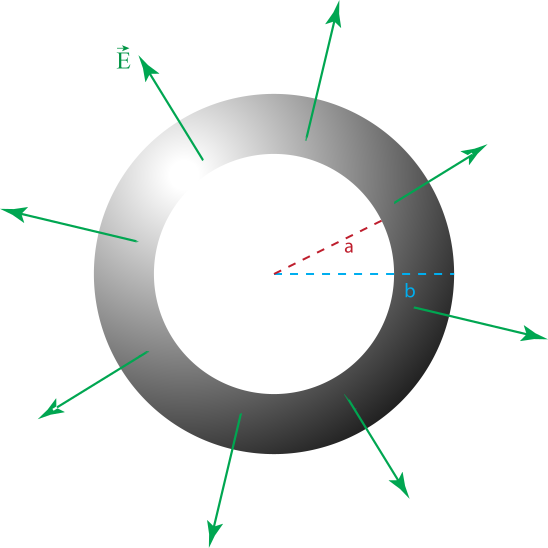
Figure 2: The electric field \(\vec{E}\) produced by the insulating shell is directed radially outwards.
Then, we can write
\begin{equation}
\label{efield}
\vec{E}=E\,\hat{\textbf{r}},
\end{equation}
where \(E\) is the magnitude of the electric field and \(\hat{\textbf{r}}\) is the unitary vector in the radial direction.
In the case of the sphere, the vector \(d\vec{A}\) can be written as
\begin{equation}
\label{da}
d\vec{A}=dA\,\hat{\textbf{r}}.
\end{equation}
Notice that the vector \(\hat{\textbf{r}}\) is a unitary vector and is always perpendicular to the spherical surface \(S\); thus, using equations \eqref{efield} and \eqref{da}, we can write equation \eqref{gauss} for our particular case as
\begin{equation}
\label{gauss2}
\oint_{S} (\vec{E}\,\hat{\textbf{r}})\cdot (dA\,\hat{\textbf{r}}) =\frac{Q_\text{enc}}{\epsilon_0}.
\end{equation}
Now, we can perform the dot product inside the integral of equation \eqref{gauss2}; remember that the dot product of two vectors \(\vec{a}\) and \(\vec{b}\) can be calculated as \(\vec{a}\cdot\vec{b}=ab\,\cos(\phi)\), where \(a\) and \(b\) are the magnitudes of the vectors and \(\phi\) is the angle between them. In our case, both vectors go in the same direction, so the angle between them is zero; hence,
\begin{equation}
\label{dotprod}
(E\,\hat{\textbf{r}})\cdot(dA\,\hat{\textbf{r}})=E dA \cos(0)= E dA.
\end{equation}
Using equation \eqref{dotprod} into equation \eqref{gauss2}, we can write
\begin{equation}
\label{gauss4}
\oint_S E_\circ dA=\frac{Q_\text{enc}}{\epsilon_0}.
\end{equation}
Notice that the magnitude of the electric field of the sphere \(E\) is constant along the whole surface \(S\), so we can take it out of the integral
\begin{equation}
\label{gauss5}
E\oint_S dA=\frac{Q_\text{enc}}{\epsilon_0},
\end{equation}
and perform the integral, which gives us the surface area of \(S\), a quantity that we denote by \(A_S\)
\begin{equation}
\label{area}
\oint_S dA=A_S.
\end{equation}
Remember that \(S\) is a sphere of radius \(r\), then \(A_S=4\pi r^2\) and equation \eqref{gauss5} (together with \eqref{area}) becomes
\begin{equation}
\label{gaussesfera}
E(4\pi r^2)=\frac{Q_\text{enc}}{\epsilon_0},
\end{equation}
which is a general simplification for Gauss’s law when the charge distribution is spherically symmetrical.
Now, we turn to calculate the electric field for the three regions. Let’s begin with region (i), the interior of the spherical shell. We draw a Gaussian surface of radius \(r<a\), as seen in figure 3.
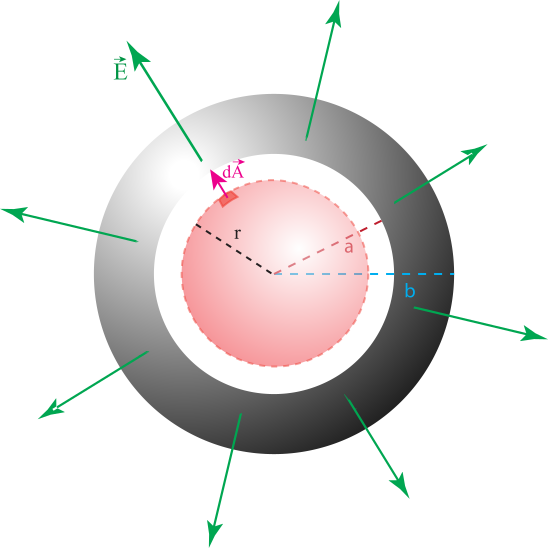
Figure 3: Spherical Gaussian surface (pink) of radius \(r<a\). The differential surface area vector \(d\vec{A}\) is perpendicular to each point in the Gaussian surface. The electric field \(\vec{E}\) produced by the insulating shell is also shown.
We notice that there is no charge enclosed by this surface for any \(r<a\), so \(Q_{\text{enc}}=0\) and equation \eqref{gaussesfera} becomes
\begin{equation}
E(4\pi r^2)=0,
\end{equation}
which implies
\begin{equation}
E=0\quad \text{for}\quad r<a.
\end{equation}
Let’s now examine region (ii). The charge is said to be distributed through the shell uniformly. As a result, the enclosed charge will be a function of \(r\). Because of this uniformity, we can define a volumetric charge density \(\rho\) as the ratio of the total charge \(Q\) and the volume of the shell \(V\); explicitly,
\begin{equation}
\label{rho}
\rho=\frac{Q}{V}.
\end{equation}
The volume of the shell can be calculated as the volume of a sphere or radius \(b\) minus the volume of a sphere of radius \(a\); namely,
\begin{equation}
V=\frac{4\pi b^3}{3}-\frac{4\pi a^3}{3},
\end{equation}
which, after factorizing the common terms, can be written as
\begin{equation}
\label{volume}
V=\frac{4\pi (b^3-a^3)}{3}.
\end{equation}
Using the expression for \(V\) given by equation \eqref{volume} into equation \eqref{rho}, we can write
\begin{equation}
\label{rho2}
\rho=\frac{3Q}{4\pi (b^3-a^3)}.
\end{equation}
This volumetric charge density \(\rho\) will allow us to calculate \(Q_{\text{enc}}\) as follows
\begin{equation}
\label{qenc}
Q_{\text{enc}}=\rho V_{\text{enc}},
\end{equation}
where \(V_{\text{enc}}\) is the volume of the shell enclosed by the surface \(S\). This enclosed volume can be calculated as the volume of a sphere of radius \(r\) minus the volume of a sphere of radius \(a\), as can be seen in the next figure; namely,
\begin{equation}
V_{\text{enc}}=\frac{4\pi r^3}{3}-\frac{4\pi a^3}{3},
\end{equation}
\begin{equation}
\label{venc}
V_{\text{enc}}=\frac{4\pi (r^3-a^3)}{3}.
\end{equation}

Figure 4: Spherical Gaussian surface (pink) of radius \(a<r<b\) enclosing part of the charged spherical shell. The differential surface area vector \(d\vec{A}\) is perpendicular to the Gaussian surface and thus parallel to the electric field \(\vec{E}\) produced by the insulating shell.
Using the explicit expressions for \(\rho\) and \(V_{\text{enc}}\) given by equations \eqref{rho2} and \eqref{venc} in \eqref{qenc}, we obtain
\begin{equation}
Q_{\text{enc}}=\frac{3Q}{4\pi (b^3-a^3)} \cdot \frac{4\pi (r^3-a^3)}{3},
\end{equation}
which is equivalent to
\begin{equation}
\label{qenc2}
Q_{\text{enc}}=\frac{Q(r^3-a^3)}{(b^3-a^3)}.
\end{equation}
Using this result in \eqref{gaussesfera} for region (ii), we obtain
\begin{equation}
E(4\pi r^2)=\frac{Q(r^3-a^3)}{(b^3-a^3)\epsilon_0},
\end{equation}
where we solve for \(E\) to get
\begin{equation}
E=\frac{Q(r^3-a^3)}{(b^3-a^3)4\pi\epsilon_0 r^2},
\end{equation}
and in vector form, according to equation \eqref{efield}
\begin{equation}
\label{eii}
\vec{E}=\frac{Q(r^3-a^3)}{(b^3-a^3)4\pi\epsilon_0 r^2}\,\hat{\textbf{r}}\quad \text{for}\quad a\leq r\leq b.
\end{equation}

Figure 5: Spherical Gaussian surface (pink) of radius \(r>b\). The differential surface area vector \(d\vec{A}\) is perpendicular to the Gaussian surface and thus parallel to the electric field \(\vec{E}\) produced by the insulating shell. The total charge is enclosed by the Gaussian surface.
Finally, for the region (iii), we notice that the whole charge \(Q\) of the insulating shell is enclosed by the Gaussian surface \(S\), as seen in figure 5. This implies that
\begin{equation}
\label{q3}
Q_{\text{enc}}=Q.
\end{equation}
Using equation \eqref{gaussesfera} and the result for \(Q_{\text{enc}}\) of equation \eqref{q3}, we obtain
\begin{equation}
E4\pi r^2=\frac{Q}{\epsilon_0},
\end{equation}
which can be solved for \(E\) to get
\begin{equation}
E=\frac{Q}{4\pi\epsilon_0 r^2},
\end{equation}
or in vector form (according to equation \eqref{efield})
\begin{equation}
\label{e3}
\vec{E}=\frac{Q}{4\pi\epsilon_0 r^2}\,\hat{\textbf{r}}\quad \text{for} \quad r>b.
\end{equation}
b) We’ll now use the numerical values to calculate the electric field for the given values of \(r\). Let’s start with \(r=20\,\text{cm}\). Because the internal radius of the shell is \(30\,\text{cm}\), we are clearly in region (i), so the electric field is
\begin{equation}
E=0\,\text{N/C}\quad \text{for}\quad r=20\,\text{cm}.
\end{equation}
For \(r=40\,\text{cm}\), we are in region (ii), so we will use equation \eqref{eii}; namely,
\begin{equation*}
\vec{E}=\frac{(0.05\,\text{C})((0.4\,\text{m})^3-(0.3\,\text{m})^3)}{((0.45\,\text{m})^3-(0.3\,\text{m})^3)4\pi (8.854\times 10^{-12}\,\text{F/m})(0.4\,\text{m})^2}\,\hat{\textbf{r}},
\end{equation*}
\begin{equation}
\vec{E}\approx1.62\times 10^{9}\,\text{N/C}\,\hat{\textbf{r}}\quad\text{for}\quad r=40\,\text{cm}.
\end{equation}
Finally, for \(r=60\,\text{cm}\) we are in region (iii), so we’ll use equation \eqref{e3}; explicitly,
\begin{equation*}
\vec{E}=\frac{0.05\,\text{C}}{4\pi(8.854\times 10^{-12}\,\text{F/m})(0.6\,\text{m})^2}\,\hat{\textbf{r}},
\end{equation*}
\begin{equation}
\vec{E}\approx 1.25\times 10^{9}\,\text{N/C}\,\hat{\textbf{r}}.
\end{equation}


Leave A Comment