

Calculate the work required to assemble three identical point charges, each of magnitude \( q = 4.2\) nC, at the corners of a triangle of side \( \ell = 1.5 cm \).
Use the formula for electric potential and relate this to the work done.
The electric potential given as:
\begin{equation*}
V=\frac{1}{4\pi\epsilon_0}\frac{q}{r}.
\end{equation*}
Based on the principle of superposition, the electric potential at a specific vertex is the sum of the electric potential from the other two charges. Then, since all charges are equal, each potential can be rewritten as:
\begin{equation*}
V=\frac{q}{2\pi\epsilon_0 \ell}.
\end{equation*}
The work done is:
\begin{equation*}
W = \sum V_i q_i,
\end{equation*}
or:
\begin{equation*}
W=\frac{3q^2}{2\pi\epsilon_0 \ell}.
\end{equation*}
which, with numerical values, is:
\begin{equation*}
W\approx 6.34 \times 10^{-5} \, \text{J}.
\end{equation*}
For a more detailed explanation of any of these steps, click on “Detailed Solution”.
To calculate the necessary amount of work to assemble the triangular array of electric charges, we must find the electric potential at each vertex.
First, let’s draw the triangular array of charges and name them according to their positions. The name of the vertexes is the same as the sub-index of the charges. Then vertex 1 is the one on the left, vertex 2 is the one on top, and vertex 3 is the one on the right (see figure 1).
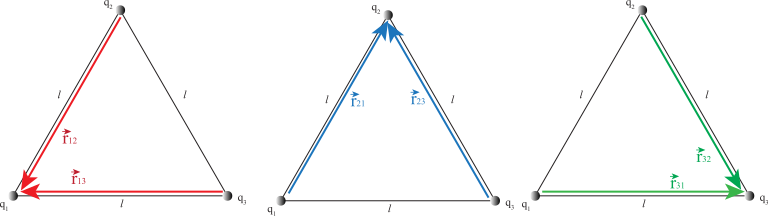
Figure 1: Distance vectors between the triangular array of charges. On the left, we have the distance vectors from charges 2 and 3 to charge 1. On the center, we have the distance vectors from charge 1 and 3 to charge 2. On the right, we have the distance vectors from charges 1 and to charge 3.
The work to assemble the charges \(W\) can be calculated as
\begin{equation}
\label{workthistime}
W=\sum_{i=1}^{3}q_iV_i,
\end{equation}
where \(q_i\) is the charge on each vertex and \(V_i\) is the electric potential at point \(i\) generated by all the charges around it.
For \(i=1\), we have that \(V_1\) is the electric potential at the left vertex of the triangle generated by charges \(q_2\) and \(q_3\). The electric potential \(V\) generated by a punctual charge \(q\) can be calculated using the following expression
\begin{equation}
\label{defV}
V=\frac{1}{4\pi\epsilon_0}\frac{q}{r},
\end{equation}
where \(r\) is the distance from the charge \(q\) to the point where the electric potential is being calculated.
From the superposition principle, the electric potential at vertex 1 is the sum of the electric potential at vertex 1 produced by \(q_2\) (\(V_{12}\)) and the electric potential at vertex 1 produced by \(q_3\) (\(V_{13}\)); namely,
\begin{equation}
\label{v1}
V_1=V_{12}+V_{13}.
\end{equation}
Using the expression for \(V\) given in \eqref{defV} in each term on the right-hand side of equation \eqref{v1}, we get
\begin{equation}
\label{v12}
V_1=\frac{1}{4\pi\epsilon_0}\frac{q_2}{r_{12}}+\frac{1}{4\pi\epsilon_0}\frac{q_3}{r_{13}},
\end{equation}
where \(r_{12}\) and \(r_{13}\) are the distances between vertices 1-2 and 1-3 respectively. Because the charges are placed on the vertices of an equilateral triangle, both \(r_{12}\) and \(r_{13}\) are equal to \(\ell\). Then, equation \eqref{v12} can be written as
\begin{equation}
V_{1}=\frac{1}{4\pi\epsilon_0}\frac{q_2}{\ell}+\frac{1}{4\pi\epsilon_0}\frac{q_3}{\ell},
\end{equation}
where we can factorize the term \(\frac{1}{4\pi\epsilon_0\ell}\) to obtain
\begin{equation}
V_1=\frac{1}{4\pi\epsilon_0\ell}\left(q_2+q_3\right).
\end{equation}
Because all charges are equal \(q_1=q_2=q_3=q\), the expression above can be written as
\begin{equation}
V_1=\frac{2q}{4\pi\epsilon_0\ell},
\end{equation}
which after simplification is
\begin{equation}
\label{v111}
V_1=\frac{q}{2\pi\epsilon_0\ell}.
\end{equation}
The triangular array is symmetric, meaning that the distance from each charge to another is always \(\ell\) and all the charges are equal to \(q\). No matter which vertex we choose, the potential will be the same; hence, the same analysis we did for \(V_1\) could have been made for \(V_2\) or \(V_3\), and we would have obtained the same result as in \eqref{v111}. Then,
\begin{equation}
\label{v222}
V_2=\frac{q}{2\pi\epsilon_0\ell},
\end{equation}
and
\begin{equation}
\label{v333}
V_3=\frac{q}{2\pi\epsilon_0\ell}.
\end{equation}
Making the sum explicit in equation \eqref{workthistime}, we get
\begin{equation}
W=q_1V_1+q_2V_2+q_3V_3,
\end{equation}
which after using equations \eqref{v111}, \eqref{v222} and \eqref{v333} becomes
\begin{equation}
W=q_1\frac{q}{2\pi\epsilon_0\ell}+q_2\frac{q}{2\pi\epsilon_0\ell}+q_3\frac{q}{2\pi\epsilon_0\ell},
\end{equation}
and, after using the fact that all charges are equal to \(q\) the equation above, reads
\begin{equation}
W=q\frac{q}{2\pi\epsilon_0\ell}+q\frac{q}{2\pi\epsilon_0\ell}+q\frac{q}{2\pi\epsilon_0\ell},
\end{equation}
\begin{equation}
W=3\frac{q^2}{2\pi\epsilon_0 \ell}.
\end{equation}
Using the given numerical values in the SI system (\(q=4.2\times 10^{-9}\,\text{C}\) and \(\ell=0.015\,\text{m}\)):
\begin{equation}
W=3\frac{(4.2\times10^{-9}\,\text{C})^2}{2\pi(8.854\times 10^{-12}\,\text{F/m})(0.015\,\text{m})},
\end{equation}
\begin{equation}
W\approx 6.34\times 10^{-5}\,\text{J}.
\end{equation}


Leave A Comment