
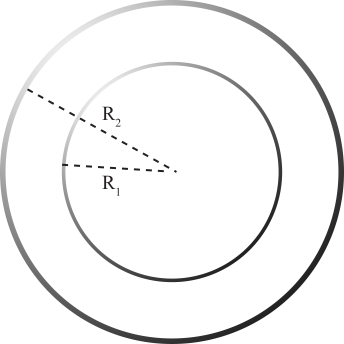
Consider two concentric conducting spherical shells, where the inner shell has a radius of 0.3 m and a charge of 5.6 \(\mu C\), and the outer shell has a radius of 0.5 m.
a) Based on principles of induction, find the charge on the inner lining of the outer shell.
b) Find the potential difference between the shells.
a) The condition of induction means that the net charge of the entire system must be equal to zero.
b) Use Gauss’s Law to calculate the strength and direction of the electric field, and use the electric field to find the electric potential.
a) Gauss’s Law states:
\begin{equation*}
\oint_S\vec{E}\cdot d\vec{A}=\frac{Q_{\text{enc}}}{\epsilon_0},
\end{equation*}
where \( Q_{\text{enc}} = 0\). Then:
\begin{equation*}
Q_0 = – Q_i = – 5.6 \, \mu \text{C}.
\end{equation*}
b) Based on Gauss’s law, the inner enclosed charge is:
\begin{equation*}
Q_{\text{enc}} = Q_i,
\end{equation*}
so:
\begin{equation*}
\vec{E}=\frac{Q_i}{4\pi \epsilon_0 r^2}\,\hat{\textbf{r}}.
\end{equation*}
The definition of the electric potential is:
\begin{equation*}
V_{b}-V_{a}=-\int_{a}^{b} \vec{E}\cdot d\vec{l}.
\end{equation*}
After performing the integral, we get:
\begin{equation*}
V_{\text{outer}}-V_{\text{inner}}=-\frac{Q_i}{4\pi \epsilon_0}\left(-\frac{1}{R_2}+\frac{1}{R_1}\right),
\end{equation*}
which, with numerical values, yields:
\begin{equation*}
V_{\text{outer}}-V_{\text{inner}}\approx -6.71\times 10^{4}\,\text{V}.
\end{equation*}
For a more detailed explanation of any of these steps, click on “Detailed Solution”.
a) To find the charge of the outer shell in its inner radius, we’ll use Gauss’ law and the fact that inside a conductor the electric field \(\vec{E}\) is always zero. First, we’ll write the equation describing Gauss’ law; namely,
\begin{equation}
\label{gauss}
\oint_S\vec{E}\cdot d\vec{A}=\frac{Q_{\text{enc}}}{\epsilon_0},
\end{equation}
where the integral is performed over the closed surface \(S\), \(d\vec{A}\) is a vector whose magnitude is the surface area differential \(dA\), and its direction is normal to the surface \(S\). The enclosed electric charge by the surface \(S\) is denoted by \(Q_{\text{enc}}\), and \(\epsilon_0\) is a physical constant known as the permittivity of free space. The electric field \(\vec{E}\) in equation \eqref{gauss} is the value of the field at the surface \(S\).
For convenience, we’ll choose our Gaussian surface \(S\) to be spherical (due to the symmetry of the problem) and located between the inner and outer radius of the outer shell, as seen in figure 1.

Figure 1: Spherical Gaussian surface (pink) placed between the inner and the outer surface of the spherical shell of radius \(R_2\). The spherical shell of radius \(R_1\) is also shown.
Because the electric field inside a conducting material is zero, we have that at the surface \(S\)
\begin{equation}
\label{efield}
\vec{E}=\vec{0}.
\end{equation}
Using the result of equation \eqref{efield} into equation \eqref{gauss}, we obtain
\begin{equation}
\oint_S\vec{0}\cdot d\vec{A}=\frac{Q_{\text{enc}}}{\epsilon_0},
\end{equation}
which becomes
\begin{equation}
\label{gauss2}
0=\frac{Q_{\text{enc}}}{\epsilon_0}.
\end{equation}
Equation \eqref{gauss2} implies that
\begin{equation}
\label{qenc}
Q_{\text{enc}}=0.
\end{equation}
Now, the enclosed charge by our Gaussian surface \(S\) will be the one of the inner shell, \(Q_i\), plus the one in the inner radius of the outer shell, \(Q_{o}\); so, we can write equation \eqref{qenc} as
\begin{equation}
Q_i+Q_o=0.
\end{equation}
Solving for \(Q_o\) from the equation above, we get
\begin{equation}
Q_o=-Q_i.
\end{equation}
Numerically
\begin{equation}
Q_o=-5.6\,\mu\text{C}.
\end{equation}
b) To find the electric potential difference between the shells \(\Delta V\), we must first find the electric field between the shells and then use the relation between electric potential \(V\) and electric field \(\vec{E}\).
Let’s begin by calculating the electric field \(\vec{E}\) in the region between the shells. We’ll use Gauss’ law with a spherical Gaussian surface between the shells, as seen in figure 2.

Figure 2: Spherical Gaussian surface (pink) with radius \(R_1<r<R_2\). This Gaussian surface encloses the total charge on the inner spherical shell.
Due to the symmetry of the enclosed charge, the electric field is directed in the radial direction and its magnitude is constant for a radial distance \(r\), as illustrated in figure 3.

Figure 3: Spherical Gaussian surface (pink) of radius \(r\) such that \(R_1<r<R_2\). The surface area differential \(d\vec{A}\) is perpendicular to each point of the Gaussian surface and thus parallel to the electric field \(\vec{E}\) produced by the charge in the inner spherical shell.
We can then write,
\begin{equation}
\label{efield2}
\vec{E}=E\,\hat{\textbf{r}},
\end{equation}
where \(E\) is the magnitude of the electric field and \(\hat{\textbf{r}}\) is the unitary vector in the radial direction. From Gauss’ law (see equation \eqref{gauss}) and from the spherical symmetry, the vector \(d\vec{A}\) is always pointing radially outwards; hence,
\begin{equation}
\label{da}
d\vec{A}=dA\,\hat{\textbf{r}}.
\end{equation}
Taking the dot product between the electric field \(\vec{E}\) and the vector \(d\vec{A}\), we obtain
\begin{equation}
\label{eda}
\vec{E}\cdot d\vec{A}=(E\,\hat{\textbf{r}})\cdot(dA\,\hat{\textbf{r}})=E\,dA,
\end{equation}
where we use the fact that \(\hat{\textbf{r}}\) is unitary, then \(\hat{\textbf{r}}\cdot\hat{\textbf{r}}=1\). Using the result of equation \eqref{eda} into equation \eqref{gauss}, we obtain
\begin{equation}
\label{gauss3}
\oint_{S}E\,dA=\frac{Q_{\text{enc}}}{\epsilon_0}.
\end{equation}
Because the magnitude of the electric field is constant along all points in the surface \(S\), it can be taken out of the integral; namely,
\begin{equation}
\label{gauss4}
E\oint_{S}dA=\frac{Q_{\text{enc}}}{\epsilon_0}.
\end{equation}
If we perform the integral \(\oint_{S}dA\), we obtain the surface area of \(S\), which for a sphere of radius \(r\) is \(4\pi r^2\); therefore, we can rewrite equation \eqref{gauss4} as
\begin{equation}
E\,4\pi r^2=\frac{Q_{\text{enc}}}{\epsilon_0}.
\end{equation}
The charge enclosed by the Gaussian surface is just the charge of the inner shell \(Q_i\), so the equation above can be written as
\begin{equation}
E\,4\pi r^2=\frac{Q_{i}}{\epsilon_0},
\end{equation}
which solving for \(E\) results in
\begin{equation}
\label{magefield}
E=\frac{Q_{i}}{4\pi \epsilon_0 r^2}.
\end{equation}
Using equation \eqref{efield2}, we can then write an expression for the electric field between the shells
\begin{equation}
\label{efield3}
\vec{E}=\frac{Q_i}{4\pi \epsilon_0 r^2}\,\hat{\textbf{r}}.
\end{equation}
Now that we have the electric field, we’ll use the following relation to find the electric potential difference
\begin{equation}
\label{difV}
V_{b}-V_{a}=-\int_{a}^{b} \vec{E}\cdot d\vec{l}.
\end{equation}
Where \(V_{a}\) and \(V_{b}\) are the electric potentials in points \(a\) and \(b\), respectively. The integral is taken over a path described by \(d\vec{l}\). Because of the dot product between the electric field \(\vec{E}\) and the vector \(d\vec{l}\), the only contribution to the integral will be from a path along the same direction of \(\vec{E}\), which is \(\hat{\textbf{r}}\); thus, we can write
\begin{equation}
\int_{a}^{b}\vec{E}\cdot d\vec{l}=\int_{a}^{b}(E\,\hat{\textbf{r}})\cdot d\vec{l},
\end{equation}
\begin{equation}
\label{intV}
\int_{a}^{b}\vec{E}\cdot d\vec{l}=\int_{r_a}^{r_b}E\,dr,
\end{equation}
where now the limits are in terms of the radius associated to points \(a\) and \(b\).
Using the result of equation \eqref{intV} in equation \eqref{difV}, we get
\begin{equation}
\label{difV2}
V_{b}-V_{a}=-\int_{r_a}^{r_b}E\,dr.
\end{equation}
Putting the expression of the magnitude of the electric field of equation \eqref{magefield} into equation \eqref{difV2}, we obtain
\begin{equation}
\label{difV3}
V_{b}-V_{a}=-\int_{r_a}^{r_b}\frac{Q_i}{4\pi\epsilon_0 r^2}\,dr.
\end{equation}
Point \(a\) will be associated with the inner shell, and point \(b\) will be a point in the outer shell; so, equation \eqref{difV3} can be written as
\begin{equation}
\label{difV4}
V_{\text{outer}}-V_{\text{inner}}=-\frac{Q_i}{4\pi\epsilon_0}\int_{R_1}^{R_2}\frac{dr}{r^2},
\end{equation}
where \(R_1\) is the outer radius of the inner shell and \(R_2\) is the inner radius of the outer shell. We have taken out of the integral all the constants. Performing the integral in equation \eqref{difV4}, we get
\begin{equation}
V_{\text{outer}}-V_{\text{inner}}=-\frac{Q_i}{4\pi \epsilon_0}\left(-\frac{1}{R_2}+\frac{1}{R_1}\right),
\end{equation}
which numerically is
\begin{equation*}
V_{\text{outer}}-V_{\text{inner}}=-\frac{5.6\times 10^{-6}\,\text{C}}{4\pi (8.854\times 10^{-12}\,\text{F/m})}\left(-\frac{1}{0.5\,\text{m}}+\frac{1}{0.3\,\text{m}}\right),
\end{equation*}
\begin{equation}
V_{\text{outer}}-V_{\text{inner}}\approx -6.71\times 10^{4}\,\text{V}.
\end{equation}


Leave A Comment