
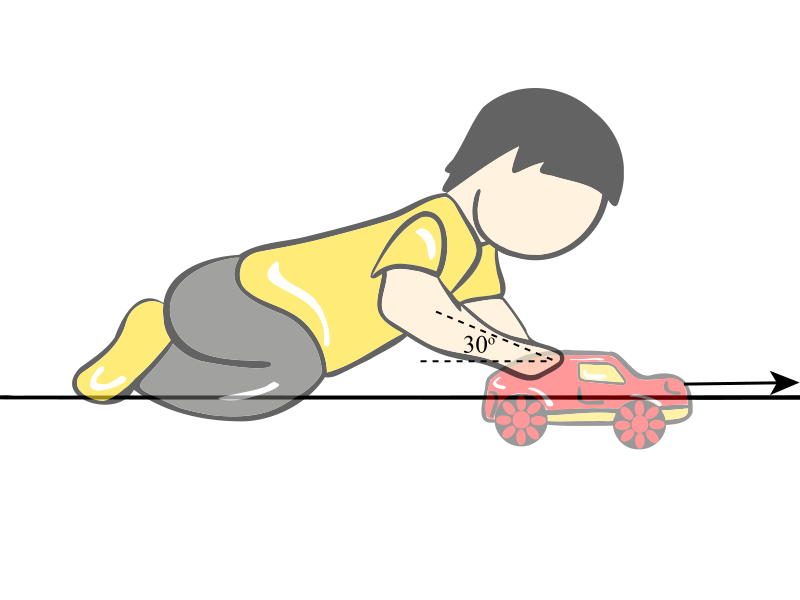
\(\text{Vroom, vroom!}\) A toddler pushes a toy car at an angle of 30 degrees, as shown in the figure. The toy is constructed as a one-piece model (to eliminate the possibility that any pieces could break and become a hazard for small children), so the wheels do not move. If the car, which has a mass of 2 kg, moves at a constant speed of \(0.5 \,\text{m}/\text{s}\) for 5 m, and the coefficient of friction the toy and the floor is 0.2, find the work done by:
(a) Friction.
(b) The kid.
(c) Gravitational force.
a) Draw a free body diagram and use that to find the normal force and the force due to friction. The work done by the force due to friction can then be easily obtained.
b) Using the free body diagram, you can also find the force applied by the kid. The work done by the kid is then easily found.
c) Consider how the work done varies with the angle.
a) Newton’s Second Law in the \({x-}\)direction can be written as:
\begin{equation*}
F_k \cos \theta- f_r = 0,
\end{equation*}
where \(f_r = \mu N\). Then, Newton’s Second Law in the \({y-}\)direction states:
\begin{equation*}
N – F_k \sin \theta- mg = 0.
\end{equation*}
In these two equations, the unknown variables are \(N\) and \(F_k\). Solving the \(2\times 2 \) system of equations, we have for \(N\):
\begin{equation*}
N=mg+\left(\frac{\mu_k mg}{\cos(\theta)-\mu_k\sin(\theta)}\right)\sin(\theta).
\end{equation*}
The work done by the force due to friction is:
\begin{equation*}
W_{f_r} =- \mu_k d \left( mg+\left(\frac{\mu_k mg}{\cos(\theta)-\mu_k\sin(\theta)}\right)\sin(\theta) \right),
\end{equation*}
which, with numerical values, is:
\begin{equation*}
W_{f_r} \approx -22.16 \, \text{J}.
\end{equation*}
b) Using the solution from the \(2\times 2 \) system of equations, we have for \(F_k\):
\begin{equation*}
F_k = \frac{\mu_k mg}{\cos \theta – \mu_k \sin \theta}.
\end{equation*}
The \(F_k\) force has both \({x-}\) and \({y-}\)components, but only the \({x-}\)component does work. This means:
\begin{equation*}
W_{F_k}=d\left(\frac{\mu_k mg}{\cos(\theta)-\mu_k\sin(\theta)}\right)\cos(\theta),
\end{equation*}
which, with numerical values, yields:
\begin{equation*}
W_{F_k}\approx 22.16\,\text{J}.
\end{equation*}
c) We know that the angle between the displacement and the gravitational force is \(-90^\circ\), so:
\begin{equation*}
W_{mg}=0.
\end{equation*}
For a more detailed explanation of any of these steps, click on “Detailed Solution”.
a) The problem asks us to find the work done by friction, the kid, and gravity over the toy. Thus, to find the solution to this problem, we will first use Newton’s second law in order to find expressions for all these forces as a function of known variables. Then, we will use the definition of work done by a force to find the work done by these forces.
In order to use Newton’s second law, let us first identify all the forces, and make a free-body diagram for the toy, using a coordinate system where X is parallel to the floor. Over the toy, there are three forces: the normal force \(\vec{N}\), which points upwards and it is produced by the floor, the kinetic friction force \(\vec{f}_r\), that opposes the motion of the toy, and the kid’s force \(\vec{F}_k\), that marks an angle of \(\theta=30^{\circ}\) with the X-axis. Hence, the force diagram is shown in figure 1.

Figure 1: Free-body diagram of the toy-car. The coordinate system is such that the positive X-axis is in the direction of the toy-car movement and the positive Y-axis points upwards. The forces shown are: the normal force \(\vec{N}\), the weight \(\vec{W}\), the friction \(\vec{f}_r\) and the force exerted by the kid \(\vec{F}_k\) along with its angle of inclination with respect to the horizontal axis.
From this diagram, we can see that the force exerted by the kid has components along the positive X axis and the negative Y axis, and so we can write this force as
\begin{equation}
\vec{F}_k=F_k\cos(\theta)\,\hat{\textbf{i}}-F_k\sin(\theta)\,\hat{\textbf{j}},
\end{equation}
where \(F_k\cos(\theta)\) is the magnitude of the X-component and \(F_k\sin(\theta)\) the magnitude of the Y-component. In order to find the work produced by this and the other force, we then need to use Newton’s second law.
Because the velocity of the toy is constant, its acceleration is zero \(\vec{a}=\vec{0}\), and so, according to Newton’s second law, the sum of forces is zero as well. Writing Newton’s second law for the X axis, noticing that the friction is negative in X and the X-component of the kid’s force is positive in X, we get
\begin{equation}
F_k\cos(\theta)\,\hat{\textbf{i}}-{f}_r \,\hat{\textbf{i}}=0\,\hat{\textbf{i}},
\end{equation}
where we used on the right side that the acceleration is zero (it is zero in total, and so zero along X). Now, the magnitude of the kinetic friction is given by \(f_r=-\mu_k N\), and so the previous equation can be written as
\begin{equation}
F_k\cos(\theta)\,\hat{\textbf{i}}-\mu_kN\,\hat{\textbf{i}}=0.
\end{equation}
Dropping the vector notation and focusing on the magnitudes, we get
\begin{equation}
\label{newtonx}
F_k\cos(\theta)-\mu_kN=0.
\end{equation}
Notice that from here we still do not know \(N\), and so we can’t compute \(F_k\). Hence, we need more equations. If we use Newton’s second law for the Y axis, noticing that the normal is positive in Y and the kid’s force has a negative Y-component that we found earlier, we get
\begin{equation}
N\,\hat{\textbf{j}}-F_k\sin(\theta)\,\hat{\textbf{j}}-mg\,\hat{\textbf{j}}=0\,\hat{\textbf{j}},
\end{equation}
where we used on the right hand side that the acceleration in Y is zero. After focusing on just the magnitudes, this becomes
\begin{equation}
\label{newtony}
N-F_k\sin(\theta)-mg=0.
\end{equation}
Solving for \(N\), we get
\begin{equation}
\label{normal}
N=mg+F_k\sin(\theta).
\end{equation}
Using this result in equation \eqref{newtonx}, we then get
\begin{equation}
F_k\cos(\theta)-\mu_k\left(mg+F_k\sin(\theta)\right)=0,
\end{equation}
which, after expanding the term in parenthesis, becomes
\begin{equation}
F_k\cos(\theta)-\mu_kmg-\mu_kF_k\sin(\theta)=0.
\end{equation}
We can now use this to solve for \(F_k\). After factorizing \(F_k\), we get
\begin{equation}
F_k\left(\cos(\theta)-\mu_k\sin(\theta)\right)=\mu_kmg.
\end{equation}
Then, we can divide by the term multiplying \(F_k\) to get
\begin{equation}
F_{k}=\frac{\mu_k mg}{\cos(\theta)-\mu_k\sin(\theta)}.
\end{equation}
We have then an expression for the kid’s force in terms of known variables. And we can use this result to find expressions for the other forces in question as well. According to equation \eqref{normal}, the normal force is
\begin{equation}
N=mg+\left(\frac{\mu_k mg}{\cos(\theta)-\mu_k\sin(\theta)}\right)\sin(\theta).
\end{equation}
Hence, since the friction is \(f_r=\mu_k N\), we get
\begin{equation}
f_r=\mu_k\left(mg+\frac{\mu_k mg\sin(\theta)}{\cos(\theta)-\mu_k\sin(\theta)}\right).
\end{equation}
Now that we know all the forces in terms of known variables and parameters, we can use the definition of work \(W\) for a constant force. If the object moves along a trajectory described by the displacement vector \(\vec{d}\), then the work exerted by a force \(\vec{F}\) over such an object is defined to be
\begin{equation}
\label{work}
W=\vec{F}\cdot\vec{d},
\end{equation}
where the dot product is defined as \(\vec{F}\cdot\vec{d}=Fd \cos \theta) \) (where the angle \(\theta\) is the angle between the force and the displacement vectors). In the case of the coordinate system chosen, the displacement vector will point along the X axis, and according to the prompt will have a magnitude of \(d=5\,\text{m}\). Therefore, we can write
\begin{equation}
\vec{d}=d\,\hat{\textbf{i}}.
\end{equation}
We can now calculate the work done by the friction force. Using equation \eqref{work}, we get
\begin{equation}
W_{f_r}=\left(-\mu_k\left(mg+\frac{\mu_k mg\sin(\theta)}{\cos(\theta)-\mu_k\sin(\theta)}\right)\,\hat{\textbf{i}}\right)\cdot \left(d\,\hat{\textbf{i}}\right).
\end{equation}
After taking the dot product, this becomes
\begin{equation}
W_{f_r}=-\mu_kd\left(mg+\frac{\mu_k mg\sin(\theta)}{\cos(\theta)-\mu_k\sin(\theta)}\right)\,\hat{\textbf{i}}\cdot\hat{\textbf{i}},
\end{equation}
and simplifies further to
\begin{equation}
W_{f_r}=-\mu_kd\left(mg+\frac{\mu_k mg\sin(\theta)}{\cos(\theta)-\mu_k\sin(\theta)}\right),
\end{equation}
where we have used the fact that \(\hat{\textbf{i}}\cdot\hat{\textbf{i}}=1\) (this is also clear from the definition of the dot product, since \(\hat{\textbf{i}}\cdot\hat{\textbf{i}}=(1)(1) \cos (0^{\circ})=1\) . Using the numerical values given in the prompt, we obtain
\begin{equation}
W_{f_r}=-(0.2)(5\,\text{m})\left((2\,\text{kg})(9.8\,\text{m/s}^2)+\frac{0.2(2\,\text{kg})(9.8\,\text{m/s}^2)\sin(30^{\circ})}{\cos(30^{\circ})-0.2\sin(30^{\circ})}\right),
\end{equation}
\begin{equation}
W_{f_r}\approx -22.16\,\text{J}.
\end{equation}
b) We can now calculate the work done by the force \(F_k\). Using equation \eqref{work}, we get
\begin{equation}
W_{F_k}=\left(\frac{\mu_k mg}{\cos(\theta)-\mu_k\sin(\theta)}\cos(\theta)\,\hat{\textbf{i}}-\frac{\mu_k mg}{\cos(\theta)-\mu_k\sin(\theta)}\sin(\theta)\,\hat{\textbf{j}}\right)\cdot \left(d\,\hat{\textbf{i}}\right),
\end{equation}
which, after taking the dot product, becomes
\begin{equation}
W_{F_k}=d\left(\frac{\mu_k mg}{\cos(\theta)-\mu_k\sin(\theta)}\right)\cos(\theta)\,\hat{\textbf{i}}\cdot\hat{\textbf{i}}-d\left(\frac{\mu_k mg}{\cos(\theta)-\mu_k\sin(\theta)}\right)\sin(\theta)\,\hat{\textbf{j}}\cdot\hat{\textbf{i}}.
\end{equation}
This simplifies further to
\begin{equation}
W_{F_k}=d\left(\frac{\mu_k mg}{\cos(\theta)-\mu_k\sin(\theta)}\right)\cos(\theta),
\end{equation}
where we have used the fact that \(\hat{\textbf{i}}\cdot\hat{\textbf{i}}=1\) and \(\hat{\textbf{j}}\cdot\hat{\textbf{i}}=0\) . That is, only the X component of the kid’s force makes work, which makes sense because a force only makes work along the direction of motion, and the Y-component is perpendicular to the direction of motion of the toy. Using the numerical values, we obtain
\begin{equation}
W_{F_k}=(5\,\text{m})\left(\frac{0.2(2\,\text{kg})(9.8\,\text{m/s}^2)}{\cos(30^{\circ})-0.2\sin(30^{\circ})}\right)\cos(30^{\circ}),
\end{equation}
\begin{equation}
W_{F_k}\approx 22.16\,\text{J}.
\end{equation}
(c) Finally, let us calculate the work done by the weight. We expect this work to be zero, since the weight is perpendicular to the direction of motion and, again, a force only makes work along the direction of motion. However, we can show this explicitly using \eqref{work}:
\begin{equation}
W_{mg}=\left(-mg\,\hat{\textbf{j}}\right)\cdot \left(d\,\hat{\textbf{i}}\right).
\end{equation}
After taking the dot product, this becomes
\begin{equation}
W_{mg}=-mgd\,\hat{\textbf{j}}\cdot\hat{\textbf{i}},
\end{equation}
which can be simplified further to
\begin{equation}
W_{mg}=0
\end{equation}
because \(\hat{\textbf{j}}\cdot\hat{\textbf{i}}=0\).
Notice that the total work is \(-22.16\,\text{J}+22.16\,\text{J}+0\,\text{J}=0\,\text{J}\), which makes sense because by the Work-Energy Theorem, the total work over an object equals the change in kinetic energy of the object. In this case, the car does not change the kinetic energy, because its speed is constant. Hence, by this theorem, there should not be any net work on the object, which is precisely what we found.


Leave A Comment