

A mischief maker decides to chuck a 50 g ball of sticky clay toward an action figure (200 g) placed 30 cm away from the edge of a table. If the coefficient of friction between the figurine and the table is 0.3, calculate what the minimum initial speed of the clay must be to make the fall action figure fall off the table.
You need to apply both Conservation of Momentum and the Work-Energy Theorem. Newton’s Second Law may also be helpful to solve for the forces.
Conservation of Momentum \(\vec{p}_i = \vec{p}_f\) in this case gives:
\begin{equation*}
m_c v_0 = (m_c+m_f) v_i,
\end{equation*}
where we can solve for \(v_i\).
Newton’s Second Law in the \({y-}\)direction can be written as:
\begin{equation*}
N – (m_c + m_f)g = 0.
\end{equation*}
Based on the Work-Energy Theorem (\(W_{net} = \Delta K \)), we can write:
\begin{equation*}
W_{net} = 0 – \frac{1}{2} (m_c + m_f) v_i^2,
\end{equation*}
where \(W_{net} = -f_k \) and \(f_k = -\mu_k N\). Substituting the normal force and \(v_i\) into the last equation, and solving for \(v_0\), we get:
\begin{equation*}
v_0=\frac{m_c+m_f}{m_c}\sqrt{2\mu_k gd},
\end{equation*}
or
\begin{equation*}
v_{0_{min}} \approx 6.64 \, \text{m/s}.
\end{equation*}
For a more detailed explanation of any of these steps, click on “Detailed Solution”.
We have to find out what the minimum initial speed of the clay ball needs to be in order to make the toy fall from the table. We’ll solve the problem in two steps:
- We’ll assume the clay ball hits the figurine with speed \(v_0\), and using linear momentum conservation we will be able to find the final speed at which the clay and figurine move together \(v_i\).
- We’ll use speed \(v_i\) as the initial speed and assume that the clay and figurine move a distance \(d\) together across the table before they stop. For this purpose, we will use the work-energy theorem.
Let’s start by writing the conservation of linear momentum law for the collision:
\begin{equation}
\label{cons}
\vec{p}_i=\vec{p}_f,
\end{equation}
where \(\vec{p}_i\) is the linear momentum of clay and figurine before their collision and \(\vec{p}_f\) will be the lineal momentum of clay and figurine right after the collision. Because all the motion occurs along one axis, say X, we write the momentum before the collision as
\begin{equation}
\vec{p}_i=m_cv_0\,\hat{\textbf{i}}+m_fv_f\,\hat{\textbf{i}},
\end{equation}
where \(m_c\) and \(m_f\) are the masses of clay and figurine respectively and \(v_0\) and \(v_f\) their velocities. Because the figurine does not move before the collision, then \(v_f=0\,\text{m/s}\) and the expression for the linear momentum before the collision becomes (see figure 1).
\begin{equation}
\label{pi}
\vec{p}_i=m_cv_0\,\hat{\textbf{i}}.
\end{equation}
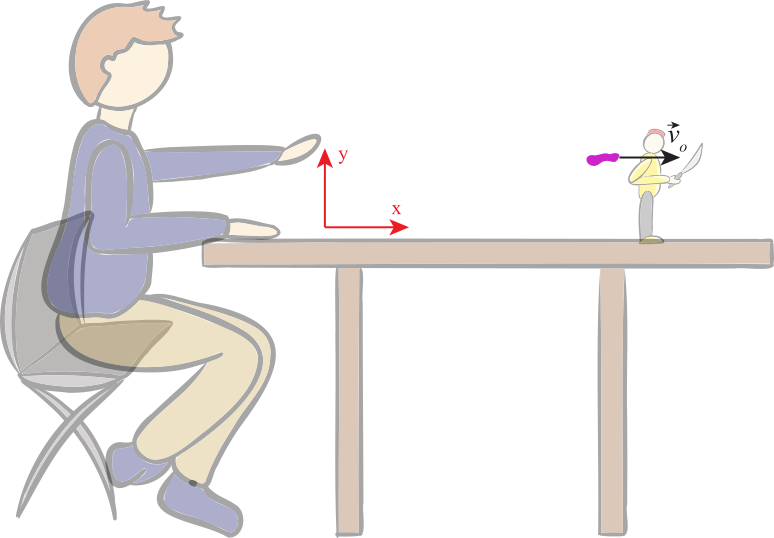
Figure 1: We place the coordinate system at the table. Moments before the collision, the piece of clay moves along the positive X axis with a velocity \(\vec{v}_0\) while the figurine is static.
The expression for the momentum right after the collision, considering that now the clay and figurine move as a whole (see figure 2), is
\begin{equation}
\label{pf}
\vec{p}_f=(m_c+m_f)v_i\,\hat{\textbf{i}}.
\end{equation}
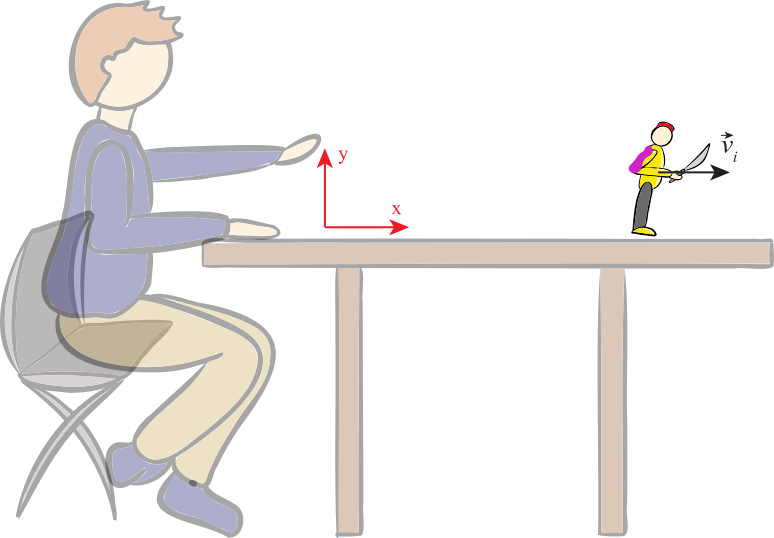
Figure 2: Right after the collision, the figurine and clay move together with the same velocity \(\vec{v}_{f}\) along the positive X axis.
Using the expressions for the momentum before and after the collision given by equations \eqref{pi} and \eqref{pf} into equation \eqref{cons}, we obtain
\begin{equation}
m_cv_0\,\hat{\textbf{i}}=(m_c+m_f)v_i\,\hat{\textbf{i}},
\end{equation}
which after dropping the vector notation and focusing on the magnitudes becomes
\begin{equation}
m_cv_0=(m_c+m_f)v_i.
\end{equation}
We can solve for \(v_i\), the speed of the clay-figurine system after the collision to get
\begin{equation}
\label{vi}
v_i=\frac{m_c v_0}{(m_c+m_f)}.
\end{equation}
Now we’ll move on to step two and express a relation between the distance traveled along the table with friction \(d\) before the system stops and the initial speed of the system \(v_i\). In order to do this, we write the work-energy theorem
\begin{equation}
\label{wet}
K_f-K_i=W_{\text{net}},
\end{equation}
where \(K_f\) and \(K_i\) are the final and initial kinetic energy of the system and \(W_{\text{net}}\) is the total work done on the system from the initial to the final point. Our initial point will be the system moving with speed \(v_i\). Thus \(K_i\) will be
\begin{equation}
K_i=\frac{1}{2}(m_c+m_f)v_i^2.
\end{equation}
The final point will be when the clay and figurine stopped, so the final speed is zero and the kinetic energy in this final point is also zero,
\begin{equation}
K_f=0.
\end{equation}
To find the work done on the system let us identify the forces exerted on it, as shown in figure 3.

Figure 3: Free–body diagram for the clay-figurine system. The forces shown are the contact force \(\vec{N}\), the friction force \(\vec{f}_k\), and the weight \(\vec{W}\).
From the free-body diagram, we identify the weight \(\vec{W}=-(m_c+m_f)g\,\hat{\textbf{j}}\), the contact force \(N\,\hat{\textbf{i}}\), and the kinetic friction \(-f_k\,\hat{\textbf{i}}\). We can calculate the total work by making the dot product between the net force (the sum of all forces) and the displacement vector, which is \(d\,\hat{\textbf{i}}\), namely
\begin{equation}
W_{\text{net}}=(-(m_c+m_f)g\,\hat{\textbf{j}}+N\,\hat{\textbf{j}}-f_k\,\hat{\textbf{i}})\cdot(d\,\hat{\textbf{i}}),
\end{equation}
which after using the distributive law becomes
\begin{equation}
W_{\text{net}}=-(m_c+m_f)gd\,\hat{\textbf{j}}\cdot\,\hat{\textbf{i}}+Nd\,\hat{\textbf{j}}\cdot\,\hat{\textbf{i}}-f_kd\,\hat{\textbf{i}}\cdot \,\hat{\textbf{i}},
\end{equation}
and simplifies to
\begin{equation}
\label{netw}
W_{\text{net}}=-f_kd,
\end{equation}
where we have used the fact that \(\hat{\textbf{j}}\cdot\hat{\textbf{i}}=0\) and \(\hat{\textbf{i}}\cdot\hat{\textbf{i}}=1\).
To calculate the kinetic friction force, we can use the expression
\begin{equation}
\label{fk}
f_k=\mu_kN,
\end{equation}
where \(\mu_k=0.3\) is the kinetic friction coefficient. In order to express \(f_k\) in terms of known variables, we use Newton’s second law on the Y axis to write
\begin{equation}
N\,\hat{\textbf{j}}-(m_c+m_f)g\,\hat{\textbf{j}}=0\,\hat{\textbf{j}}.
\end{equation}
Dropping the vector notation and focusing on the magnitudes, we can express the equation above as
\begin{equation}
N-(m_c+m_f)g=0,
\end{equation}
where we can solve for the contact force to obtain
\begin{equation}
N=(m_c+m_f)g.
\end{equation}
Thus, using this expression for the contact force in equation \eqref{fk}, we obtain
\begin{equation}
f_k=\mu_k(m_c+m_f)g.
\end{equation}
The expression for the total work is then (following equation \eqref{netw})
\begin{equation}
W_{\text{net}}=-(\mu_k(m_c+m_f)g)d.
\end{equation}
Putting everything together in the work-energy theorem \eqref{wet}, we obtain
\begin{equation}
0-\frac{1}{2}(m_c+m_f)v_i^2=-\mu_k(m_c+m_f)gd.
\end{equation}
We can simplify the equation above by simplifying the sum of masses and the minus sign to obtain
\begin{equation}
\frac{1}{2}v_i^2=\mu_kgd.
\end{equation}
Using the expression for \(v_i\) that we have found in step 1 of the solution, given by equation \eqref{vi}, in the equation above we get
\begin{equation}
\frac{1}{2}\left(\frac{m_cv_0}{(m_c+m_f)}\right)^2=\mu_k gd.
\end{equation}
We can now solve for \(v_0\) as follows
\begin{equation}
\left(\frac{m_cv_0}{m_c+m_f}\right)^2=2\mu_kgd,
\end{equation}
and taking the square-root on both sides
\begin{equation}
\frac{m_cv_0}{m_c+m_f}=\sqrt{2\mu_k gd},
\end{equation}
hence
\begin{equation}
v_0=\frac{m_c+m_f}{m_c}\sqrt{2\mu_k gd}.
\end{equation}
Therefore, we have found a relation between the speed at which the clay collides with the figurine \(v_0\) and the distance \(d\) the whole system travels across a flat surface before it stops. Notice that, as expected, as \(d\) increases so does the necessary speed \(v_0\). In particular, we are interested in the minimum speed that is needed to knock the clay and figurine fall off the table, so we will use \(d=30\,\text{cm}=0.3\,\text{m}\) and find the necessary speed \(v_0\). Explicitly, using the numerical values
\begin{equation}
v_{0\,\text{min}}=\frac{50\,\text{g}+200\,\text{g}}{50\,\text{g}}\sqrt{2(0.3)(9.8\,\text{m/s}^2)(0.3\,\text{m})},
\end{equation}
\begin{equation}
v_{0\,\text{min}}\approx 6.64\,\text{m/s}.
\end{equation}


Leave A Comment