
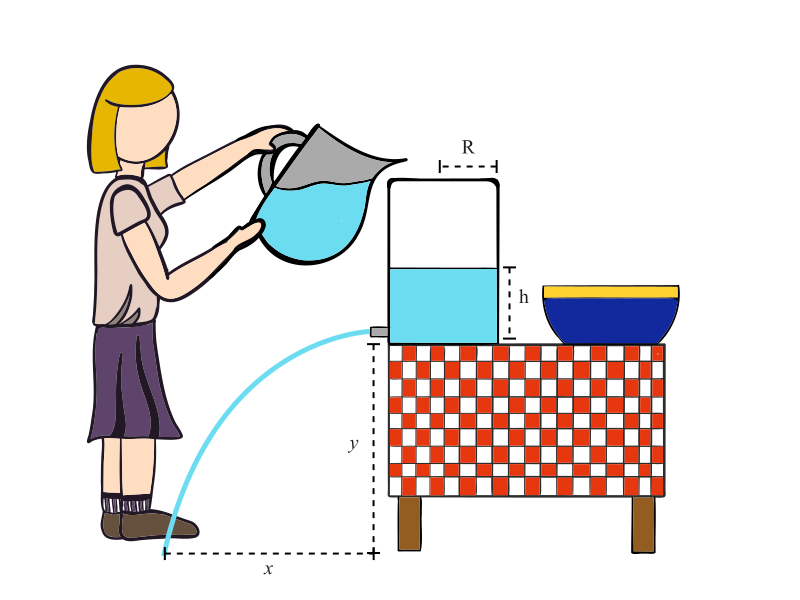
Loren has a cylindrical jug full of water. She calculates that it is filled to a height \(h = 0.6 \, \text{m} \) and has a radius \(R = 0.2 \, \text {m} \). The jug has a hole at the bottom that points horizontally, as seen in the figure. To keep the water in the jug at the same height and prevent it from emptying, she must fill it from the top at a constant rate.
a) If Laura holds the jug at a height \(y = 1.4 \, \text{m}\) from the ground, what horizontal distance \(x\) can the water reach if the jug is filling at a constant rate?
b) At what rate must the jug be filled so the water level is constant if the radius of the hole is \(r = 0.8 \, \text{cm} \)?
a) Apply Bernoulli’s equation to find the velocity. Use the kinematics equations in semi-parabolic motion to determine the time it takes the water to fall from a certain height, and finally solve for the horizontal distance with the time.
b) The rate of volume per unit time is just like the continuity equation but one-sided, which is the equation you need to answer this question.
a) Bernoulli’s equation states:
\begin{equation*}
P_A+\rho g z_A + \frac{1}{2}\rho v_A^2=P_B+\rho g z_B+\frac{1}{2}\rho v_B^2,
\end{equation*}
where \(z_A = y+h\) and \(z_B = y\). Solving for \(v_B\) we get:
\begin{equation*}
v_B=\sqrt{2gh}.
\end{equation*}
By the kinematics equation for the Y-axis we have:
\begin{equation*}
y_f=y_0+v_{0y}t-\frac{1}{2}gt^2,
\end{equation*}
where solving for \(t\) we get:
\begin{equation*}
t=\sqrt{\frac{2y}{g}}.
\end{equation*}
For the horizontal distance traveled we can use:
\begin{equation*}
x = v \cdot t,
\end{equation*}
where the velocity and the time were recently found. Replacing those variables we get:
\begin{equation*}
x = \sqrt{4hy},
\end{equation*}
or with numerical values:
\begin{equation*}
x \approx 1.83 \, \text{m}.
\end{equation*}
b) The rate of volume can be calculated as:
\begin{equation*}
\frac{dV}{dt} = vA,
\end{equation*}
which with the variables is:
\begin{equation*}
\frac{dV}{dt}=\sqrt{2gh}\,\pi r^2,
\end{equation*}
or with numerical values:
\begin{equation*}
\frac{dV}{dt} \approx 0.086 \, \text{m}^3\text{/s}.
\end{equation*}
For a more detailed explanation of any of these steps, click on “Detailed Solution”.
a) The problem asks us to find the horizontal distance \(x\) that the water reaches if the jug is being filled at a constant rate. To approach this problem, we must first use Bernoulli’s equation to find the velocity at which water pours out of the jug. Then, since water describes a parabolic trajectory, we must use kinematic equations to find the displacement in the horizontal direction.
Let’s start by considering a streamline between points A and B, as seen in figure 1. Notice that, in this case, Bernoulli’s equation can be used since it is a stationary flow, that is, the fluid variables (such as pressure and velocity) do not change in time. We deduce this from the problem since Loren pours water into the jug at a rate such that \(h\) does not change.
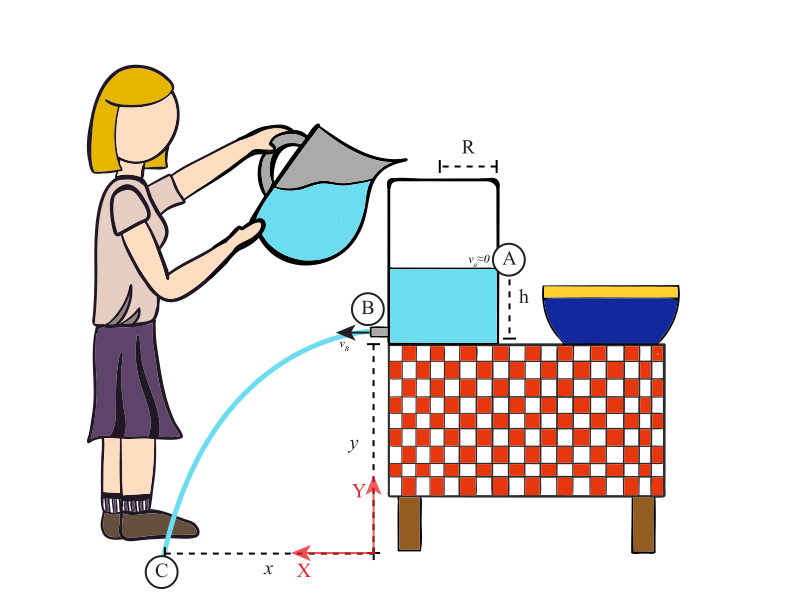
Figure 1: Jug partially filled with water. Some of the water pours out at point B. Point A is the free surface of the water, which is static since Loren fills the tank at the same rate at which water pours out. The water describes a parabolic trajectory from B to C traveling a distance \(y\) along the Y-axis and \(x\) along the X-axis. The coordinated system is placed on the ground below point B.
Since \(h\) does not change, the velocity in point A is approximately zero \(v_A\approx0\). The pressure at this point in the surface of the water is equal to the atmospheric pressure in the room where the jug is, we will call this pressure \(P_0\). At point B, the water pours out of the jug at a certain velocity \(v_B\). The pressure in point B is also the atmospheric pressure because the water coming out of B is surrounded by air at such pressure.
We can now write Bernoulli’s equation between points A and B as
\begin{equation}
\label{bernoulliAB}
P_A+\rho g z_A + \frac{1}{2}\rho v_A^2=P_B+\rho g z_B+\frac{1}{2}\rho v_B^2,
\end{equation}
where \(P_A,\,P_B\) are the pressures at points A and B respectively; \(z_A,\,z_B\) are the heights of points A and B respectively and \(v_A,\,v_B\) are the velocities at points A and B respectively. The Greek letter \(\rho\) is the density of the fluid. If we use the fact that
\begin{equation}
P_A=P_B=P_0,
\end{equation}
we can simplify equation \eqref{bernoulliAB} to
\begin{equation}
\label{bernoulliAB2}
P_0+\rho g z_A+\frac{1}{2}\rho v_A^2=P_0+\rho g z_B+\frac{1}{2}\rho v_B^2.
\end{equation}
The expression in \eqref{bernoulliAB2} can be further simplified to
\begin{equation}
\label{bernoulliAB3}
\rho g z_A+\frac{1}{2}\rho v_A^2=\rho g z_B +\frac{1}{2}\rho v_B^2.
\end{equation}
Now, if we use our assumption that \(v_A\approx0\) then equation \eqref{bernoulliAB3} becomes
\begin{equation}
\label{bernoulliAB4}
\rho g z_A=\rho g z_B+\frac{1}{2}\rho v_B^2.
\end{equation}
In figure 1, our frame of reference is located on the floor; then the heights of points A and B will be
\begin{equation}
\label{za}
z_A=y+h,
\end{equation}
and \begin{equation}
\label{zb}
z_B=y.
\end{equation}
Using the expressions given in equations \eqref{za} ad \eqref{zb} into equation \eqref{bernoulliAB4}, we obtain
\begin{equation}
\label{b5}
\rho g (y+h)=\rho g y +\frac{1}{2}\rho v_B^2,
\end{equation}
where we can solve for \(v_B\) in terms of known variables. Notice from equation \eqref{b5} that \(\rho\) is a common factor in all terms, then we can cancel it out to get
\begin{equation}
\label{b6}
gy+gh=gy+\frac{1}{2}\rho v_B^2,
\end{equation}
where we can also cancel the term \(gy\), the expression in equation \eqref{b6} becomes
\begin{equation}
\label{b7}
gh=\frac{1}{2}v_B^2.
\end{equation}
It is easy now to solve \(v_B\) from equation \eqref{b7} if we multiply both sides by 2 and take the square root in both sides. Explicitly,
\begin{equation}
\label{veloc}
v_B=\sqrt{2gh}.
\end{equation}
Now that we know the velocity at which the water pours out horizontally from point B, we must find \(x\), the horizontal distance that travels the water before it touches the ground. In order to find \(x\), we must use the cinematic equation in the case of zero acceleration for this axis, namely,
\begin{equation}
\label{eqxa0}
\Delta x=v_{0x}t,
\end{equation}
where in our case \(\Delta x=x\) is the distance travelled, \(v_{0x}\) is the initial horizontal velocity, which in our case is given by equation \eqref{veloc} and \(t\) is the time spent on the trajectory. This time is the same time it takes the fluid to fall from a height \(y\) to the ground. Therefore, we can write the equation for the vertical axis as
\begin{equation}
\label{ye}
y_f=y_0+v_{0y}t-\frac{1}{2}gt^2,
\end{equation}
where \(y_f\) is the final position, which is zero (the floor); \(y_0\) is the initial position, that is \(y\); \(v_{0y}\) is the initial vertical velocity, which is zero and \(g\) is the gravitational acceleration. Then equation \eqref{ye} simplifies to
\begin{equation}
\label{ye2}
0=y-\frac{1}{2}gt^2,
\end{equation}
where we can solve for time \(t\), which is the time it takes the water to fall from \(y\) to the floor. We can take the negative in term in \eqref{ye2} to the left-hand side to get
\begin{equation}
\label{ye3}
\frac{1}{2}gt^2=y.
\end{equation}
Multiplying both sides of equation \eqref{ye3} by 2, dividing both sides by \(g\) and taking the square root, we obtain
\begin{equation}
\label{ladetiempo}
t=\sqrt{\frac{2y}{g}}.
\end{equation}
Now we can go back to equation \eqref{eqxa0} and use the results from equation \eqref{veloc} and \eqref{ladetiempo} to obtain
\begin{equation}
x=\left(\sqrt{2gh}\right)\left(\sqrt{\frac{2y}{g}}\right),
\end{equation}
which can be simplified by putting all the terms under the same square root to get
\begin{equation}
x=\sqrt{\frac{4ghy}{g}},
\end{equation}
where we can clearly see that \(g\) cancels out. Finally, we obtain
\begin{equation}
x=\sqrt{4hy}.
\end{equation}
Using the numerical values
\begin{equation}
x=\sqrt{4(0.6\,\text{m})(1.4\,\text{m})}\approx 1.83\,\text{m}.
\end{equation}
b) The last part of the problem inquires about the rate at which the jug must be filled in order for the water level to be constant. We will need to use the conservation of mass relation for fluids. The rate of volume of water per unit time \(\frac{dV}{dt}\) pouring out of the jug can be calculated as
\begin{equation}
\label{caudal}
\frac{dV}{dt}=vA,
\end{equation}
where \(v\) is the velocity of the water that gets out of the jug and \(A\) is the transverse area of the hole from which water pours out. This is the same rate at which Loren must add water to the jug so that the water level is unchanged. We already calculated the velocity \(v\), see equation \eqref{veloc}. The only thing that remains is the transverse area \(A\). We assume from the problem that the hole is circular with a radius \(r=0.8\,\text{cm}=0.008\,\text{m}\), so its transverse area is
\begin{equation}
\label{areacirculo}
A=\pi r^2.
\end{equation}
Putting the results from equations \eqref{veloc} and \eqref{areacirculo} into equation \eqref{caudal}, we finally obtain
\begin{equation}
\frac{dV}{dt}=\sqrt{2gh}\,\pi r^2.
\end{equation}
Which numerically is
\begin{equation}
\frac{dV}{dt}=\sqrt{2(9.8\,\text{m/s}^2)(0.6\,\text{m})}\,\pi (0.008\,\text{m})\approx 0.086\,\text{m}^3\text{/s}.
\end{equation}
Which is the volume of water per second that Loren must add to keep \(h\) constant as water pours out from B.


Leave A Comment