
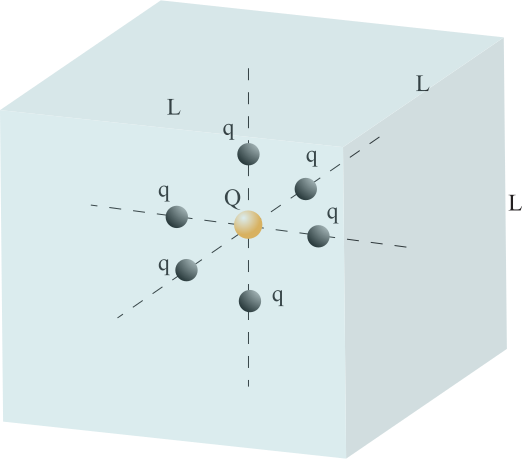
A point charge \(Q = 8 \, \mu \text{C}\) is located at the center of a cube of side \(L = 0.3 \, \text{m}\). Six equal point charges ( \(q = -2 \, \mu \text{C}\) ) are placed symmetrically around \(Q\), as shown in the figure.
a) What is the net electric flux through the cube?
b) What is the electric flux through one face of the cube?
c) What is the electric flux through the cube if one of the charges \(q\) is removed?
d) Following from c), is it possible to calculate the electric flux through one of the faces of the cube using the same methods?
a) By Gauss’ law, the electric flux is obtained directly.
b) Think about the symmetry of the problem.
c) Same hint as in a).
d) The real question is: what about the symmetry?
a) To find the electric flux \(\Phi_E\) through the cube, we use Gauss’ law, as follows:
\begin{equation*}
\Phi_E=\oint_S \vec{E}\cdot d \vec{A}=\frac{Q_\text{enc}}{\epsilon_0},
\end{equation*}
where \(Q_\text{enc} = Q + 6q\). Then, the flux is:
\begin{equation*}
\Phi_E=\frac{Q + 6q}{\epsilon_0},
\end{equation*}
or with numerical values:
\begin{equation}
\Phi_E \approx -4.5\times 10^5\,\text{V m}.
\end{equation}
b) By symmetry:
\begin{equation*}
\Phi_E^{\text{face}}=\frac{\Phi_E}{6}\approx-7.5\times 10^4\,\text{V m}.
\end{equation*}
c) With one charge removed \(Q_\text{enc} = Q + 5q\). Then:
\begin{equation*}
\Phi_E=\frac{Q + 5q}{\epsilon_0},
\end{equation*}
or with numerical values:
\begin{equation}
\Phi_E \approx -2.25\times 10^5\,\text{V m}.
\end{equation}
d) One charge \(q\) removed, then symmetry is lost. Therefore, dividing by the number of faces is no longer valid and the flux could not be calculated just in terms of the enclosed charges. The flux will now depend on the relative position of the charges with respect to each face.
For a more detailed explanation of any of these steps, click on “Detailed Solution”.
To approach this problem, we’ll use Gauss’ law to calculate the flux in each case. Let’s first calculate the flux through the whole cube and then, using the symmetry of the problem, deduce the flux through one of the cube’s faces.
a) To find the electric flux \(\Phi_E\) through the cube, we use Gauss’ law since this law relates the flux through a surface with the charge enclosed by that surface. Gauss’ law states that
\begin{equation}
\label{gausslaw}
\Phi_E=\oint_S \vec{E}\cdot d \vec{A}=\frac{Q_\text{enc}}{\epsilon_0},
\end{equation}
where the integral is taken over the closed Gaussian surface \(S\) (that we need to choose), \(\vec{E}\) is the electric field, \(Q_{\text{enc}}\) is the total charge enclosed by the surface \(S\), and \(\epsilon_0\) is a physical constant called permittivity of free space. Notice from equation \eqref{gausslaw} that in order to calculate the electric flux through a closed surface, all we need to know is the charge enclosed by that surface; hence, we can write Gauss’ law as
\begin{equation}
\label{gausslaw2}
\Phi_E=\frac{Q_{\text{enc}}}{\epsilon_0}.
\end{equation}
For our Gaussian surface we will choose the surface of the cube. Why? Because they ask us for the flux through the cube, and since Gauss’ law relates the flux through a surface with the charge enclosed by the surface, then the quickest way to solve the problem is by using the cube itself as the Gaussian surface (but we do not need to do this, we could also use a different surface such as sphere and check that the total flux is the same as in the cube). Then the charge enclosed by it will be the charge \(Q\) located at the center of the cube and the other six \(q\) charges distributed symmetrically around the cube’s center; explicitly,
\begin{equation}
\label{encq}
Q_\text{enc}=Q+6q.
\end{equation}
Using the result from equation \eqref{encq} into equation \eqref{gausslaw2}, we have our answer
\begin{equation}
\label{fluxa}
\Phi_E=\frac{Q+6q}{\epsilon_0}.
\end{equation}
Using the numerical values, we can calculate the net electric flux through the whole cube from equation \eqref{fluxa}; namely,
\begin{equation}
\Phi_E=\frac{8\,\mu\text{C}+6(-2\,\mu\text{C})}{ 8.854 \times 10^{-12}\, \text{C/V m}},
\end{equation}
which simplifies to
\begin{equation}
\Phi_E=\frac{-4\times 10^{-6}\,\text{C}}{8.854 \times 10^{-12}\, \text{C/V m}}\approx -4.5\times 10^{5}\,\text{V m}.
\end{equation}
The flux is negative, indicating that the electric field lines are directed from the outside of the cube towards the negative charges.
b) To calculate the flux on one of the faces of the cube, we must use a symmetry argument. Notice that the configuration of the charges is symmetrical with respect to the center of the cube. Due to this symmetry, the flux through each face of the cube is the same. It might be useful to see the cube from the perspective of one side, as pictured in figure 1.

Figure 1: Cube from the perspective of one face.
The total flux \(\Phi_E\), calculated in (a) is the sum of the flux through each of the six faces, so
\begin{equation}
\label{fluxface}
\Phi_E=6\Phi_E^{\text{face}},
\end{equation}
where \(6\Phi_E^{\text{face}}\) is the flux of electric field through one face. Solving equation \eqref{fluxface}, we finally obtain
\begin{equation}
\Phi_E^{\text{face}}=\frac{\Phi_E}{6}\approx\frac{-4.5\times 10^5\,\text{V m}}{6}=-7.5\times 10^4\,\text{V m}.
\end{equation}
c) If one of the charges \(q\) is removed, then the charge enclosed by the cubic Gaussian surface will be the charge \(Q\) placed in the center plus 5 \(q\) charges distributed inside the cube; explicitly,
\begin{equation}
\label{qenc2}
Q_{\text{enc}}=Q+5q.
\end{equation}
We can then use equation \eqref{gausslaw} and \eqref{qenc2} to calculate the new electric flux as
\begin{equation}
\Phi_E=\frac{Q+5q}{\epsilon_0}.
\end{equation}
Using the numerical values given in the problem, we obtain
\begin{equation}
\Phi_E=\frac{8\,\mu\text{C}+5(-2\,\mu\text{C})}{ 8.854 \times 10^{-12}\, \text{C/V m}},
\end{equation}
or simplifying and using scientific notation
\begin{equation}
\Phi_E=\frac{-2\times 10^{-6}\,\text{C}}{8.854 \times 10^{-12}\, \text{C/V m}}\approx -2.25\times 10^{5}\,\text{V m}.
\end{equation}
This is again negative, indicating that the flux enters the cube from the outside.
d) If one of the charges \(q\) is removed, the symmetry around the center of the cube is lost. Therefore, equation \eqref{fluxface} is no longer valid and the flux could not be calculated just in terms of the enclosed charges. The flux will now depend on the relative position of the charges with respect to each face.


Leave A Comment