
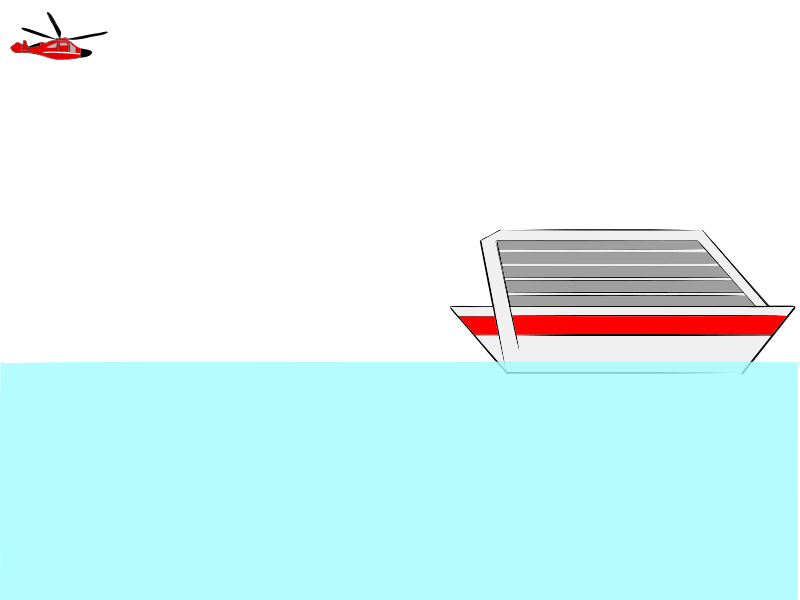
\({SOS!}\) A quarantining cruise ship is in desperate need of supplies, and a helicopter is tasked with dropping off much needed vittles. The helicopter is flying at an altitude 150m above sea level, and traveling horizontally at 100 mph (\(44 \,\text{m}/\text{s}\)). The quarantining cruise that is moving at 22 mph (\(10 \,\text{m}/\text{s}\)) in the same direction as the helicopter, and the ship’s height is 70 m. The helicopter needs drop the care package directly on the deck of the cruise ship, so the pilot needs to know exactly how much distance should be left between the helicopter and the ship when they push the red ejection button. Help the pilot by calculating the necessary distance between the helicopter and the cruise ship to ensure a successful delivery.
If you find the time that it takes the package to fall from a given height, you can use it to find the distance with the equations of motion for objects with constant speed.
The equation of motion for the package and the ship on the horizontal component (X) is:
\begin{equation*}
x=x_i + v_it,
\end{equation*}
where \(x_i=0\) for the package if the coordinate system is placed on top of it. And the equation of motion along Y (with initial velocity zero) is:
\begin{equation*}
y_p=y_i-\frac{1}{2}gt^2.
\end{equation*}
Solving for \(t\), we get:
\begin{equation*}
t=\sqrt{\frac{2(y_i-y_p)}{g}}.
\end{equation*}
Using the equations of motion on X for both the package and the ship and replacing \(t\), we get:
\begin{equation*}
x_{i,s}+v_s\left(\sqrt{\frac{2(y_i-y_p)}{g}}\right)=v_i\left(\sqrt{\frac{2(y_i-y_p)}{g}}\right).
\end{equation*}
Solving for \(x_{i,s}\) and using the numerical values:
\begin{equation}
x_{i,s}=(v_i-v_s)\left(\sqrt{\frac{2(y_i-y_p)}{g}}\right) \approx 137.4\,\text{m}.
\end{equation}
For a more detailed explanation of any of these steps, click on “Detailed Solution”.
We’ve been asked to calculate the horizontal distance between the helicopter and the ship that’s required for a successful drop to take place. In order to solve this problem, we must use the equation for parabolic motion for the package and the equation for constant velocity for the ship. To obtain the equation of motion for the package in the horizontal direction, we’ll use the fact that the initial velocity \(\vec{v}_i\) of the package is the same as the velocity of the helicopter and, thus, only goes along the horizontal axis.
Let’s start by placing a coordinate system at sea level and where the X axis points in the direction of motion for the package and the ship. See figure 1.

Figure 1: We place a coordinate system at sea level. We indicate the horizontal distance \(d\) that we must find.
Now let’s write the equations of motion for the package on the the X and Y axes using the fact that the only acceleration is on the Y axis (this is the gravitational acceleration \(g\)). For the X axis, we have a motion of constant velocity, and so we get
\begin{equation}
x_p\,\hat{\textbf{i}}=x_{i,p}\,\hat{\textbf{i}}+v_it\,\hat{\textbf{i}},
\end{equation}
where \(x_{i,p}\) and \(x_p\) are the initial position of the package and the position after time \(t\), respectively (\(x_p\) is what we need to find to get the distance). If we focus on only the magnitudes, and use the fact that, according to our system, the initial position is zero, we get
\begin{equation}
\label{kinemx}
x_p=v_it.
\end{equation}
Notice that this equation is not sufficient for getting \(x_p\) because we don’t have the time, and so we need to find more equations.
For the Y axis, the package has negative constant acceleration and no initial vertical velocity since the package is simply dropped (instead of being thrown). Hence, we get
\begin{equation}
y_p\,\hat{\textbf{j}}=y_i\,\hat{\textbf{j}}-\frac{1}{2}gt^2\,\hat{\textbf{j}},
\end{equation}
where \(y_i\) and \(y_p\) are the initial position along the Y axis and the position after a time \(t\) has passed, respectively. Focusing on just the magnitudes, we get
\begin{equation}
\label{kinemy}
y_p=y_i-\frac{1}{2}gt^2.
\end{equation}
Solving for the time \(t\) in equation \eqref{kinemy}, we get
\begin{equation}
\frac{1}{2}gt^2=y_i-y_p.
\end{equation}
Then,
\begin{equation}
t^2=\frac{2(y_i-y_p)}{g},
\end{equation}
and taking the square-root on both sides, we finally obtain
\begin{equation}
\label{time}
t=\sqrt{\frac{2(y_i-y_p)}{g}}.
\end{equation}
This is the time that the package takes to get from the helicopter to the ship. Using this expression for the time in equation \eqref{kinemx}, we obtain
\begin{equation}
\label{xp}
x_p=v_i\left(\sqrt{\frac{2(y_i-y_p)}{g}}\right).
\end{equation}
Now let’s write the equation of motion for the ship along the X axis, which is the equation for constant velocity on a straight line:
\begin{equation}
x_s\,\hat{\textbf{i}}=x_{i,s}\,\hat{\textbf{i}}+v_st\,\hat{\textbf{i}},
\end{equation}
where \(v_s\) is the speed of the ship and \(x_{i,s}\) its initial position. If we focus on the magnitudes, we get
\begin{equation}
x_s=x_{i,s}+v_st.
\end{equation}
We’re interested in the position of the ship after the time \(t\) given in equation \eqref{time} has passed. So, using that time here, we obtain the following expression for the position of the ship:
\begin{equation}
\label{xs}
x_s=x_{i,s}+v_s\left(\sqrt{\frac{2(y_i-y_p)}{g}}\right).
\end{equation}
The condition for a successful drop is that the positions along X and Y are the same for both the package and the ship. This means that
\begin{equation}
x_s=x_p,
\end{equation}
which, after using the explicit expressions for the positions given by equations \eqref{xp} and \eqref{xs}, reads
\begin{equation}
\label{igualdad}
x_{i,s}+v_s\left(\sqrt{\frac{2(y_i-y_p)}{g}}\right)=v_i\left(\sqrt{\frac{2(y_i-y_p)}{g}}\right).
\end{equation}
Notice that according to the coordinate system, \(y_i=150\,\text{m}\) and the final position of the package is \(y_p=70\,\text{m}\), which is the height of the deck of the ship. From this coordinate system, we also get that \(x_{i,s}=d\) (the ship is initially at a horizontal distance \(d\) from the package).
Thus, we can simplify equation \eqref{igualdad} and write it in terms of \(d\), our unknown variable, as
\begin{equation}
d+v_s\left(\sqrt{\frac{2(y_i-y_p)}{g}}\right)=v_i\left(\sqrt{\frac{2(y_i-y_p)}{g}}\right).
\end{equation}
We can solve for \(d\) in this equation to get
\begin{equation}
d=v_i\left(\sqrt{\frac{2(y_i-y_p)}{g}}\right)-v_s\left(\sqrt{\frac{2(y_i-y_p)}{g}}\right).
\end{equation}
If we factorize the term within parenthesis, this becomes
\begin{equation}
d=(v_i-v_s)\left(\sqrt{\frac{2(y_i-y_p)}{g}}\right).
\end{equation}
Using the numerical values, we then get
\begin{equation}
d=(44\,\text{m/s}-10\,\text{m/s})\left(\sqrt{\frac{2(150\,\text{m}-70\,\text{m})}{9.8\,\text{m/s}^2}}\right),
\end{equation}
which is
\begin{equation}
d\approx 137.4\,\text{m}.
\end{equation}



Leave A Comment