
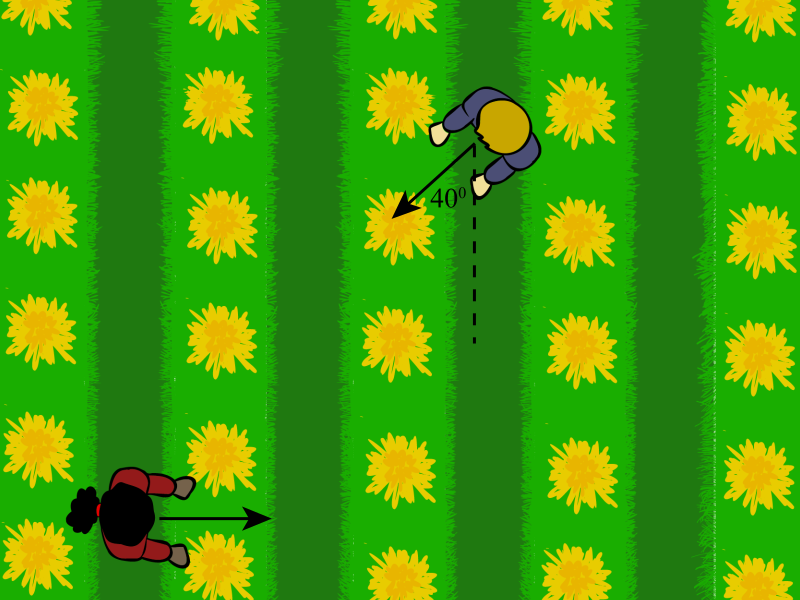
In dramatic fashion, Mary and Don are running toward one another in a cornfield. Mary runs with a speed of \(1 \,\text{m}/\text{s}\), and Don with a speed of \(3 \,\text{m}/\text{s}\), in the directions shown in the figure.
a) Calculate Mary’s velocity relative to Don.
b) Calculate Don’s velocity relative to Mary.
(a) Place a coordinate system and decompose by components Don’s velocity. Then apply relative velocity equations.
(b) The previous result is similar to the one that you’re looking for in this part of the answer, but be careful with the orientation.
(a) To calculate Mary’s velocity relative to Don, let’s use the following equation:
\begin{equation*}
\vec{v}_{M/D}=\vec{v}_{M/G}-\vec{v}_{D/G},
\end{equation*}
where \(M/D\) is Mary’s velocity relative to Don, \(M/G\) and \(D/G\) Mary’s velocity and Don’s velocity respectively, relative to the ground.
Don’s equation can be written with its components as:
\begin{equation*}
\vec{v}_{D/G}=-{v}_{{D/G}_x}\,\hat{\textbf{i}}-{v}_{{D/G}_y}\,\hat{\textbf{j}}.
\end{equation*}
Setting a coordinate system such that:
\begin{equation*}
\vec{v}_{M/G}=1\,\text{m/s}\,\hat{\textbf{i}},
\end{equation*}
then we get:
\begin{equation*}
\vec{v}_{M/D}\approx 2.93\,\text{m/s}\,\hat{\textbf{i}}+2.30\,\text{m/s}\,\hat{\textbf{j}}.
\end{equation*}
(b) The result is the same as the previous one that we found but with negative sign:
\begin{equation*}
\vec{v}_{D/M}\approx -2.93\,\text{m/s}\,\hat{\textbf{i}}-2.30\,\text{m/s}\,\hat{\textbf{j}}.
\end{equation*}
For a more detailed explanation of any of these steps, click on “Detailed Solution”.
a) To calculate Mary’s velocity relative to Don, we must find an expression relating this velocity to the velocity of Mary and Don with respect to the ground. In general, the relative velocity between two objects A and B is given by the difference between A’s and B’s velocity with respect to the ground:
\begin{equation}
\vec{v}_{A/B}=\vec{v}_{A/G}-\vec{v}_{B/G},
\end{equation}
where \(\vec{v}_{A/B}\) is the velocity of A relative to B, \(\vec{v}_{A/G}\) is the velocity of A relative to the ground, and \(\vec{v}_{B/G}\) is B’s velocity relative to the ground. Let’s apply this equation for the case of Mary and Don:
\begin{equation}
\label{relative1}
\vec{v}_{M/D}=\vec{v}_{M/G}-\vec{v}_{D/G}.
\end{equation}
where \(\vec{v}_{M/D}\) is the velocity of Mary relative to Don, \(\vec{v}_{M/G}\) is the velocity of Mary relative to the ground, and \(\vec{v}_{D/G}\) is Don’s velocity relative to the ground.
Now let’s find an explicit expression for the the velocity of Mary and Don with respect to the ground. To do that, let’s start by placing a coordinate system, as shown in the next figure:

Figure 1: Coordinate system
According to our coordinate system placed in the ground, Mary moves along the X axis:
\begin{equation}
\label{vmg1}
\vec{v}_{M/G}={v}_{M/G}\,\hat{\textbf{i}}=1\,\text{m/s}\,\hat{\textbf{i}},
\end{equation}
where we used the fact that her speed with respect to the ground is one meter per second.
On the other hand, Don moves along both the negative X and the negative Y axes. So, we can write Don’s total velocity in terms of components, like this:
\begin{equation}
\label{vdg2}
\vec{v}_{D/G}=-{v}_{{D/G}_x}\,\hat{\textbf{i}}-{v}_{{D/G}_y}\,\hat{\textbf{j}}.
\end{equation}
Now, using some basic trigonometric, we can write the X component and the Y component in terms of the \(40^{\circ}\) angle and Don’s total speed. In particular, we find that
\begin{equation}
\label{vdg}
\vec{v}_{D/G}=-(3\,\text{m/s})\sin(40^{\circ})\,\hat{\textbf{i}}-(3\,\text{m/s})\cos(40^{\circ})\,\hat{\textbf{j}},
\end{equation}
where we used the fact that his speed is \(3\,\text{m/s}\).
Using the explicit expressions for the velocities given by equations \eqref{vmg1} and \eqref{vdg} into equation \eqref{relative1}, we obtain
\begin{equation}
\vec{v}_{M/D}=\left(1\,\text{m/s}\,\hat{\textbf{i}}\right)-\left(-(3\,\text{m/s})\sin(40^{\circ})\,\hat{\textbf{i}}-(3\,\text{m/s})\cos(40^{\circ})\,\hat{\textbf{j}}\right),
\end{equation}
\begin{equation}
\vec{v}_{M/D}\approx 2.93\,\text{m/s}\,\hat{\textbf{i}}+2.30\,\text{m/s}\,\hat{\textbf{j}}.
\end{equation}
b) Don’s velocity relative to Mary can be found in the exact same way, using equation \(\vec{v}_{A/B}=\vec{v}_{A/G}-\vec{v}_{B/G},\). But now the order of the variables is the opposite one because we want the difference between Don’s velocity relative to the ground and Mary’s velocity relative to the ground:
\begin{equation}
\label{relative2}
\vec{v}_{D/M}=\vec{v}_{D/G}-\vec{v}_{M/G}.
\end{equation}
The good thing is that we don’t need to calculate this because it’s just the same as \((\vec{v}_{M/G}-\vec{v}_{D/G})\), which we found earlier, except that it has a negative sign:
\begin{equation}
\label{relative3}
\vec{v}_{D/M}=\vec{v}_{D/G}-\vec{v}_{M/G}=-(\vec{v}_{M/G}-\vec{v}_{D/G}).
\end{equation}
Hence, we get
\begin{equation}
\vec{v}_{D/M}\approx -2.93\,\text{m/s}\,\hat{\textbf{i}}-2.30\,\text{m/s}\,\hat{\textbf{j}}.
\end{equation}
This is always true: the relative velocity of A with respect to B is the same as the relative velocity of B with respect to A with a minus sign.


Leave A Comment