
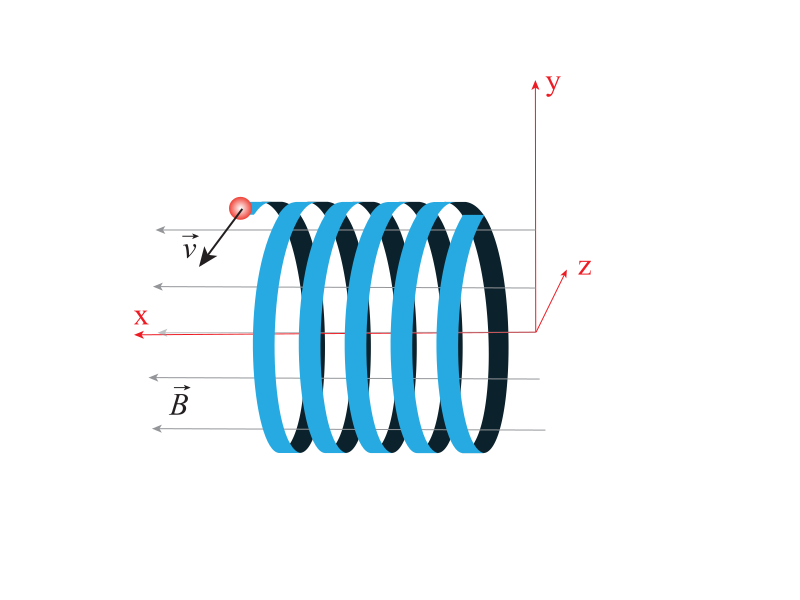
At time \(t = 0\), a proton has velocity \(\vec{v} = 1.8 \times 10^5 \, \text{m/s} \, \hat{\textbf{i}} + 2.4 \times 10^5 \, \text{m/s} \, \hat{\textbf{j}} \) and enters a region of magnetic field \(\vec{B} = 0.6 \, \text{T} \, \hat{\textbf{i}}\). Ignoring the effects of gravity, calculate at \(t = 0\):
a) The force on the proton.
b) The acceleration of the proton.
c) The radius of the resulting helical path.
d) The angular speed of the proton.
e) The distance traveled along the axis perpendicular to the helical plane after each revolution.
a) The definition of the magnetic force can be used to find the answer.
b) Use Newton’s Second Law to solve for the acceleration.
c) Use a circular motion equation to relate the radius to the centripetal acceleration.
d) The velocity and the radius are known variables, so the angular velocity can be easily obtained.
e) Find the time required to make one full revolution. Using one component of the velocity, the distance can then be found.
a) The magnetic force is:
\begin{equation*}
\vec{F}=q\vec{v}\times\vec{B}.
\end{equation*}
Plugging in the numerical values, and performing the cross product with the unitary vectors, we obtain:
\begin{equation*}
\vec{F}=-2.31\times 10^{-14}\,\text{N}\,\hat{\textbf{k}}.
\end{equation*}
b) Using Newton’s Second Law, we have:
\begin{equation*}
\sum\vec{F}=m\vec{a},
\end{equation*}
which, with numerical values, yields:
\begin{equation*}
\vec{a} \approx -1.38\times 10^{13}\,\text{m/s}^2\,\hat{\textbf{k}}.
\end{equation*}
c) The centripetal acceleration is:
\begin{equation*}
a_c= \frac{v^2}{R},
\end{equation*}
where solving for \(R\), and plugging in numerical values, we get:
\begin{equation*}
R \approx 4.2\times 10^{-3}\,\text{m}.
\end{equation*}
d) The angular velocity is:
\begin{equation*}
\omega=\frac{v}{R},
\end{equation*}
which, in our case, is equal to:
\begin{equation*}
\omega \approx5.7\times 10^{7}\,\text{rad/s}.
\end{equation*}
e) The period, in terms of the angular speed, is:
\begin{equation*}
T=\frac{2\pi}{\omega}.
\end{equation*}
The distance is simply the speed multiplied by the time, which is:
\begin{equation*}
\Delta x=v_xt.
\end{equation*}
The time is the period that was previously solved. The distance, numerically, then is:
\begin{equation*}
\Delta x \approx0.02\,\text{m}.
\end{equation*}
For a more detailed explanation of any of these steps, click on “Detailed Solution”.
a) The force exerted on the proton \(\vec{F}\) due to the magnetic field at \(t=0\) can be calculated using the expression for the Lorentz force (in the absence of an electric field), namely,
\begin{equation}
\label{force}
\vec{F}=q\vec{v}\times\vec{B},
\end{equation}
where \(q\) is the charge of the particle, \(\vec{v}\) is the velocity at \(t=0\) and \(\vec{B}\) is the magnetic field. In our case, the particle is a proton with charge \(q=e\approx 1.602\times 10^{-19}\,\text{C}\). Since the prompt already gave us all the variables we need in order to calculate this force, we have that
\begin{equation}
\vec{F}=1.602\times 10^{-19}\,\text{C} (1.8\times 10^5\,\text{m/s}\,\hat{\textbf{i}}+2.4\times 10^5\,\text{m/s}\,\hat{\textbf{j}})\times(0.6\,\text{T}\,\hat{\textbf{i}}).
\end{equation}
Distribute the parentheses, to get the following two terms
\begin{equation}
\label{forceB}
\vec{F}\approx (1.73\times 10^{-14}\,\text{N})\,\hat{\text{i}}\times\hat{\textbf{i}}+(2.31\times10^{-14}\,\text{N})\,\hat{\textbf{j}}\times\hat{\textbf{i}}.
\end{equation}
Now we use that the cross product between parallel vectors is always zero, that is,
\begin{equation}
\label{ii}
\hat{\textbf{i}}\times\hat{\textbf{i}}=0.
\end{equation}
The cross product between two different unitary Cartesian vectors is always another unitary Cartesian vector, namely
\begin{equation}
\label{ji}
\hat{\textbf{j}}\times\hat{\textbf{i}}=-\hat{\textbf{k}},
\end{equation}
where the minus sign comes from the right-hand rule, as illustrated here

We use the right-hand rule to find that \(\hat{\textbf{j}}\times\hat{\textbf{i}}=-\hat{\textbf{k}}\).
Using the results from \eqref{ii} and \eqref{ji} into \eqref{forceB}, we obtain our answer:
\begin{equation}
\label{resulta}
\vec{F}=-2.31\times 10^{-14}\,\text{N}\,\hat{\textbf{k}}.
\end{equation}
b) The acceleration of the proton can be found using Newton’s second law,
\begin{equation}
\label{secondlaw}
\sum\vec{F}=m\vec{a},
\end{equation}
where \(\sum \vec{F}\) is the sum of all forces acting on the proton, \(m\) is the mass of the proton and \(\vec{a}\) is the acceleration of the proton. Solving for \(\vec{a}\), we find
\begin{equation}
\vec{a}=\frac{\sum\vec{F}}{m}
\end{equation}
Since the mass of the proton is extremely low, we can ignore the effects of gravity and so the only relevant force acting on the proton is the one due to the magnetic field. Then, using our result from equation \eqref{resulta} and the numerical value for the mass of the proton \(m_p=1.67\times 10^{-27}\,\text{kg}\), we find
\begin{equation}
\label{resultb}
\vec{a}=\frac{-2.31\times 10^{-14}\,\text{N}\,\hat{\textbf{k}}}{1.67\times 10^{-27}\,\text{kg}}\approx -1.38\times 10^{13}\,\text{m/s}^2\,\hat{\textbf{k}}.
\end{equation}
c) In order to find the radius of the elliptical path, we must first make a free body diagram of the proton. As we have seen before, the only relevant force is the one due to the magnetic field. This force generate an acceleration that affects only the direction of the velocity, not its magnitude (it does not affect the magnitude because the force is perpendicular to the velocity due to the cross product). Indeed, the acceleration is always directed towards the center of the helical path, as shown here:

On the left we have the original drawing. On the right we see the trajectory from the perspective of the YZ plane. We use the right-hand rule to show that the magnetic force always points towards the center of the circle (it is perpendicular to both \(v_\perp\) and the magnetic field \(\vec{B}\)).
To better appreciate that the force is always radially inwards, let us consider three arbitrary points, shown in the following picture
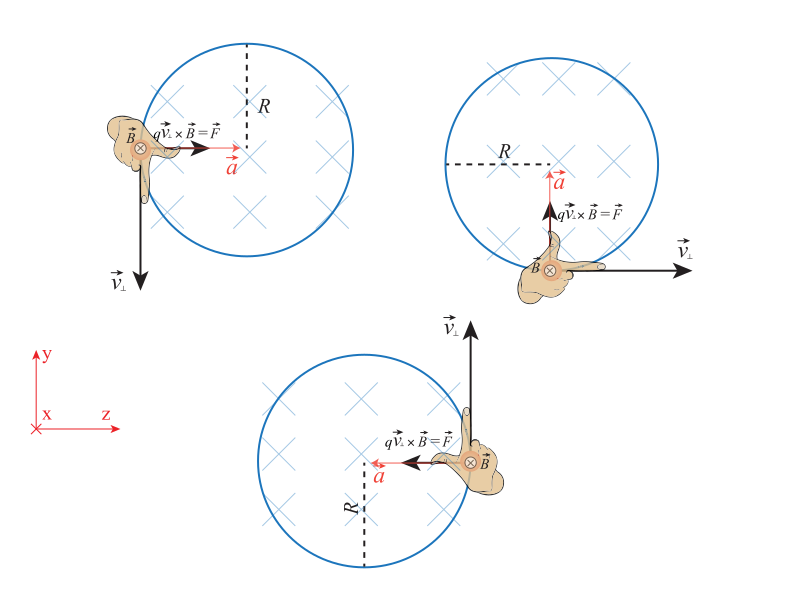
Diagram showing different points in the particle’s trajectory from the YZ plane perspective. The force always points radially inwards.
The component of the velocity affected by the acceleration is the one perpendicular to the magnetic field \(v_\perp\) in the previous figure. Focusing on just the YZ plane, the particle follows a circular path, and so we can use the definition for the centripetal acceleration in terms of the speed and the radius:
\begin{equation}
\label{acentr}
a_c= \frac{v^2}{R},
\end{equation}
where \(a_c\) is the magnitude of the centripetal acceleration, which can be calculated by considering the magnitude of equation \eqref{resultb}. The variable \(v\) is the magnitude of the tangential velocity relative to the circular motion. In our case this is \(v_\perp\), which at \(t=0\) points along the Y axis, as seen in the second figure. Solving for \(R\) in equation \eqref{acentr}, we get
\begin{equation}
R=\frac{v_\perp^2}{a_c}.
\end{equation}
Using the numerical values for \(a_c\) and \(v_\perp\), we finally obtain
\begin{equation}
R=\frac{(2.4 \times 10^5 \, \text{m/s})^2}{1.38\times 10^{13}\,\text{m/s}^2}\approx 4.2\times 10^{-3}\,\text{m}.
\end{equation}
d) Since we already have the tangential velocity and the radius of the circular motion, we can easily calculate its angular speed \(\omega\) using the relation
\begin{equation}
\omega=\frac{v}{R},
\end{equation}
which in our case is equal to
\begin{equation}
\omega\approx\frac{2.4 \times 10^5 \, \text{m/s}}{4.2\times 10^{-3}\,\text{m}}\approx5.7\times 10^{7}\,\text{rad/s}.
\end{equation}
e) Finally, to find the distance travelled along the X axis as one revolution occurs, we must first find the time it takes to make a revolution. This time is the period of the circular motion, and it is related to the angular speed through the following equation
\begin{equation}
\label{period}
T=\frac{2\pi}{\omega}.
\end{equation}
Since we want to calculate the distance traveled along the X axis \(\Delta x\), and there is no acceleration along this axis, we know from kinematics that the distance is just the speed times the time, that is
\begin{equation}
\label{cinematica}
\Delta x=v_xt.
\end{equation}
In our case, the velocity along the X axis is the one which is parallel to the magnetic field, that is \(v_\parallel\). The time we will use in equation \eqref{cinematica} is the period \(T\). Then, using the expression for the period given by equation \eqref{period} in equation \eqref{cinematica}, we obtain
\begin{equation}
\Delta x=v_\parallel \frac{2\pi}{\omega}.
\end{equation}
Using the numerical values, we finally get
\begin{equation}
\Delta x=(1.8\times 10^5\,\text{m/s})\frac{2\pi}{5.7\times 10^7\,\text{rad/s}}\approx0.02\,\text{m}.
\end{equation}

Leave A Comment