
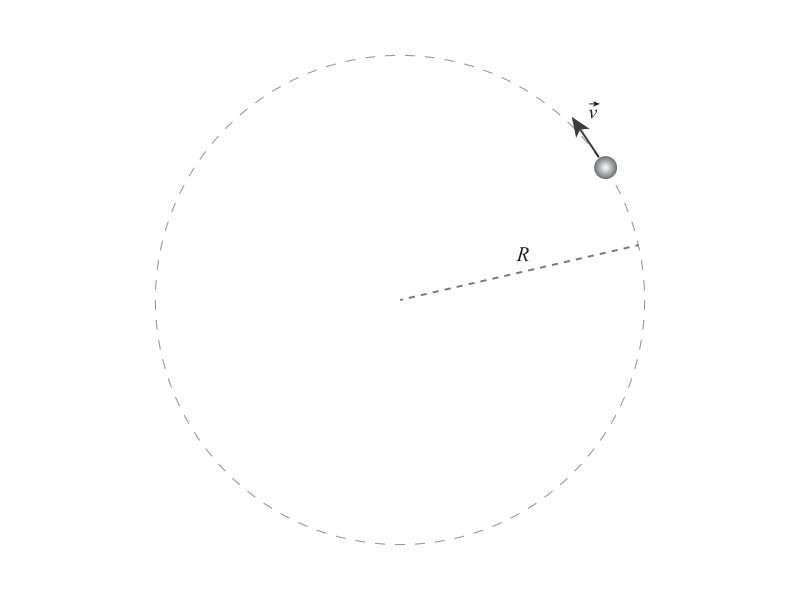
An electron is moving in a circular orbit with radius \(4.7 \times 10^{-10} \, \text{m} \) at a constant speed of \(3.2 \times 10^{6} \, \text{m/s}\).
a) What is the orbital period of the electron?
b) Consider the orbiting electron as a current loop. What is the current?
c) What is the magnetic moment of the electron?
a) Use the circular motion equation which relates velocity and radius to solve for the period.
b) Use the definition of current that relates current to charge.
c) Use the magnetic moment equation. (The dimensions are already known.)
a) The velocity for circular motion, in terms of the period and the radius of the trajectory, is:
\begin{equation*}
v=\frac{2\pi R}{T}.
\end{equation*}
Solving for \(T\), and plugging in numerical values, we get:
\begin{equation*}
T\approx 9.23\times 10^{-16}\,\text{s}.
\end{equation*}
b) The current can be written as:
\begin{equation*}
I\approx \frac{e}{T}.
\end{equation*}
which, with numerical values, gives:
\begin{equation*}
I\approx 1.74 \times 10^{-4} \, \text{A}.
\end{equation*}
c) The magnetic moment is:
\begin{equation*}
\vec{\mu}=IA\,\hat{\textbf{n}},
\end{equation*}
which can be rewritten with dimension to be:
\begin{equation*}
\vec{\mu}=I \pi R \,\hat{\textbf{k}},
\end{equation*}
Plugging in numerical values, we get:
\begin{equation*}
\vec{\mu}\approx 1.2\times 10^{-22}\,\text{A m}^2\,\hat{\textbf{k}}.
\end{equation*}
For a more detailed explanation of any of these steps, click on “Detailed Solution”.
a) We need to calculate the orbital period of the electron. Notice that as the electron moves in circles, its speed does not change throughout the trajectory (there is no tangential acceleration because the speed is constant). Hence, the only acceleration is centripetal. In this case, the tangential speed \(v\) can be written as the ratio of the distance traveled over time. So, if the distance is the perimeter of the circular path, the time will be the orbital period \(T\), and so we can write
\begin{equation}
\label{vrt}
v=\frac{2\pi R}{T},
\end{equation}
where \(R\) is the radius of the orbit. Solving for \(T\), we get
\begin{equation}
T=\frac{2\pi R}{V},
\end{equation}
which numerically yields
\begin{equation}
T=\frac{2\pi (4.7\times 10^{-10}\,\text{m})}{3.2\times10^{6}\,\text{m/s}},
\end{equation}
\begin{equation}
T\approx 9.23\times 10^{-16}\,\text{s}.
\end{equation}
b) Consider the electron to be a current loop. In that case, we should use the definition of electric current \(I\) in terms of charge \(q\) and time \(t\) as
\begin{equation}
I=\frac{dq}{dt}.
\end{equation}
In its approximate form (for small intervals), this can be written as
\begin{equation}
\label{current}
I\approx \frac{\Delta q}{\Delta t},
\end{equation}
where in this case we interpret the current as the amount of charge \(\Delta q\) that passes through a point in space every \(\Delta t\) amount of time. In our case, the amount of charge is the charge of the electron \(e\), and it passes through the same point after an interval of time \(\Delta t=T\) (the period) passes. Using these results in equation \eqref{current}, we get
\begin{equation}
I\approx \frac{e}{T}.
\end{equation}
Numerically, this is
\begin{equation}
I\approx \frac{1.602\times 10^{-19}\,\text{C}}{9.23\times 10^{-16}\,\text{s}},
\end{equation}
\begin{equation}
I\approx {1.74\times 10^{-4}\,\text{A}}.
\end{equation}
c) To calculate the magnetic moment \(\vec{\mu}\) of the electron for its circular path, we must recall the definition of \(\vec{\mu}\):
\begin{equation}
\label{momamg}
\vec{\mu}=IA\,\hat{\textbf{n}},
\end{equation}
where \(I\) is the current passing through the loop, \(A\) is the area enclosed by the loop and \(\hat{\textbf{n}}\) is a unitary vector which is normal to the area \(A\) and whose direction is given by the right-hand rule. If we close our fingers on the right hand along the direction of the current, the thumb will point upwards. This means that \(\hat{\textbf{n}}\) is \(\hat{\textbf{k}}\), as seen in figure 1.

Figure 1: We use the right-hand rule to find the direction of the unitary vector \(\hat{\textbf{n}}\), and thus the magnetic moment vector \(\vec{\mu}\). The fingers, except for the thumb, close in the same direction as the current. The thumb then points in the direction of \(\vec{\mu}\). On the left: a view from above where the direction of \(\hat{\textbf{n}}\) is along the positive Z-axis. On the right: a view showing the direction of all vectors involved along all the axes.
The area enclosed by the loop is the area of a circle of radius \(R\), that is, \(A=\pi R^2\). Using this and the fact that (\hat{\textbf{n}}\) is \(\hat{\textbf{k}}\) in equation \eqref{momamg}, we can then write
\begin{equation}
\vec{\mu}=I \pi R^2 \,\hat{\textbf{k}}.
\end{equation}
Putting in the numerical values for the different variables, we get
\begin{equation}
\vec{\mu}= (1.74\times 10^{-4}\,\text{A}) \pi (4.7\times 10^{-10}\,\text{m})^2\,\hat{\textbf{k}},
\end{equation}
\begin{equation}
\vec{\mu}\approx 1.2\times 10^{-22}\,\text{A m}^2\,\hat{\textbf{k}}.
\end{equation}

Leave A Comment