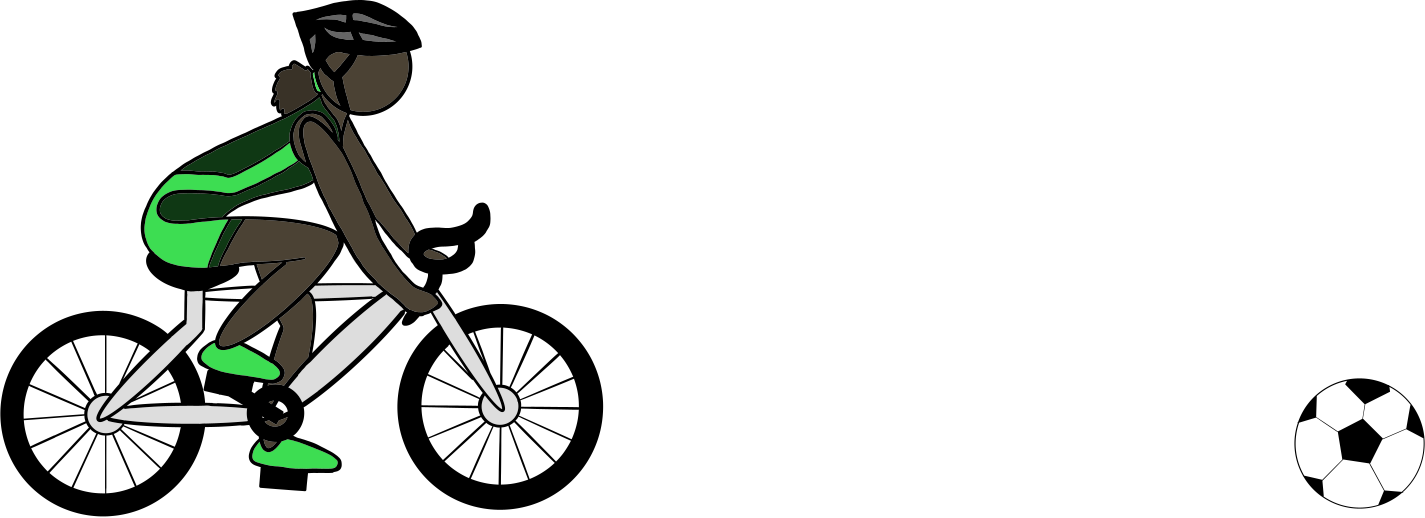
A cyclist rides with a constant speed of 20 m/s along a narrow path. A soccer ball is moving ahead in the same direction with a constant speed of 3 m/s. When the cyclist sees the soccer ball, she starts braking in a constant manner. After traveling 20 meters, she is just behind the soccer ball and both have the same speed.
(a) How much time passed from the moment she started braking until the moment she reached the soccer ball?
(b) Make a qualitative plot of position vs time for the cyclist and the soccer ball (a single plot for both).

-------------------------------------------------------------------------------------------------------------------------------------------------------------------------------------------------

Select all of the known variables

Question 1 of 4

(a) The cyclist reaches the soccer ball after traveling 20 meters, and so the time at which the cyclist reaches the soccer ball (which is what we need to find) is equivalent to the time at which the cyclist travels 20 meters. And to find this time, we need to find her equation of motion.

In order to write the equation of motion, let's start by choosing a coordinate system. We will use one where the origin is at the location of the cyclist at the moment she starts braking, and where the positive X axis points in the direction in which she is moving.

Figure 1: Coordinate system for the problem.

They tell us that the cyclist starts braking in a constant manner. This means that she follows a ...

Question 2 of 4

so her equation of motion is of the form:

\begin{equation}
\vec{x}_f = \frac{1}{2} \vec{a} t^2 + \vec{v}_i t + \vec{x}_i,
\end{equation}

where \(\vec{x}_f\) is the final position, \(\vec{x}_i\) is the initial position, \(\vec{v}_i\) the initial velocity, \(a\) the acceleration and \(t\) the time. In the present context, according to our coordinate system, the acceleration is negative because the cyclists is braking, the initial velocity is positive in X, the final position is positive in X and the initial position is zero. So, the equation of motion for the cyclist is

Question 3 of 4

(b) In order to make a plot of position vs time for both objects, we need to consider their equations of motion again. Recall that the equation of motion for the cyclists is

\begin{equation}
\label{Cyclist_xfGeneral2}
x_{fc} = - \frac{1}{2} a t^2 + v_{i} t.
\end{equation}

This is the equation of a parabola that opens downwards because of the minus sign in front of \(1/2\). When \(t=0\), we get \(x_{fc} = 0\), thus the parabola starts at the origin. Also, at \(t=0\) there is some initial positive velocity, and so the parabola has to start going 'up' instead of going immediately 'down'. Putting all these things together, for the cyclist we get (we plot four seconds): Look at equation \eqref{Cyclist_aceleracionNegativaConGorro}

Question 4 of 4