
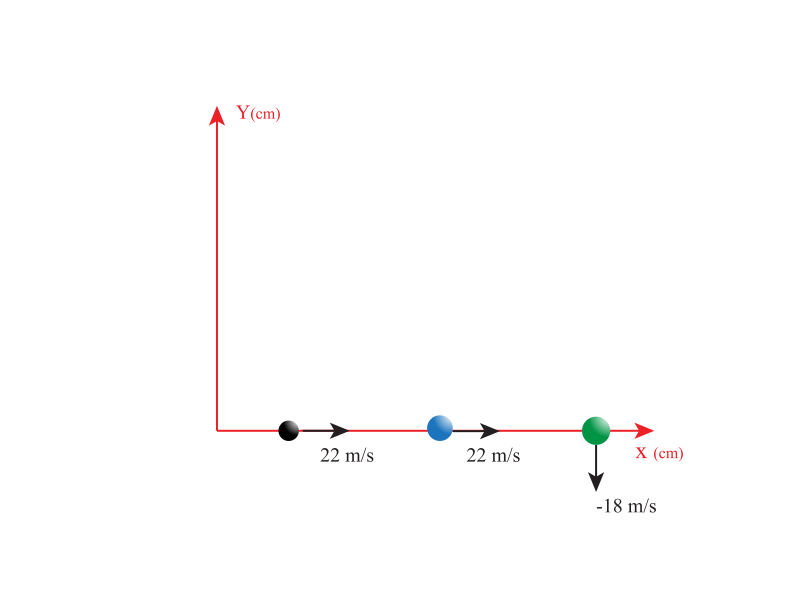
Three spheres with masses of 4 kg, 7 kg and 13 kg are located at x = 5 cm, x = 16 cm and x = 22 cm, respectively. The 4 kg and 7 kg spheres have a velocity of 22 m/s \( \hat{\textbf{i}}\), while the velocity of the 13 kg sphere is -18 m/s \( \hat{\textbf{j}}\).
a) Find the total kinetic energy of the system.
b) Find the speed of the system’s center of mass.
c) Find the kinetic energy of the system’s center of mass.
d) Calculate the kinetic energy of the objects with respect to the coordinate system located at the center of mass of the system.
e) Add the kinetic energy of the objects calculated in (d) with the kinetic energy of the center of mass and compare it with the result in (a).
f) Show that this result can be generalized.
a) Apply the definition of kinetic energy to each object.
b) Apply the definition of velocity to each object’s center of mass.
c) Use the definition of kinetic energy, and use the result found in part (b) to find the velocity of the center of mass.
d) Note that the difference between the velocity of each particle and the velocity of the center of mass is the relative velocity for each particle. Given these relative velocities, find the kinetic energy of the system.
e) Sum the two kinetic energies found.
f) Using the definition of the dot product, write the velocity as a dot product with itself, and then relate the obtained relationship to the kinetic energy of the system. (You may need to multiply both sides by a constant to get the kinetic energy.)
a) The total energy is the sum of the energies of all the particles.
\begin{equation*}
K_{\text{tot}} = \sum_i \frac{1}{2} m_i v_i^2.
\end{equation*}
Plugging in numerical values, we have:
\begin{equation*}
K_{\text{tot}} = 4768 \, \text{J}.
\end{equation*}
b) The velocity of the center of mass is:
\begin{equation*}
\vec{v}_\text{cm}=\frac{\sum_i m_i \vec{v}_i}{\sum_i m_i},
\end{equation*}
which, in this case, results in:
\begin{equation*}
\vec{v}_\text{cm}=\frac{121}{12}\,\text{m/s}\,\hat{\textbf{i}}-\frac{39}{4}\,\text{m/s}\,\hat{\textbf{j}}.
\end{equation*}
c) The magnitude of the velocity at the center of mass found in part (b) is:
\begin{equation*}
\vec{v}_\text{cm}=\sqrt{\frac{14165}{72}} \, \text{m/s}.
\end{equation*}
The kinetic energy at the center of mass is:
\begin{equation*}
K_{\text{cm}} = \frac{1}{2} \left( \sum_i m_i \right) v_{\text{cm}}^2,
\end{equation*}
which, with numerical values, is:
\begin{equation*}
K_{\text{cm}} \approx 2361 \, \text{J}.
\end{equation*}
d) For each particle, the velocity relative to the center of mass will be:
\begin{equation*}
\vec{v}’ = \vec{v} – \vec{v}_{\text{cm}}.
\end{equation*}
The relative kinetic energy is:
\begin{equation*}
K_{\text{rel}} = \frac{1}{2} m_1 v_1’^2 + \frac{1}{2} m_2 v_2’^2 + \frac{1}{2} m_3 v_3’^2
\end{equation*}
Plugging in numerical values, we get:
\begin{equation*}
K_{\text{rel}} \approx 2407 \, \text{J}.
\end{equation*}
e) The sum of the two kinetic energies is:
\begin{equation*}
K_{\text{cm}} + K_{\text{cm}} = 4768 \, \text{J},
\end{equation*}
which is the same as the sum found in part (a).
f) The velocity is:
\begin{equation*}
\vec{v}=\vec{v}’+\vec{v}_{\text{cm}}.
\end{equation*}
The dot product of the last vector with itself can be written as:
\begin{equation*}
v_i^2=v_i’^2+2\vec{v}’_i\cdot\vec{v}_{\text{cm}}+v_\text{cm}^2.
\end{equation*}
Multiplying all the factors in the equation above by \(\frac{1}{2}m_i\), we get:
\begin{equation*}
\frac{1}{2}m_iv_i^2=\frac{1}{2}m_iv_i’^2+m_i\vec{v}’_i\cdot\vec{v}_{\text{cm}}+\frac{1}{2}m_iv_\text{cm}^2.
\end{equation*}
Summing all the particles in the expression above, we get the expression for the kinetic energies. This can be written as:
\begin{equation*}
K_\text{tot}=K_{\text{rel}}+ \sum_im_i\vec{v}_i\cdot\vec{v}_{\text{cm}}+K_{\text{cm}}.
\end{equation*}
Doing some algebra, we can write the middle term as:
\begin{equation*}
\sum_i m_i \vec{v}’_i\cdot\vec{v}_{\text{cm}}=\sum_i m_i\left(\frac{\sum_im_i\vec{v}_i}{\sum_i m_i}-\vec{v}_{\text{cm}}\right)\cdot\vec{v}_{\text{cm}},
\end{equation*}
which is the definition of the velocity at the center of mass in parentheses. Therefore, this middle term is zero. Finally:
\begin{equation*}
K_\text{tot}=K_{\text{rel}}+K_{\text{cm}}.
\end{equation*}
For a more detailed explanation of any of these steps, click on “Detailed Solution”.
a) They’ve asked us to find the total kinetic energy of the system. Due to the spherical symmetry of the objects, we can approximate them to particles that are located at the center of each sphere. Let’s start by establishing the following labels for the spheres that we’ll use throughout the problem: the sphere with mass \(4\,\text{kg}\) is particle 1, the sphere with mass \(7\,\text{kg}\) is particle 2 and the sphere with mass \(13\,\text{kg}\) is particle 3.
The total kinetic energy \(K_{\text{tot}}\) will be the sum of the individual kinetic energies, that is
\begin{equation}
K=\sum_i K_i,
\end{equation}
which, in our particular case, is
\begin{equation}
\label{ktot}
K_{\text{tot}}=K_1+K_2+K_3,
\end{equation}
where the sub-index is used to indicate the kinetic energy of each particle. For a particle of mass \(m\) and speed \(v\), the kinetic energy \(K\) can be written as
\begin{equation}
\label{kinetic}
K=\frac{1}{2}mv^2.
\end{equation}
Using the result above in each term of the the right-hand side of equation \eqref{ktot}, we get
\begin{equation}
\label{defktot}
K_{\text{tot}}=\sum_i\frac{1}{2}m_iv_i^2,
\end{equation}
\begin{equation}
K_{\text{tot}}=\frac{1}{2}m_1v_1^2+\frac{1}{2}m_2v_2^2+\frac{1}{2}m_3v_3^2,
\end{equation}
where \(v_1\) \(v_2\) and \(v_3\) are the speed, that is the magnitude of the velocity vector, of each particle. Using the numerical values, we obtain
\begin{equation}
K_{\text{tot}}=\frac{1}{2}(4\,\text{kg})(22\,\text{m/s})^2+\frac{1}{2}(7\,\text{kg})(22\,\text{m/s})^2+\frac{1}{2}(13\,\text{kg})(18\,\text{m/s})^2,
\end{equation}
\begin{equation}
\label{ktot2}
K_{\text{tot}}= 4768\,\text{J}.
\end{equation}
b) The velocity of the center of mass \(\vec{v}_\text{cm}\) can be calculated according to the following equation
\begin{equation}
\label{defvcm}
\vec{v}_\text{cm}=\frac{\sum_i m_i \vec{v}_i}{\sum_i m_i},
\end{equation}
which, for our case, reduces to
\begin{equation}
\vec{v}_\text{cm}=\frac{m_1\vec{v}_1+m_2\vec{v}_2+m_3\vec{v}_3}{m_1+m_2+m_3}.
\end{equation}
Using the given values
\begin{equation}
\vec{v}_\text{cm}=\frac{(4\,\text{kg})(22\,\text{m/s}\,\hat{
\textbf{i}})+(7\,\text{kg})(22\,\text{m/s}\,\hat{
\textbf{i}})+(13\,\text{kg})(-18\,\text{m/s}\,\hat{
\textbf{j}})}{4\,\text{kg}+7\,\text{kg}+13\,\text{kg}},
\end{equation}
which simplifies to
\begin{equation}
\label{vcm}
\vec{v}_\text{cm}=\frac{121}{12}\,\text{m/s}\,\hat{\textbf{i}}-\frac{39}{4}\,\text{m/s}\,\hat{\textbf{j}}.
\end{equation}
c) The kinetic energy of the center of mass \(K_{\text{cm}}\) can be calculated using the following expression
\begin{equation}
\label{defkcm}
K_{\text{cm}}=\frac{1}{2}\left(\sum_i m_i\right)v_{\text{cm}}^2,
\end{equation}
where \(v_{\text{cm}}\) is the magnitude of the vector \(\vec{v}_{\text{cm}}\). In our particular case of three masses, the expression above becomes
\begin{equation}
\label{kcm}
K_{\text{cm}}=\frac{1}{2}(m_1+m_2+m_3)v_{\text{cm}}^2.
\end{equation}
To calculate the magnitude of the vector \(\vec{v}_{\text{cm}}\), we use the result of equation \eqref{vcm}, namely
\begin{equation}
v_\text{cm}=\sqrt{\left(\frac{121}{12}\,\text{m/s}\right)^2+\left(\frac{39}{4}\,\text{m/s}\right)^2},
\end{equation}
\begin{equation}
v_{\text{cm}}=\sqrt{\frac{14165}{72}}\,\text{m/s}.
\end{equation}
Now we use the numerical result above and the numerical values for the masses to calculate the kinetic energy of the center of mass given in equation \eqref{kcm}
\begin{equation}
K_{\text{cm}}=\frac{1}{2}(4\,\text{kg}+7\,\text{kg}+13\,\text{kg})\left(\sqrt{\frac{14165}{72}}\,\text{m/s}\right)^2,
\end{equation}
which is
\begin{equation}
\label{kcm2}
K_{\text{cm}}=\frac{14165}{6}\,\text{J} \approx 2361 \,\text{J} .
\end{equation}
d) To calculate the kinetic energy of the objects with respect to a coordinate system that moves with the same velocity as the center of mass, we must first calculate their relative velocities with respect to such coordinate system. In order to calculate this relative velocities \(\vec{v}’\), we must use the following relation
\begin{equation}
\label{relative}
\vec{v}’=\vec{v}-\vec{v}_\text{cm}.
\end{equation}
Which, especially in our case, we can calculate the relative velocities for the three particles as follows. For particle 1, we can write, using equation \eqref{relative}
\begin{equation}
\vec{v}_1’=\vec{v}_1-\vec{v}_\text{cm},
\end{equation}
which, after using the given values and the velocity of the center of mass calculated in equation \eqref{vcm}, is
\begin{equation}
\vec{v}_1’=22\,\text{m/s}\,\hat{\textbf{i}}-\left(\frac{121}{12}\,\text{m/s}\,\hat{\textbf{i}}-\frac{39}{4}\,\text{m/s}\,\hat{\textbf{j}}\right),
\end{equation}
\begin{equation}
\vec{v}_1’=\frac{143}{12}\,\text{m/s}\,\hat{\textbf{i}}+\frac{39}{4}\,\text{m/s}\,\hat{\textbf{j}}.
\end{equation}
The magnitude of the relative velocity for particle 1 is
\begin{equation}
v_1’=\sqrt{\left(\frac{143}{12}\,\text{m/s}\right)^2+\left(\frac{39}{4}\,\text{m/s}\right)^2},
\end{equation}
\begin{equation}
\label{v1p}
v_1’=\sqrt{\frac{17069}{72}}\,\text{m/s}.
\end{equation}
For particle 2, we can write, with the help of equation \eqref{relative}
\begin{equation}
\vec{v}_2’=\vec{v}_2-\vec{v}_\text{cm},
\end{equation}
which, after using the given values and the velocity of the center of mass calculated in equation \eqref{vcm}, is
\begin{equation}
\vec{v}_2’=22\,\text{m/s}\,\hat{\textbf{i}}-\left(\frac{121}{12}\,\text{m/s}\,\hat{\textbf{i}}-\frac{39}{4}\,\text{m/s}\,\hat{\textbf{j}}\right),
\end{equation}
\begin{equation}
\vec{v}_2’=\frac{143}{12}\,\text{m/s}\,\hat{\textbf{i}}+\frac{39}{4}\,\text{m/s}\,\hat{\textbf{j}}.
\end{equation}
The magnitude of the relative velocity for particle 2 is
\begin{equation}
v_2’=\sqrt{\left(\frac{143}{12}\,\text{m/s}\right)^2+\left(\frac{39}{4}\,\text{m/s}\right)^2},
\end{equation}
\begin{equation}
\label{v2p}
v_2’=\sqrt{\frac{17069}{72}}\,\text{m/s}.
\end{equation}
For particle 3, we can write, with the help of equation \eqref{relative}
\begin{equation}
\vec{v}_3’=\vec{v}_3-\vec{v}_\text{cm},
\end{equation}
which, after using the given values and the velocity of the center of mass calculated in equation \eqref{vcm}, is
\begin{equation}
\vec{v}_3’=-18\,\text{m/s}\,\hat{\textbf{j}}-\left(\frac{121}{12}\,\text{m/s}\,\hat{\textbf{i}}-\frac{39}{4}\,\text{m/s}\,\hat{\textbf{j}}\right),
\end{equation}
\begin{equation}
\vec{v}_3’=-\frac{121}{12}\,\text{m/s}\,\hat{\textbf{i}}-\frac{33}{4}\,\text{m/s}\,\hat{\textbf{j}}.
\end{equation}
The magnitude of the relative velocity for particle 3 is
\begin{equation}
v_3’=\sqrt{\left(-\frac{121}{12}\,\text{m/s}\right)^2+\left(-\frac{33}{4}\,\text{m/s}\right)^2},
\end{equation}
\begin{equation}
\label{v3p}
v_3’=\sqrt{\frac{12221}{72}}\,\text{m/s}.
\end{equation}
The kinetic energy of the particles with respect to this coordinate system will be
\begin{equation}
\label{defkrel}
K_{\text{rel}}=\sum_i\frac{1}{2}m_iv_i’^2,
\end{equation}
\begin{equation}
K_{\text{rel}}=K_1’+K_2’+K_3′,
\end{equation}
where each term in the right-hand side is calculated according to equation \eqref{kinetic} but using the relative velocity. Therefore, the explicit expression for the kinetic energy with respect to the center of mass coordinate system is
\begin{equation}
K_{\text{rel}}=\frac{1}{2}m_1v_1’^2+\frac{1}{2}m_2v_2’^2+\frac{1}{2}m_3v_3’^2.
\end{equation}
Using the numerical values of equations \eqref{v1p}, \eqref{v2p} and \eqref{v3p} into the equation above, we obtain
\begin{equation*}
K_{\text{rel}}=\frac{1}{2}(4\,\text{kg})\left(\sqrt{\frac{17069}{72}}\,\text{m/s}\right)^2+\frac{1}{2}(7\,\text{kg})\left(\sqrt{\frac{17069}{72}}\,\text{m/s}\right)^2\end{equation*}\begin{equation}+\frac{1}{2}(13\,\text{kg})\left(\sqrt{\frac{12221}{72}}\,\text{m/s}\right)^2,
\end{equation}
\begin{equation}
\label{krel}
K_{\text{rel}}=\frac{14443}{6}\,\text{J} \approx 2407 \,\text{J}.
\end{equation}
e) Adding up the kinetic energy of the center of mass and the kinetic energy of the particles with respect to the center of mass coordinate system, we obtain (using the results of equations \eqref{kcm2} and \eqref{krel})
\begin{equation}
K_{\text{cm}}+K_{\text{rel}}=\frac{14165}{6}\,\text{J}+\frac{14443}{6}\,\text{J},
\end{equation}
\begin{equation}
K_{\text{cm}}+K_{\text{rel}}=4768\,\text{J},
\end{equation}
which is the same as the total kinetic energy given by equation \eqref{ktot2}.
f) We can generalize this result through equation \eqref{relative}, which solving for \(\vec{v}\) is
\begin{equation}
\label{velvec}
\vec{v}=\vec{v}’+\vec{v}_{\text{cm}}.
\end{equation}
Its magnitude can be found in terms of the square-root of the dot product with itself, namely
\begin{equation}
v=\sqrt{\vec{v}\cdot\vec{v}},
\end{equation}
or equivalently
\begin{equation}
\label{vmag2}
v^2=\vec{v}\cdot\vec{v}.
\end{equation}
Using the expression for the velocity vector given in \eqref{velvec} into the equation above, we have
\begin{equation}
v^2=(\vec{v}’+\vec{v}_{\text{cm}})\cdot(\vec{v}’+\vec{v}_{\text{cm}}),
\end{equation}
which, after expanding, is
\begin{equation}
\label{realtion}
v^2=\vec{v}’\cdot\vec{v}’+2\vec{v}’\cdot\vec{v}_{\text{cm}}+\vec{v_{\text{cm}}}\cdot\vec{v_{\text{cm}}},
\end{equation}
where we have used the distributive law and the commutativity of the dot product. Following a similar expression, as given in equation \eqref{vmag2}, we can write
\begin{equation}
v’^2=\vec{v}’\cdot\vec{v}’,
\end{equation}
and
\begin{equation}
v_{\text{cm}}=\vec{v}_{\text{cm}}\cdot\vec{v}_{\text{cm}}.
\end{equation}
Therefore, equation \eqref{realtion} can be written as
\begin{equation}
v^2=v’^2+2\vec{v}’\cdot\vec{v}_{\text{cm}}+v_\text{cm}^2.
\end{equation}
In particular, for the \(i\)-th particle of mass \(m_i\), we can write
\begin{equation}
v_i^2=v_i’^2+2\vec{v}’_i\cdot\vec{v}_{\text{cm}}+v_\text{cm}^2.
\end{equation}
Multiplying all the factors in the equation above by \(\frac{1}{2}m_i\), we get
\begin{equation}
\frac{1}{2}m_iv_i^2=\frac{1}{2}m_iv_i’^2+m_i\vec{v}’_i\cdot\vec{v}_{\text{cm}}+\frac{1}{2}m_iv_\text{cm}^2.
\end{equation}
Taking the sum over all particles in the expression above, we get the expression
\begin{equation}
\label{equiv}
\sum_i\frac{1}{2}m_iv_i^2= \sum_i\frac{1}{2}m_iv_i’^2+ \sum_im_i\vec{v}_i\cdot\vec{v}_{\text{cm}}+ \sum_i\frac{1}{2}m_iv_\text{cm}^2.
\end{equation}
The term on the left-hand side of equation \eqref{equiv} is the total kinetic energy according to equation \eqref{defktot}. The first term on the right-hand side of equation \eqref{equiv} is the kinetic energy relative to the center of mass system according to equation \eqref{defkrel}. The last term on the right-hand side of equation \eqref{equiv} is equivalent to the kinetic energy of the center of mass according to equation \eqref{defkcm}.
We can then write from equation \eqref{equiv}
\begin{equation}
\label{equiv2}
K_\text{tot}=K_{\text{rel}}+ \sum_im_i\vec{v}_i\cdot\vec{v}_{\text{cm}}+K_{\text{cm}}.
\end{equation}
Let’s examine the term in the middle of the right-hand side of equation \eqref{equiv2} explicitly,
\begin{equation}
\label{yacasi}
\sum_i m_i \vec{v}’_i\cdot\vec{v}_{\text{cm}}=\sum_i m_i (\vec{v}_i-\vec{v}_{\text{cm}})\cdot\vec{v}_{\text{cm}},
\end{equation}
where we have used equation \eqref{relative} to write \(\vec{v}_i’\) in terms of \(\vec{v}_i\) and \(\vec{v}_{\text{cm}}\). Expanding the parenthesis in equation \eqref{yacasi}, we get
\begin{equation}
\label{yacasi2}
\sum_i m_i \vec{v}’_i\cdot\vec{v}_{\text{cm}}=\left(\sum_im_i\vec{v}_i-\sum_im_i\vec{v}_{\text{cm}}\right)\cdot\vec{v}_{\text{cm}},
\end{equation}
where we can take the term \(\sum_i m_i\) as a common factor to get
\begin{equation}
\label{yacasi3}
\sum_i m_i \vec{v}’_i\cdot\vec{v}_{\text{cm}}=\sum_i m_i\left(\frac{\sum_im_i\vec{v}_i}{\sum_i m_i}-\vec{v}_{\text{cm}}\right)\cdot\vec{v}_{\text{cm}}.
\end{equation}
The term in parenthesis is zero due to equation \eqref{defvcm}, thus
\begin{equation}
\sum_i m_i \vec{v}’_i\cdot\vec{v}_{\text{cm}}=0.
\end{equation}
As conclusion, we can write equation \eqref{equiv2} as
\begin{equation}
K_\text{tot}=K_{\text{rel}}+K_{\text{cm}},
\end{equation}
showing that the result for part (e) can be generalized.



Leave A Comment